Oklahoma Social Studies AWH.C.10.3
Standard Cluster
Describe political developments in medieval Europe from the Norman Conquest to the Mongol Invasions including the development of English Common Law, including Henry II’s consolidation of royal power, reorganization of the judicial system, and establishment of criminal justice procedures partial disintegration of the Holy Roman Empire and the rise of independent city-states in Italy and Germany consequences of the European Crusades in the 11th to 13th centuries, including the Fourth Crusade, the Crusader conquest of Orthodox Christian Byzantium, and the Crusader Kingdoms of Greece divergence of Russia from Western Europe (e.g., Orthodox Christianity, Baltic Crusades, the Mongol Yoke).
Oklahoma Academic Standards for Social Studies (2026)
Cluster contents
Standards in This Cluster
AWH.C.10.3 is a cluster heading. These are the individual standards under it.
- AWH.C.10.3.A
development of English Common Law, including Henry II’s consolidation of royal power, reorganization of the judicial system, and establishment of criminal justi...
- AWH.C.10.3.B
partial disintegration of the Holy Roman Empire and the rise of independent city-states in Italy and Germany
- AWH.C.10.3.C
consequences of the European Crusades in the 11th to 13th centuries, including the Fourth Crusade, the Crusader conquest of Orthodox Christian Byzantium, and th...
- AWH.C.10.3.D
divergence of Russia from Western Europe (e.g., Orthodox Christianity, Baltic Crusades, the Mongol Yoke).
Teacher's field guide
What This Cluster Means
What Students Need to Do
- Students explain how Henry II expanded royal courts and changed criminal investigations after the Norman Conquest. They track weaker imperial control, independent Italian and German cities, and crusader rule in Byzantium and Greece. They connect Orthodox Christianity, Baltic Crusades, and Mongol rule to Rus's different path from Western Europe.
What Mastery Looks Like
- A student can place the Norman Conquest, Henry II's court reforms, the Fourth Crusade, and the Mongol conquest of Rus in order. They can explain why royal courts gained power in England while some Italian and German cities gained independence. They can link the Fourth Crusade to crusader states in Greece.
Common Misconceptions
- Students may picture Henry II's juries as modern trial juries, rather than local men sworn to report crimes. Some think the Fourth Crusade attacked Jerusalem instead of Orthodox Constantinople. Others assume emperors tightly controlled every city in the Holy Roman Empire.
How to Assess It
- Exit ticket: Put Henry II's court reforms, the capture of Constantinople in 1204, and Mongol rule in Rus in order. For each, name one political change.
Lesson moves
Ways to Teach It
Give pairs cards for 1066, Henry II's courts, 1204, and the Mongol conquest of Rus; have them build a labeled timeline.
Ask: Why could Henry II strengthen royal courts while Italian and German cities gained independence from emperors?
Have teams sort cards labeled Fourth Crusade, Constantinople, Greek crusader kingdoms, Orthodox Rus, Baltic Crusades, and Mongol rule by region and consequence.
Show a modern map of Orthodox and Catholic regions; ask students to label one medieval event that helps explain the pattern.
Free download
Printable AWH.C.10.3 Worksheet
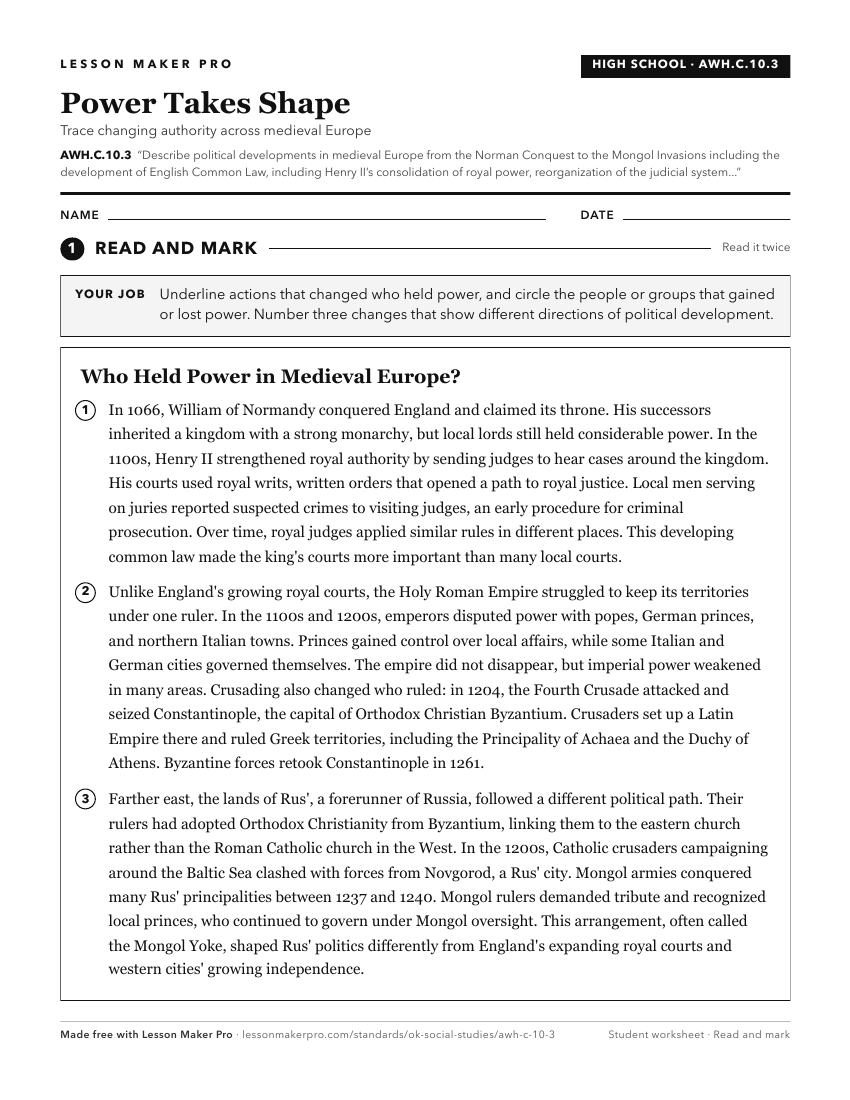
A ready-to-print activity worksheet aligned to AWH.C.10.3, with an answer key for the teacher on its own page. No account needed.
PDF, US Letter, prints cleanly in black and white.
Download the worksheetKeep exploring
Related Standards
- AWH.C.10.2
Examine how William the Conqueror at the Battle of Hastings established the French- speaking Normans as rulers of England and brought about a significant cultur...
- AWH.C.12.2
Explain developments in medieval English legal and constitutional history and their importance in the rise of modern institutions and self-government (e.g., com...
- AWH.C.10.5
Examine religious, intellectual, cultural, technological, and economic developments in medieval Europe from the Norman Conquest to 1300.
- AWH.C.9.5.C
Trace the rise of Anglo-Saxon England, the Danish invasions, and the influence of Alfred the Great.
Turn this cluster into a lesson
Grade, subject, topic, and the complete cluster are prefilled. Create one free, no account needed.
Also for this cluster:Make a WorksheetMake a QuizMake a Sub Lesson