Oklahoma Social Studies 8.C.9.1
Standard Cluster
- 8.C.9
- Examine the political, economic, social, and geographic changes that occurred during the period of westward movement.
Examine multiple perspectives on the justification for and impact on westward expansion and analyze the influence of immigration. Explain how the fur trade provided economic incentive for early exploration of the West including the crucial role played by traders and frontiersmen (e.g., Jedediah Smith, John C. Fremont, Kit Carson) in transcontinental migration (e.g., mapping of vast territory, establishing trade routes and relations with Native peoples). Define the concept of Manifest Destiny including its belief in the inevitable spread of American institutions (e.g., religion, government, culture) and analyze claims made in such writings as The Great Nation of Futurity by John O’Sullivan. Explain how the idea of Manifest Destiny influenced migration by identifying push and pull factors impacting the settlement of western territories. Analyze the impact of the waves of immigration from Northern Europe on settlement patterns. Analyze Alexis de Tocqueville’s claim regarding the concept of American exceptionalism and identify ways in which America has been an “exception to the rule” (e.g., stability, realizations of liberty and civil equality, prosperity, innovation).
Oklahoma Academic Standards for Social Studies (2026) · 8.C.9
Cluster contents
Standards in This Cluster
8.C.9.1 is a cluster heading. These are the individual standards under it.
- 8.C.9.1.A
Explain how the fur trade provided economic incentive for early exploration of the West including the crucial role played by traders and frontiersmen (e.g., Jed...
- 8.C.9.1.B
Define the concept of Manifest Destiny including its belief in the inevitable spread of American institutions (e.g., religion, government, culture) and analyze ...
- 8.C.9.1.C
Explain how the idea of Manifest Destiny influenced migration by identifying push and pull factors impacting the settlement of western territories.
- 8.C.9.1.D
Analyze the impact of the waves of immigration from Northern Europe on settlement patterns.
- 8.C.9.1.E
Analyze Alexis de Tocqueville’s claim regarding the concept of American exceptionalism and identify ways in which America has been an “exception to the rule” (e...
Teacher's field guide
What This Cluster Means
What Students Need to Do
- Students explain how fur traders and guides opened routes west and traded with Native peoples. They compare reasons for expansion with its effects on Native communities. They explain how Manifest Destiny and immigration from Northern Europe shaped where people settled.
What Mastery Looks Like
- A student can use a map to connect fur trade routes with later migration. They can identify a push factor and a pull factor, explain O’Sullivan’s claim, and describe where Northern European immigrants settled. They can test Tocqueville’s claim about American liberty against the experiences of Native peoples.
Common Misconceptions
- Students may treat Manifest Destiny as a fact rather than a belief used to justify expansion. They may assume trade with Native peoples meant Native communities welcomed settlement. They may read American exceptionalism as a claim that everyone enjoyed equal rights.
How to Assess It
- Show a fur trade route map and ask: “How could this route help a Northern European immigrant move west? Name one push or pull factor, one claim used to justify expansion, and one cost to Native peoples.”
Lesson moves
Ways to Teach It
Give pairs a blank U.S. map and two source maps; have them mark fur trade routes and Northern European settlement clusters in different colors.
Read a short passage from O’Sullivan and a Native account of land loss; ask, “Whose reasons for expansion appear, and whose do not?”
Sort cards labeled scarce farmland, cheap western land, fur profits, and religious pressure into push or pull piles; defend two choices.
Read an 1850s western town advertisement beside Tocqueville’s claim about liberty; circle its promises and list who was excluded.
Free download
Printable 8.C.9.1 Worksheet
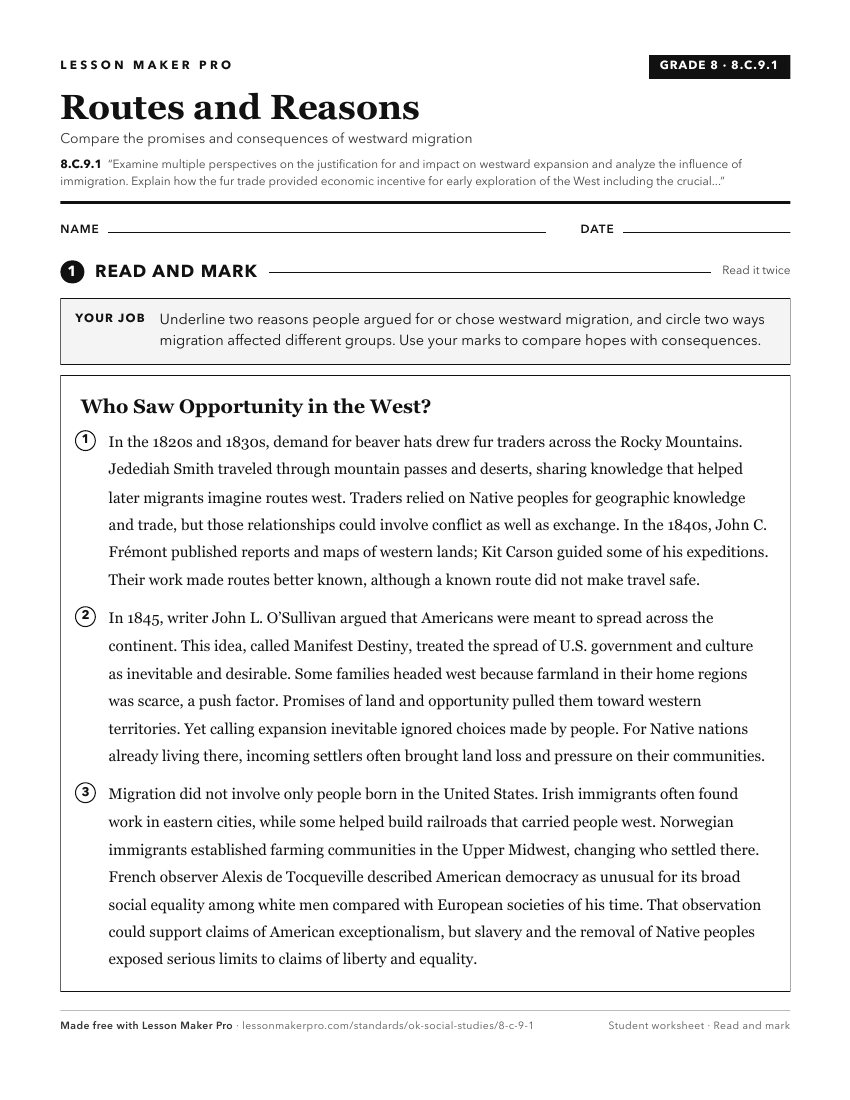
A ready-to-print activity worksheet aligned to 8.C.9.1, with an answer key for the teacher on its own page. No account needed.
PDF, US Letter, prints cleanly in black and white.
Download the worksheetKeep exploring
Related Standards
- 8.C.9.2
Analyze the territorial growth of the United States of America and the consequences of westward expansion.
- 8.C.13.5
Evaluate the impact of federal policies related to the on-going migration and settlement of the West.
- USH.C.1.3
Analyze the causes and effects of the continuing westward migration and territorial growth after the Civil War.
- 8.C.9
Examine the political, economic, social, and geographic changes that occurred during the period of westward movement.
Turn this cluster into a lesson
Grade, subject, topic, and the complete cluster are prefilled. Create one free, no account needed.
Also for this cluster:Make a WorksheetMake a QuizMake a Sub Lesson