Oklahoma Social Studies 6.C.6
Standard Cluster
Analyze economic systems of the world and how they impact the development of a nation and region. Explain how people organize economic systems to address basic economic questions regarding which goods and services will be produced, how they will be distributed, and who will consume them. Analyze the benefits and limitations of the world’s economic systems. Define the characteristics of traditional, market, and command economic systems. Describe how government policies affect economic activities within a nation, as well as determine trade relationships. Compare the outcomes of different economic systems for human prosperity, equality, and freedom. Explain how different sectors of a nation’s economy contribute to the development of a nation. Primary Sector: Extraction and harvesting of natural products (e.g., Venezuela’s Orinoco Belt, Chile’s artisanal fishing, logging of Canada’s boreal forests). Secondary Sector: Production of goods through manufacturing and construction (e.g., United States of America's steel industry, Argentina’s meat-processing, Mexico’s automotive exports). Tertiary Sector: Businesses that provide services to consumers (e.g., Costa Rica's ecotourism, New York Stock Exchange, Houston’s MD Anderson Cancer Center). Quaternary Sector: Research and intellectual services such as technological advancement and innovation (e.g., Silicon Valley and Sao Paulo’s technology centers, Massachusetts Institute of Technology). Identify and compare the characteristics of developed and developing countries by analyzing data (e.g., literacy rate, life expectancy, per capita income, and infant mortality) used by geographers to measure development.
Oklahoma Academic Standards for Social Studies (2026)
Cluster contents
Standards in This Cluster
6.C.6 is a cluster heading. These are the individual standards under it.
- 6.C.6.1
Explain how people organize economic systems to address basic economic questions regarding which goods and services will be produced, how they will be distribut...
- 6.C.6.2
Analyze the benefits and limitations of the world’s economic systems.
- 6.C.6.2.A
Define the characteristics of traditional, market, and command economic systems.
- 6.C.6.2.B
Describe how government policies affect economic activities within a nation, as well as determine trade relationships.
- 6.C.6.2.C
Compare the outcomes of different economic systems for human prosperity, equality, and freedom.
- 6.C.6.3
Explain how different sectors of a nation’s economy contribute to the development of a nation.
- 6.C.6.3.A
Primary Sector: Extraction and harvesting of natural products (e.g., Venezuela’s Orinoco Belt, Chile’s artisanal fishing, logging of Canada’s boreal forests)
- 6.C.6.3.B
Secondary Sector: Production of goods through manufacturing and construction (e.g., United States of America's steel industry, Argentina’s meat-processing, Mexi...
- 6.C.6.3.C
Tertiary Sector: Businesses that provide services to consumers (e.g., Costa Rica's ecotourism, New York Stock Exchange, Houston’s MD Anderson Cancer Center).
- 6.C.6.3.D
Quaternary Sector: Research and intellectual services such as technological advancement and innovation (e.g., Silicon Valley and Sao Paulo’s technology centers,...
- 6.C.6.4
Identify and compare the characteristics of developed and developing countries by analyzing data (e.g., literacy rate, life expectancy, per capita income, and i...
Teacher's field guide
What This Cluster Means
What Students Need to Do
- Students compare how custom, buyers and sellers, or government plans decide what gets made and who gets it. They explain how an import tax can change trade and affect wealth, fairness, and choice. They sort jobs into four economic sectors and use country data to compare development.
What Mastery Looks Like
- A student can identify an economic system from a short example and explain who makes the decisions. They can predict how an import tax affects buyers and sellers. They can sort fishing, car assembly, tourism, and medical research by sector, then compare countries using literacy, income, life expectancy, and infant mortality.
Common Misconceptions
- Students may think market economies have no government rules or that command economies give consumers no choices. They often mistake research jobs for manufacturing jobs. Some think high income means everyone is doing well, or read high infant mortality as a sign of better health.
How to Assess It
- Exit ticket: A government orders bakeries to make 100 loaves and assigns them to households. Name the economic system, predict one effect of a tax on imported wheat, and label fishing, baking, and food science by sector.
Lesson moves
Ways to Teach It
Give groups 12 paper bread tokens and rule cards for family custom, market bidding, and government assignment; record who gets bread.
Ask, 'Would a tax on imported cars help local factory workers but raise prices for buyers?' Have students defend both sides.
Play a four-corner sort with job cards for mining, car assembly, hotel work, and vaccine research; students explain each choice.
Give students country data cards for Mexico and Canada showing literacy, income, life expectancy, and infant mortality; ask which shows higher development.
Free download
Printable 6.C.6 Worksheet
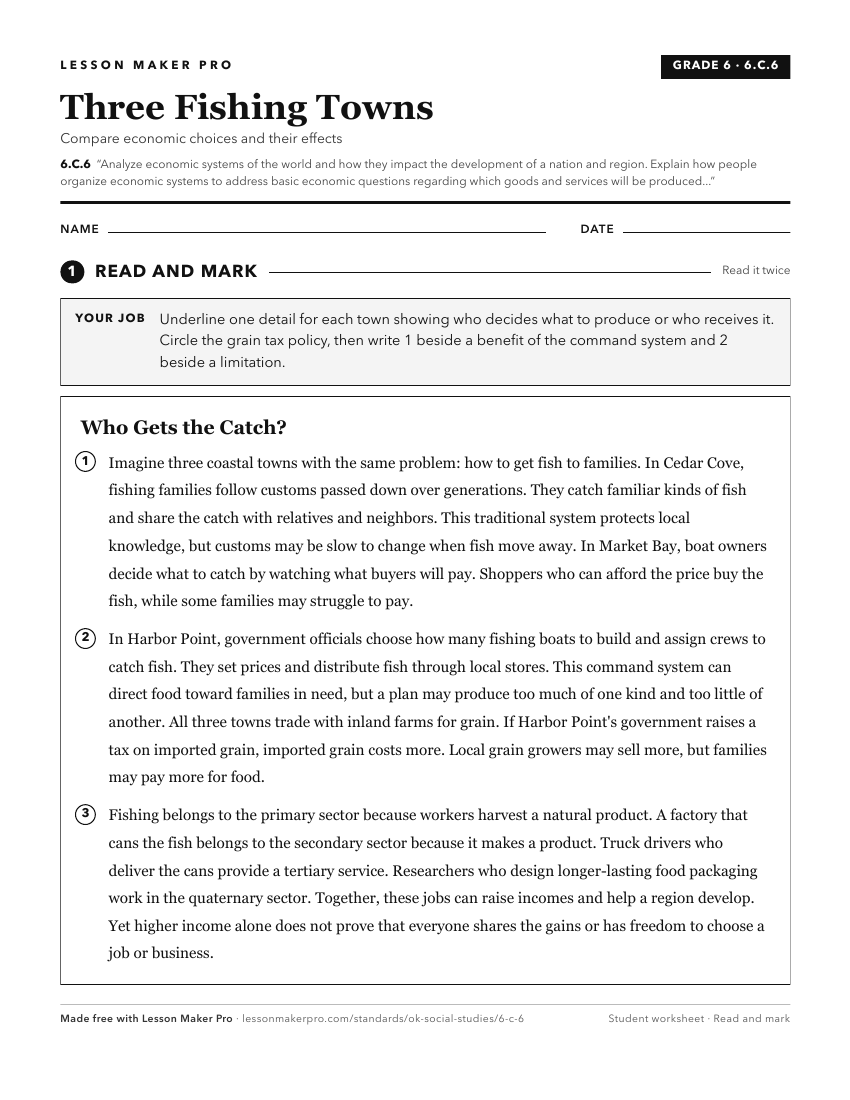
A ready-to-print activity worksheet aligned to 6.C.6, with an answer key for the teacher on its own page. No account needed.
PDF, US Letter, prints cleanly in black and white.
Download the worksheetKeep exploring
Related Standards
Turn this cluster into a lesson
Grade, subject, topic, and the complete cluster are prefilled. Create one free, no account needed.
Also for this cluster:Make a WorksheetMake a QuizMake a Sub Lesson