Oklahoma Social Studies 6.C.6.2
Standard Cluster
- 6.C.6
- Analyze economic systems of the world and how they impact the development of a nation and region.
Analyze the benefits and limitations of the world’s economic systems. Define the characteristics of traditional, market, and command economic systems. Describe how government policies affect economic activities within a nation, as well as determine trade relationships. Compare the outcomes of different economic systems for human prosperity, equality, and freedom.
Oklahoma Academic Standards for Social Studies (2026) · 6.C.6
Cluster contents
Standards in This Cluster
6.C.6.2 is a cluster heading. These are the individual standards under it.
- 6.C.6.2.A
Define the characteristics of traditional, market, and command economic systems.
- 6.C.6.2.B
Describe how government policies affect economic activities within a nation, as well as determine trade relationships.
- 6.C.6.2.C
Compare the outcomes of different economic systems for human prosperity, equality, and freedom.
Teacher's field guide
What This Cluster Means
What Students Need to Do
- Students identify who makes production and distribution choices in traditional, market, and command economies. They trace how taxes, subsidies, and tariffs can change prices, work, and trade. They weigh each system’s strengths and limits for living standards, equality, and freedom.
What Mastery Looks Like
- Given a short description of an economy, a student can identify the system and point to evidence about who makes decisions. They can explain how a tariff might affect imports and compare the gains and costs of different systems without claiming one always works best.
Common Misconceptions
- Students may think every country uses only one economic system. They may assume markets have no government rules or that command economies leave no room for individual choices. They may think a tariff affects only foreign sellers, not shoppers at home.
How to Assess It
- Exit ticket: A government orders farms to grow wheat and taxes imported wheat. Name the system the farm rule resembles, predict one effect on trade, and give one possible benefit and one cost for households.
Lesson moves
Ways to Teach It
Give groups food cards and play money; assign customary shares, price bids, or government quotas, then tally who gets enough.
Ask, “Should the government set bread prices during a shortage?” Have students write who benefits, who might lose, and why.
Run a three-column card sort: students match family trades, private stores, and state factories to economic systems, then defend two choices.
Use grocery ads for local and imported apples; add a sample tariff and compare prices and buying choices.
Free download
Printable 6.C.6.2 Worksheet
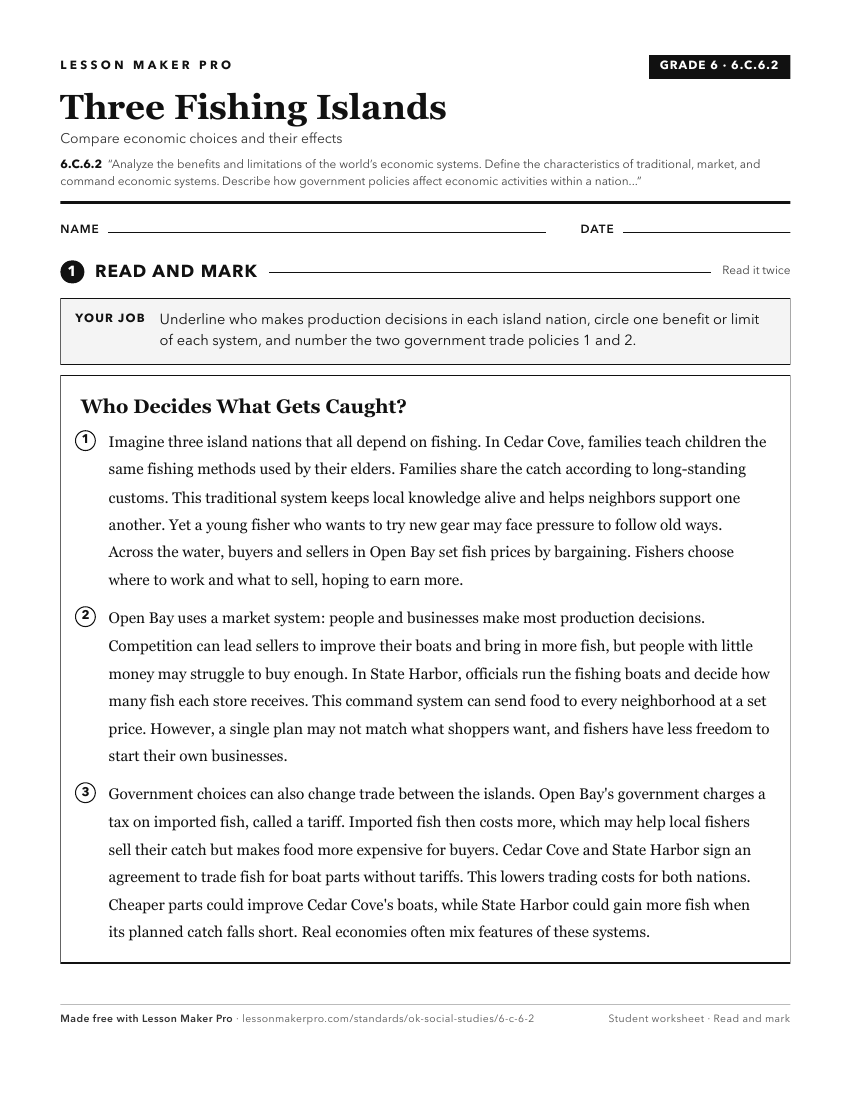
A ready-to-print activity worksheet aligned to 6.C.6.2, with an answer key for the teacher on its own page. No account needed.
PDF, US Letter, prints cleanly in black and white.
Download the worksheetKeep exploring
Related Standards
- 6.P.2.4.B
Identify different types of economic systems, comparing advantages and disadvantages for citizens and the growth of a nation’s economy.
- 7.P.2.4.B
Identify different types of economic systems, comparing advantages and disadvantages for citizens and the growth of a nation’s economy.
- 6.C.6
Analyze economic systems of the world and how they impact the development of a nation and region.
- 8.P.2.4.B
Identify different types of economic systems, comparing advantages and disadvantages for citizens and the growth of a nation’s economy.
Turn this cluster into a lesson
Grade, subject, topic, and the complete cluster are prefilled. Create one free, no account needed.
Also for this cluster:Make a WorksheetMake a QuizMake a Sub Lesson