Oklahoma Social Studies E.C.11
Standard Cluster
Analyze how international trade affects the economies of nations. Explain how trade among individuals, regions, and nations reflects voluntary exchange and specialization. Define and distinguish between absolute and comparative advantages and explain how these concepts influence trade. Describe common trade barriers (e.g., tariffs and quotas) and evaluate arguments for and against their use. Explain how exchange rates affect international trade and purchasing power.
Oklahoma Academic Standards for Social Studies (2026)
Cluster contents
Standards in This Cluster
E.C.11 is a cluster heading. These are the individual standards under it.
- E.C.11.1
Explain how trade among individuals, regions, and nations reflects voluntary exchange and specialization.
- E.C.11.2
Define and distinguish between absolute and comparative advantages and explain how these concepts influence trade.
- E.C.11.3
Describe common trade barriers (e.g., tariffs and quotas) and evaluate arguments for and against their use.
- E.C.11.4
Explain how exchange rates affect international trade and purchasing power.
Teacher's field guide
What This Cluster Means
What Students Need to Do
- Students explain why buyers and sellers choose to trade and how specialization affects national economies. They use output and opportunity cost to distinguish absolute from comparative advantage. They predict how tariffs, quotas, and exchange rates change prices and buying power.
What Mastery Looks Like
- Given production numbers for two countries, students identify who makes more and who gives up less to make each good. They explain how both countries could gain from trade. They predict how an import limit, import tax, or currency change affects buyers and producers.
Common Misconceptions
- Students may think a country that makes more of everything has no reason to trade. They may confuse making more with giving up less, or mistake a quota for a tax. They may think a stronger home currency makes imports cost more.
How to Assess It
- Exit ticket: Country A can make 8 shirts or 4 phones; Country B can make 6 shirts or 6 phones. Ask which country should specialize in each good, why, and how a shirt tariff would affect buyers.
Lesson moves
Ways to Teach It
Give pairs cards showing A makes 8 shirts or 4 phones and B makes 6 shirts or 6 phones; calculate trade-offs and trade tokens.
Ask: Should a town tax imported shirts to protect its shirt factory? Write one benefit and one cost.
Run a card sort: match a $2 import tax and a 100-shirt import limit to tariff or quota, then predict price changes.
Show a €20 backpack and exchange rates of $1.10 and $1.25 per euro; calculate both dollar prices and compare buying power.
Free download
Printable E.C.11 Worksheet
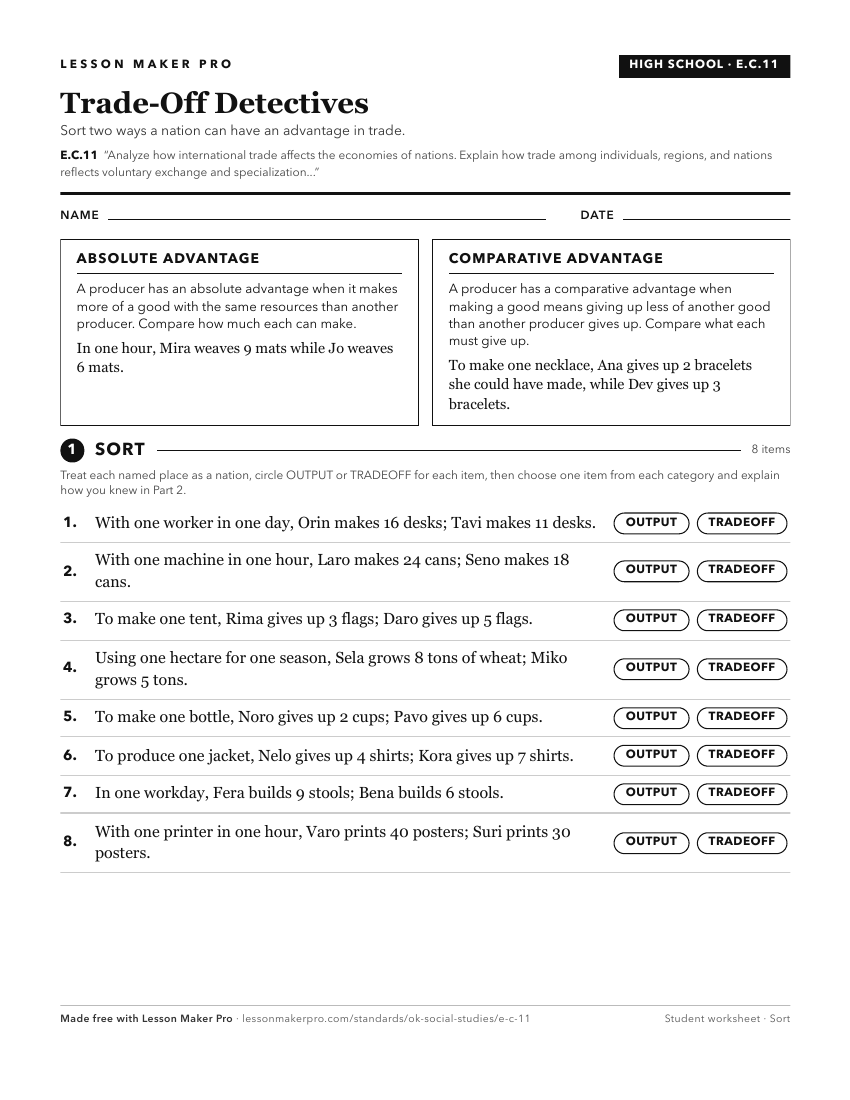
A ready-to-print activity worksheet aligned to E.C.11, with an answer key for the teacher on its own page. No account needed.
PDF, US Letter, prints cleanly in black and white.
Download the worksheetKeep exploring
Related Standards
- 6.C.6.2.B
Describe how government policies affect economic activities within a nation, as well as determine trade relationships.
- 6.C.6
Analyze economic systems of the world and how they impact the development of a nation and region.
- 7.C.8.4
Examine indicators of economic interdependence and world trade, including why nations are concerned with the balance of trade, and explain major trade patterns ...
- E.C.8
Examine the impact of the global economy on domestic conditions within the United States of America’s economy.
Turn this cluster into a lesson
Grade, subject, topic, and the complete cluster are prefilled. Create one free, no account needed.
Also for this cluster:Make a WorksheetMake a QuizMake a Sub Lesson