Oklahoma Social Studies E.C.11.1
The Standard
- E.C.11
- Analyze how international trade affects the economies of nations.
Explain how trade among individuals, regions, and nations reflects voluntary exchange and specialization.
Oklahoma Academic Standards for Social Studies (2026) · E.C.11
Teacher's field guide
What This Standard Means
What Students Need to Do
- Given a trade, students name what each side gives up and gets, then explain why both agree. They connect the trade to the work each person or place focuses on.
What Mastery Looks Like
- A student can trace wheat from an Oklahoma farmer to a Texas mill, then flour from that mill to a Canadian bakery. They name what changes hands at each sale and explain why both sides expect to benefit.
Common Misconceptions
- Students may think trade counts only when goods cross national borders, or that one side must lose for the other to gain. Some think a bakery must grow its own wheat to make bread.
How to Assess It
- Exit ticket: An Oklahoma mill sells flour to a local baker, a Texas bakery, and a Canadian bakery. Label each trade, then explain why the mill and one buyer agree and how their jobs differ.
Lesson moves
Ways to Teach It
Give half the groups paper to make bookmarks and half paper to make labels, then let them negotiate trades for both products.
Ask: Why might an Oklahoma wheat farmer sell grain to a Texas mill instead of milling it? What does each side get?
Hand out farmer, miller, baker, and grocer cards; have pairs match possible trades and explain why each side agrees.
Show a 'Product of Mexico' avocado sign; ask why an Oklahoma store buys those avocados and why a Mexican grower sells them.
Free download
Printable E.C.11.1 Worksheet
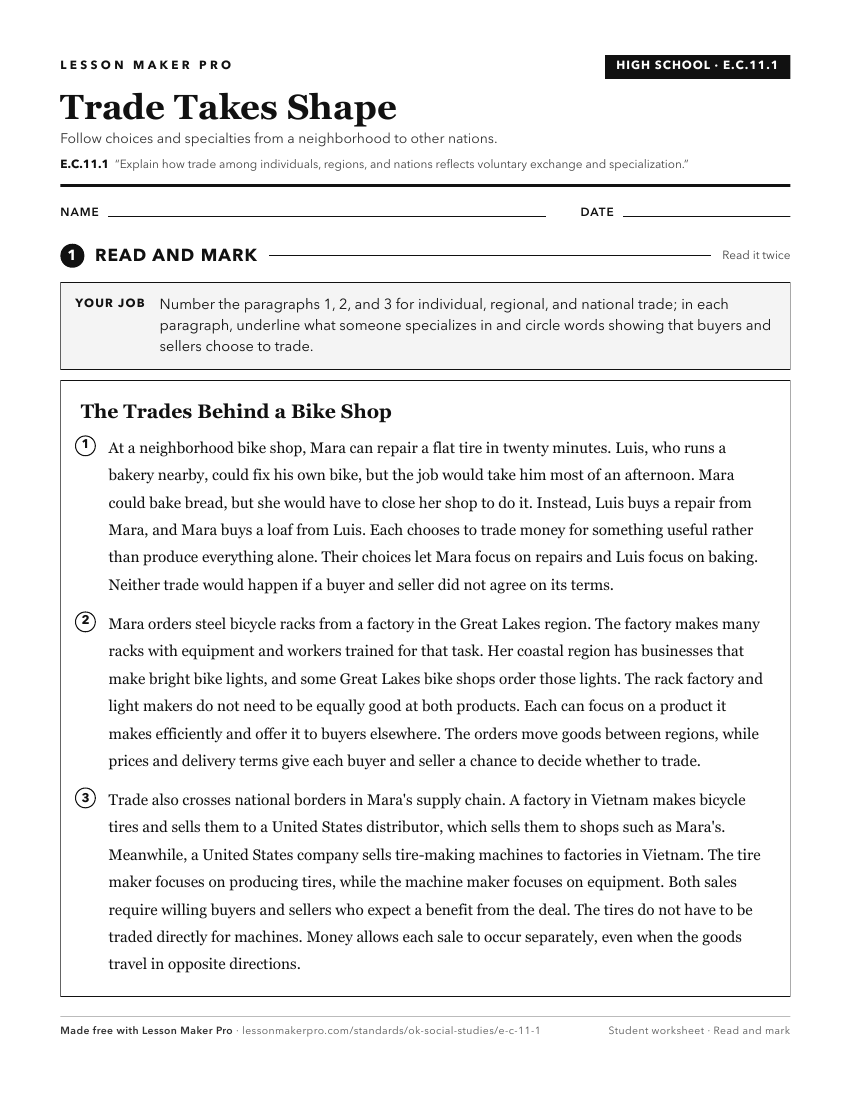
A ready-to-print activity worksheet aligned to E.C.11.1, with an answer key for the teacher on its own page. No account needed.
PDF, US Letter, prints cleanly in black and white.
Download the worksheetKeep exploring
Related Standards
- E.C.1.6
Explain how voluntary exchange occurs when all parties expect to benefit and how trade contributes to mutual gain and overall well-being.
- E.C.2.2
Describe how comparative and absolute advantage influence specialization and trade in answering the three basic economic questions.
- 3.P.2.4.C
Describe examples of the goods and services that local and state governments provide, explaining why people trade.
- 2.C.4.6
Define trade and explain how trade can lead to interdependence among people and communities.
Turn this exact standard into a lesson
Grade, subject, topic, and the complete standard are prefilled. Create one free, no account needed.
Also for this standard:Make a WorksheetMake a QuizMake a Sub Lesson