Oklahoma Social Studies MWH.C.3
Standard Cluster
Analyze developments in politics, science, and philosophy contributing to human advancement and the rise of modern institutions of self-government. Compare theories and forms of government regarding sources of authority and legitimacy. Distinguish between limited and unlimited forms of government, including the role of the citizen and the concept of individual liberty. Examine the Dynastic Cycle (Chinese Mandate of Heaven) by explaining its principle that virtuous rulers are bestowed power from a heavenly mandate, yet subject to rebellion if abusive. Describe the theory of Absolutism which supports the exercise of unlimited power according to an inherited divine right to rule (e.g., Louis XIV). Examine rule by enlightened monarchs and how the ideas of the Enlightenment tempered Absolutism (e.g., Joseph II, Frederick the Great, Catherine the Great). Analyze government's source of authority under a constitutional monarchy by explaining how and why powers are limited by a written or unwritten constitution (e.g., English Parliament). Explain England’s response to Absolutism in Europe, which influenced global thoughts on self-government. Identify the causes, essential events, and effects of the English Civil War and the Glorious Revolution. Examine the development of parliamentary sovereignty constitutional mixed government and liberty in England, including the importance of the English Bill of Rights and how it limited the power of the Monarch. Describe England’s fiscal, commercial, and technological innovations, including the culture of trade, England’s military success in successive wars with France, and the consequent establishment of a British Empire in North America. Analyze the impact of the Enlightenment on modern government and economic institutions. Explain how the major ideas of enlightened philosophy influenced the concepts of natural rights and consent of the governed. Describe the contributions of major Enlightenment thinkers (e.g., Locke, Montesquieu, Voltaire, Rousseau), contrasting the views of Thomas Hobbes regarding the divine right theory. Examine the impact of Adam Smith’s theories, as presented in The Wealth of Nations, on modern economic thought and free enterprise.
Oklahoma Academic Standards for Social Studies (2026)
Cluster contents
Standards in This Cluster
MWH.C.3 is a cluster heading. These are the individual standards under it.
- MWH.C.3.1
Compare theories and forms of government regarding sources of authority and legitimacy.
- MWH.C.3.1.A
Distinguish between limited and unlimited forms of government, including the role of the citizen and the concept of individual liberty.
- MWH.C.3.1.B
Examine the Dynastic Cycle (Chinese Mandate of Heaven) by explaining its principle that virtuous rulers are bestowed power from a heavenly mandate, yet subject ...
- MWH.C.3.1.C
Describe the theory of Absolutism which supports the exercise of unlimited power according to an inherited divine right to rule (e.g., Louis XIV).
- MWH.C.3.1.D
Examine rule by enlightened monarchs and how the ideas of the Enlightenment tempered Absolutism (e.g., Joseph II, Frederick the Great, Catherine the Great).
- MWH.C.3.1.E
Analyze government's source of authority under a constitutional monarchy by explaining how and why powers are limited by a written or unwritten constitution (e....
- MWH.C.3.2
Explain England’s response to Absolutism in Europe, which influenced global thoughts on self-government.
- MWH.C.3.2.A
Identify the causes, essential events, and effects of the English Civil War and the Glorious Revolution.
- MWH.C.3.2.B
Examine the development of parliamentary sovereignty, constitutional mixed government, and liberty in England, including the importance of the English Bill of R...
- MWH.C.3.2.C
Describe England’s fiscal, commercial, and technological innovations, including the culture of trade, England’s military success in successive wars with France,...
- MWH.C.3.3
Analyze the impact of the Enlightenment on modern government and economic institutions.
- MWH.C.3.3.A
Explain how the major ideas of enlightened philosophy influenced the concepts of natural rights and consent of the governed.
- MWH.C.3.3.B
Describe the contributions of major Enlightenment thinkers (e.g., Locke, Montesquieu, Voltaire, Rousseau), contrasting the views of Thomas Hobbes regarding the ...
- MWH.C.3.3.C
Examine the impact of Adam Smith’s theories, as presented in The Wealth of Nations, on modern economic thought and free enterprise.
Teacher's field guide
What This Cluster Means
What Students Need to Do
- Students compare where rulers get power, what limits them, and when citizens can resist. They trace how England's civil war, revolution, trade, and wars with France shaped Parliament and the British Empire. They connect scientific thinking and Enlightenment ideas to rights, constitutions, and markets.
What Mastery Looks Like
- A student can explain why a Chinese ruler might lose the Mandate of Heaven while Louis XIV claimed inherited power. They use the English Bill of Rights to show how Parliament limited the monarch. They connect Locke to natural rights, Montesquieu to separated powers, and Smith to free markets.
Common Misconceptions
- Students may treat the Mandate of Heaven as unconditional divine right, though it allowed rebellion against an abusive ruler. They may think enlightened monarchs gave up absolute power or that Hobbes based authority on divine right. Some assume a limited monarch has no power at all.
How to Assess It
- On an exit ticket, ask: How did Louis XIV's authority differ from an English monarch's authority after the Glorious Revolution? Name one event or idea that explains the difference.
Lesson moves
Ways to Teach It
Give pairs ruler cards for a Chinese emperor, Louis XIV, and an English monarch after 1689; sort them by source and limits of power.
Ask, 'Could subjects remove a ruler who breaks their rights?' Have students answer using Locke, Hobbes, and the Mandate of Heaven.
Give teams four short quotes from Locke, Montesquieu, Rousseau, and Smith; match each to rights, separated powers, popular sovereignty, or markets.
Show a headline about a legislature voting on taxes alongside the English Bill of Rights; ask who controls taxes in each case.
Free download
Printable MWH.C.3 Worksheet
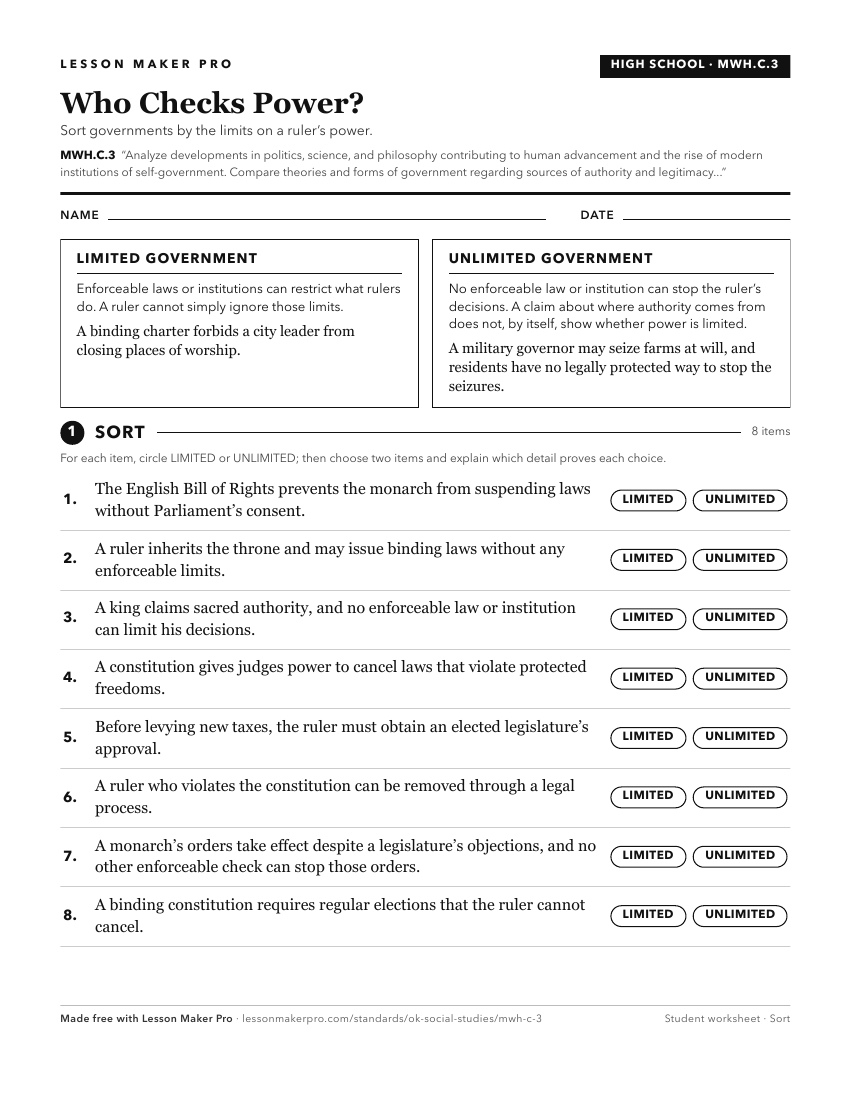
A ready-to-print activity worksheet aligned to MWH.C.3, with an answer key for the teacher on its own page. No account needed.
PDF, US Letter, prints cleanly in black and white.
Download the worksheetKeep exploring
Related Standards
- 6.C.5
Analyze why and how humans develop rules, laws, and governments, including the role of citizens in government.
- 7.P.2.1.A
Compare and analyze civic virtues and democratic principles in historic and global settings, explaining how they influence political institutions.
- 6.P.2.1.A
Compare and analyze civic virtues and democratic principles in historic and global settings, explaining how they influence political institutions.
- MWH.C.1.1
Analyze the influence of religious, political, and philosophical ideas on society.
Turn this cluster into a lesson
Grade, subject, topic, and the complete cluster are prefilled. Create one free, no account needed.
Also for this cluster:Make a WorksheetMake a QuizMake a Sub Lesson