Oklahoma Social Studies MWH.C.3.3.B
The Standard
- MWH.C.3
- Analyze developments in politics, science, and philosophy contributing to human advancement and the rise of modern institutions of self-government.
- MWH.C.3.3
- Analyze the impact of the Enlightenment on modern government and economic institutions.
Describe the contributions of major Enlightenment thinkers (e.g., Locke, Montesquieu, Voltaire, Rousseau), contrasting the views of Thomas Hobbes regarding the divine right theory.
Oklahoma Academic Standards for Social Studies (2026) · MWH.C.3.3
Teacher's field guide
What This Standard Means
What Students Need to Do
- Students connect Locke to natural rights, Montesquieu to separated powers, Voltaire to religious tolerance, and Rousseau to rule by the people. They explain that Hobbes favored a strong ruler for safety, but did not base that ruler's power on God's choice.
What Mastery Looks Like
- Given a claim about government, a student can name the thinker and explain the match. They can tell the difference between divine right and Hobbes's view that people give a ruler power to keep order.
Common Misconceptions
- Students may think Hobbes supported divine right because he favored a powerful ruler. They may also confuse Montesquieu's separate branches with Rousseau's view that political authority comes from the people.
How to Assess It
- Exit ticket: Match Locke, Montesquieu, Voltaire, and Rousseau to natural rights, separated powers, religious tolerance, and rule by the people. Then explain why Hobbes's strong ruler did not need a claim of divine right.
Lesson moves
Ways to Teach It
Give pairs six claim cards to sort under Locke, Montesquieu, Voltaire, Rousseau, Hobbes, and divine right.
Ask: Would Hobbes accept a king's claim that God gave him power? Write two sentences explaining your answer.
Read claims such as 'split government into branches' aloud; have students hold up a card naming the matching thinker.
Show a chart of the three branches of U.S. government and ask students to identify the thinker whose idea it reflects.
Free download
Printable MWH.C.3.3.B Worksheet
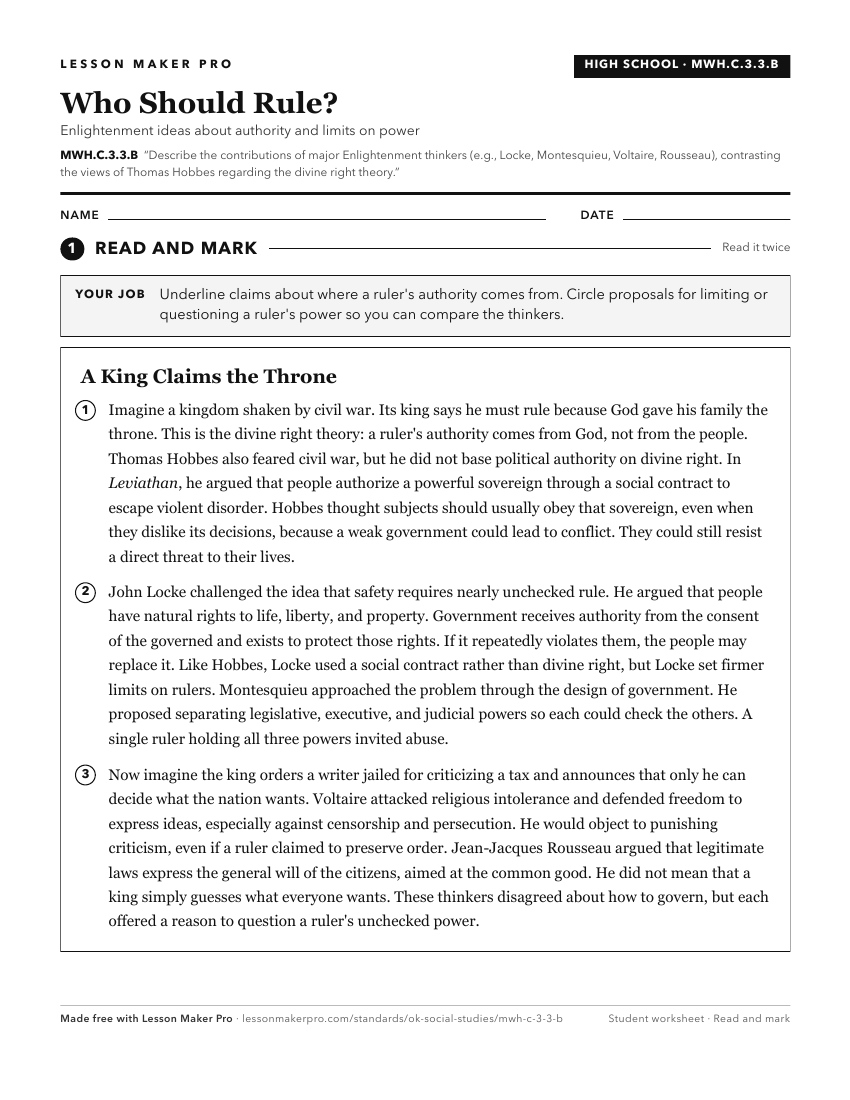
A ready-to-print activity worksheet aligned to MWH.C.3.3.B, with an answer key for the teacher on its own page. No account needed.
PDF, US Letter, prints cleanly in black and white.
Download the worksheetKeep exploring
Related Standards
- MWH.C.3.3.A
Explain how the major ideas of enlightened philosophy influenced the concepts of natural rights and consent of the governed.
- USG.C.2.1.D
Describe how Enlightenment philosophy contributed to the concept of a social contract, the existence of natural, inalienable rights (e.g., life, liberty, and th...
- USG.C.1.3.D
Evaluate how religious traditions, moral philosophy, and enlightenment principles contributed to the development of key American founding ideas, such as natural...
- 8.C.1.5.B
Describe the intellectual origins of American political thought as proposed by such Enlightenment philosophers as John Locke and his theory on natural rights.
Turn this exact standard into a lesson
Grade, subject, topic, and the complete standard are prefilled. Create one free, no account needed.
Also for this standard:Make a WorksheetMake a QuizMake a Sub Lesson