Oklahoma Social Studies MWH.C.3.1.C
The Standard
- MWH.C.3
- Analyze developments in politics, science, and philosophy contributing to human advancement and the rise of modern institutions of self-government.
- MWH.C.3.1
- Compare theories and forms of government regarding sources of authority and legitimacy.
Describe the theory of Absolutism which supports the exercise of unlimited power according to an inherited divine right to rule (e.g., Louis XIV).
Oklahoma Academic Standards for Social Studies (2026) · MWH.C.3.1
Teacher's field guide
What This Standard Means
What Students Need to Do
- Students explain how absolute monarchs claimed broad power to govern. They connect that claim to inherited rule and the belief that God gave the monarch authority, using Louis XIV as an example.
What Mastery Looks Like
- A student can explain that Louis XIV inherited the throne and claimed his authority came from God. They can explain why, under this theory, he did not need his subjects' permission to rule.
Common Misconceptions
- Students may think divine right means the king was a god, rather than claiming God authorized his rule. Some confuse inheriting the throne with being elected, or assume a king could control everything in practice.
How to Assess It
- Exit ticket: A king inherits the throne and says God gave his family the right to rule. Name the theory and explain why he claims he does not need his subjects' permission.
Lesson moves
Ways to Teach It
Give pairs cards labeled God, Louis XIV, heir, and subjects; have them draw arrows for divine authority, succession, and obedience.
Write Louis XIV's reply to a noble who says a king needs his subjects' permission to rule; include God and inheritance.
Read four ruler claims aloud; students hold up 'divine right' or 'popular consent' cards and defend their choice with one clue.
Compare a mock presidential ballot with Louis XIV's portrait in coronation robes; students write where each leader's authority comes from.
Free download
Printable MWH.C.3.1.C Worksheet
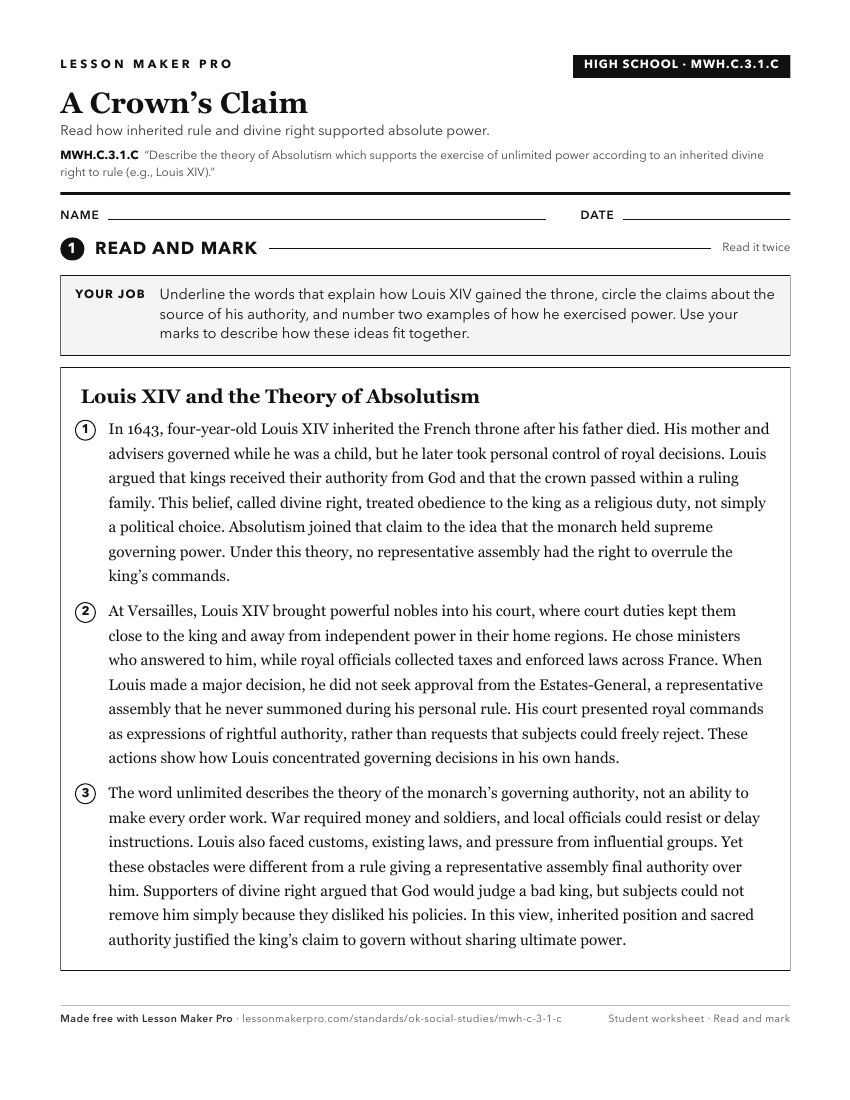
A ready-to-print activity worksheet aligned to MWH.C.3.1.C, with an answer key for the teacher on its own page. No account needed.
PDF, US Letter, prints cleanly in black and white.
Download the worksheetKeep exploring
Related Standards
- MWH.C.3.1.D
Examine rule by enlightened monarchs and how the ideas of the Enlightenment tempered Absolutism (e.g., Joseph II, Frederick the Great, Catherine the Great).
- MWH.C.3.3.B
Describe the contributions of major Enlightenment thinkers (e.g., Locke, Montesquieu, Voltaire, Rousseau), contrasting the views of Thomas Hobbes regarding the ...
- MWH.C.3.1.E
Analyze government's source of authority under a constitutional monarchy by explaining how and why powers are limited by a written or unwritten constitution (e....
- MWH.C.3.2
Explain England’s response to Absolutism in Europe, which influenced global thoughts on self-government.
Turn this exact standard into a lesson
Grade, subject, topic, and the complete standard are prefilled. Create one free, no account needed.
Also for this standard:Make a WorksheetMake a QuizMake a Sub Lesson