Oklahoma Social Studies MWH.C.3.1.D
The Standard
- MWH.C.3
- Analyze developments in politics, science, and philosophy contributing to human advancement and the rise of modern institutions of self-government.
- MWH.C.3.1
- Compare theories and forms of government regarding sources of authority and legitimacy.
Examine rule by enlightened monarchs and how the ideas of the Enlightenment tempered Absolutism (e.g., Joseph II, Frederick the Great, Catherine the Great).
Oklahoma Academic Standards for Social Studies (2026) · MWH.C.3.1
Teacher's field guide
What This Standard Means
What Students Need to Do
- Students examine how rulers adopted some Enlightenment ideas while keeping power for themselves. They compare policies on religious freedom, courts, and serfdom with the limits those rulers kept in place.
What Mastery Looks Like
- A student can explain that Joseph II expanded religious tolerance but did not give up his throne. They can contrast his reforms with Catherine the Great's privileges for nobles and explain how peasants were affected.
Common Misconceptions
- Students may think an enlightened ruler gave people the vote or gave up absolute power. They may also assume Catherine freed serfs, though her policies strengthened nobles' control over many peasants.
How to Assess It
- Give students two policy cards, Joseph II's 1781 toleration decree and Catherine's 1785 Charter to the Nobility. Ask: Who gained rights under each policy, and what power stayed with the ruler?
Lesson moves
Ways to Teach It
Give pairs policy cards on toleration, courts, serfdom, and noble privilege; have them sort the cards into reforms and limits on reform.
Ask, 'Can a ruler allow religious freedom and still hold absolute power?' Have students cite Joseph II's toleration decree.
Play policy match: read aloud Joseph II's toleration decree, Catherine's nobles' charter, and Frederick's court reforms; students name each ruler.
Compare a principal seeking student input on lunch menus but keeping final approval with Joseph II's reforms and retained authority.
Free download
Printable MWH.C.3.1.D Worksheet
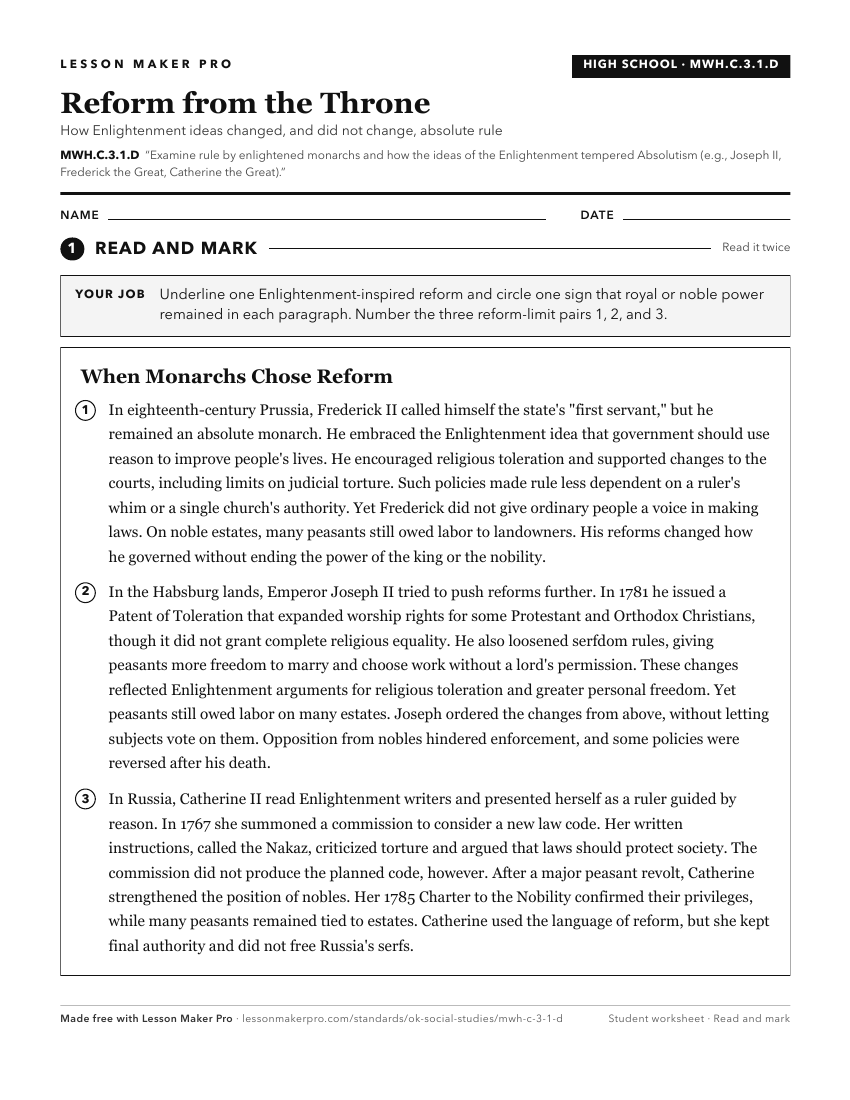
A ready-to-print activity worksheet aligned to MWH.C.3.1.D, with an answer key for the teacher on its own page. No account needed.
PDF, US Letter, prints cleanly in black and white.
Download the worksheetKeep exploring
Related Standards
- MWH.C.3.2.B
Examine the development of parliamentary sovereignty, constitutional mixed government, and liberty in England, including the importance of the English Bill of R...
- MWH.C.4.1.A
Examine the influence of Enlightenment philosophy, economic conditions, the rising influence of the middle class, and the excesses and corruption of the French ...
- MWH.C.3.3
Analyze the impact of the Enlightenment on modern government and economic institutions.
- MWH.C.3.2
Explain England’s response to Absolutism in Europe, which influenced global thoughts on self-government.
Turn this exact standard into a lesson
Grade, subject, topic, and the complete standard are prefilled. Create one free, no account needed.
Also for this standard:Make a WorksheetMake a QuizMake a Sub Lesson