Oklahoma Social Studies MWH.C.3.2.B
The Standard
- MWH.C.3
- Analyze developments in politics, science, and philosophy contributing to human advancement and the rise of modern institutions of self-government.
- MWH.C.3.2
- Explain England’s response to Absolutism in Europe, which influenced global thoughts on self-government.
Examine the development of parliamentary sovereignty constitutional mixed government and liberty in England, including the importance of the English Bill of Rights and how it limited the power of the Monarch.
Oklahoma Academic Standards for Social Studies (2026) · MWH.C.3.2
Teacher's field guide
What This Standard Means
What Students Need to Do
- Students trace how the English Civil War and Glorious Revolution changed the balance of power. They explain Parliament’s authority over laws and taxes, the roles of the monarch, Lords, and Commons, and liberties protected by the English Bill of Rights.
What Mastery Looks Like
- A student can put the Civil War, Glorious Revolution, and Bill of Rights in order and describe the shift toward Parliament. They can explain why a monarch could not suspend a law or levy a tax alone, while naming a protected liberty such as petitioning.
Common Misconceptions
- Some students think the Bill of Rights ended the monarchy or gave everyone the vote. Others confuse it with the U.S. Bill of Rights and miss its limits on royal power.
How to Assess It
- Exit ticket: A monarch orders a new tax and suspends a law without Parliament’s consent. Name the two limits being broken and explain who must consent instead.
Lesson moves
Ways to Teach It
Give pairs royal action cards and short Bill of Rights excerpts; have them match each action to the rule that blocks it.
Ask students to write how the monarch, Lords, and Commons shared government after 1689, and why a monarch could not tax alone.
Have teams order cards for the Civil War, Glorious Revolution, and Bill of Rights, then explain one shift in power.
Read a current UK budget headline; students identify Parliament’s role in approving taxes and compare it with a monarch imposing a tax alone.
Free download
Printable MWH.C.3.2.B Worksheet
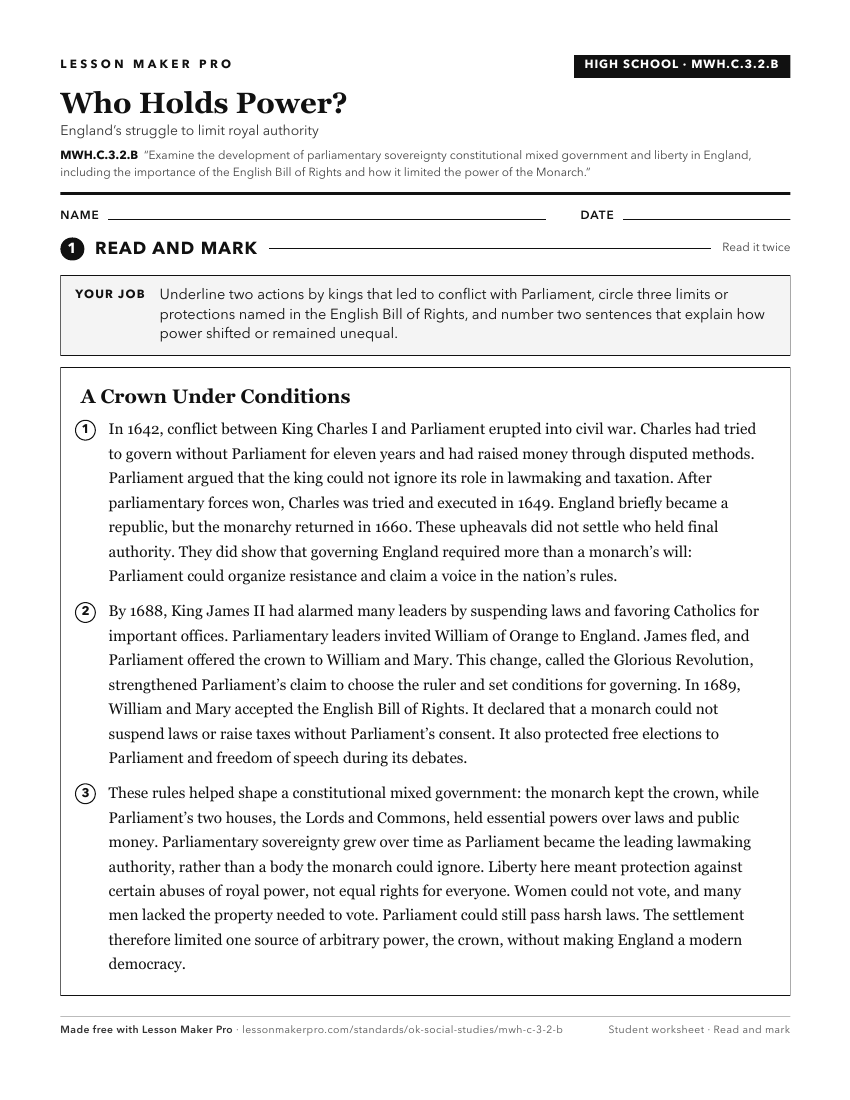
A ready-to-print activity worksheet aligned to MWH.C.3.2.B, with an answer key for the teacher on its own page. No account needed.
PDF, US Letter, prints cleanly in black and white.
Download the worksheetKeep exploring
Related Standards
- MWH.C.3.1.E
Analyze government's source of authority under a constitutional monarchy by explaining how and why powers are limited by a written or unwritten constitution (e....
- 5.C.2.4.A
Explain how English traditions of limited government (Parliament’s relationship to the monarchy) and ethical traditions reflected in colonial covenants and poli...
- AWH.C.12.2
Explain developments in medieval English legal and constitutional history and their importance in the rise of modern institutions and self-government (e.g., com...
- 7.C.6.2.C
Describe influences of early English tradition related to the principles of limited government and individual rights, such as found in the Magna Carta and estab...
Turn this exact standard into a lesson
Grade, subject, topic, and the complete standard are prefilled. Create one free, no account needed.
Also for this standard:Make a WorksheetMake a QuizMake a Sub Lesson