Oklahoma Social Studies MWH.C.3.3
Standard Cluster
- MWH.C.3
- Analyze developments in politics, science, and philosophy contributing to human advancement and the rise of modern institutions of self-government.
Analyze the impact of the Enlightenment on modern government and economic institutions. Explain how the major ideas of enlightened philosophy influenced the concepts of natural rights and consent of the governed. Describe the contributions of major Enlightenment thinkers (e.g., Locke, Montesquieu, Voltaire, Rousseau), contrasting the views of Thomas Hobbes regarding the divine right theory. Examine the impact of Adam Smith’s theories, as presented in The Wealth of Nations, on modern economic thought and free enterprise.
Oklahoma Academic Standards for Social Studies (2026) · MWH.C.3
Cluster contents
Standards in This Cluster
MWH.C.3.3 is a cluster heading. These are the individual standards under it.
- MWH.C.3.3.A
Explain how the major ideas of enlightened philosophy influenced the concepts of natural rights and consent of the governed.
- MWH.C.3.3.B
Describe the contributions of major Enlightenment thinkers (e.g., Locke, Montesquieu, Voltaire, Rousseau), contrasting the views of Thomas Hobbes regarding the ...
- MWH.C.3.3.C
Examine the impact of Adam Smith’s theories, as presented in The Wealth of Nations, on modern economic thought and free enterprise.
Teacher's field guide
What This Cluster Means
What Students Need to Do
- Students explain how Locke's natural rights and Rousseau's general will shaped ideas about government by consent. They connect Montesquieu's divided powers and Voltaire's religious tolerance to modern laws. They contrast Hobbes's strong ruler, whose authority came from an agreement, with divine right, and explain how Smith's ideas shaped markets.
What Mastery Looks Like
- A student links Locke's rights to limited government and Rousseau's general will to laws made by citizens. They connect branches of government to Montesquieu, religious freedom to Voltaire, and competing businesses to Smith. They explain that Hobbes's ruler gained authority through an agreement, not God's appointment.
Common Misconceptions
- Some students think Hobbes defended divine right because he supported a strong ruler. Others think Locke's rights come from government or that Smith opposed all business rules. Students may mistake Rousseau's general will for a ruler's personal wishes.
How to Assess It
- Exit ticket: Name the thinkers behind natural rights, divided powers, and market competition. Give one present-day example of those ideas, then explain why Hobbes's ruler was not based on divine right.
Lesson moves
Ways to Teach It
Have pairs match Locke, Montesquieu, Voltaire, Rousseau, Hobbes, and Smith cards to idea cards: rights, divided powers, tolerance, general will, contract-based ruler, competition.
Ask: Would Hobbes or Locke put more limits on a ruler's power? Defend your answer with one claim from each thinker.
Run 'Who said it?' with six slips: rights lawsuit, veto fight, religious ban, public vote, contract-backed ruler, rival bakery prices.
Show competing grocery ads and a three-branch government chart; ask how prices reflect Smith and branches reflect Montesquieu.
Free download
Printable MWH.C.3.3 Worksheet
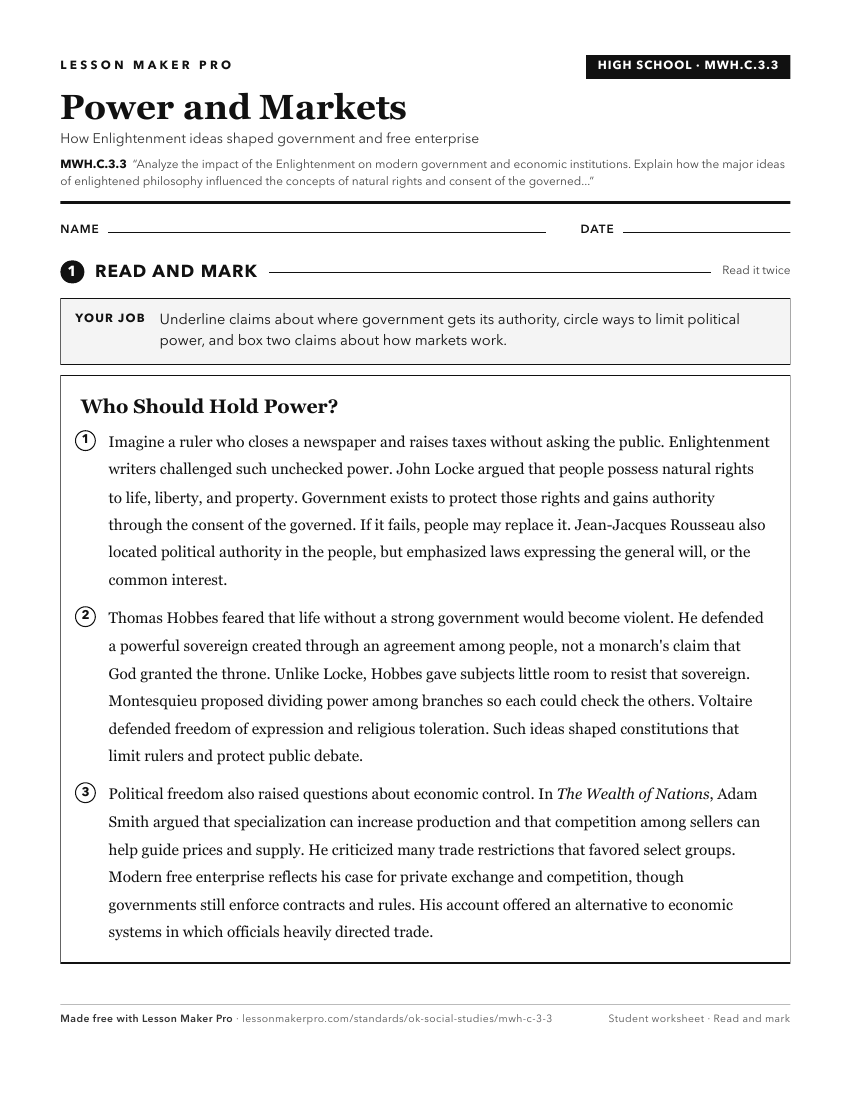
A ready-to-print activity worksheet aligned to MWH.C.3.3, with an answer key for the teacher on its own page. No account needed.
PDF, US Letter, prints cleanly in black and white.
Download the worksheetKeep exploring
Related Standards
- USG.C.2.2.D
Analyze ways in which the Federalist and the Anti-Federalist debates about the nature and extent of government continue in modern times.
- MWH.C.4.1.A
Examine the influence of Enlightenment philosophy, economic conditions, the rising influence of the middle class, and the excesses and corruption of the French ...
- MWH.C.3
Analyze developments in politics, science, and philosophy contributing to human advancement and the rise of modern institutions of self-government.
- MWH.C.1.1
Analyze the influence of religious, political, and philosophical ideas on society.
Turn this cluster into a lesson
Grade, subject, topic, and the complete cluster are prefilled. Create one free, no account needed.
Also for this cluster:Make a WorksheetMake a QuizMake a Sub Lesson