Oklahoma Social Studies 6.P.2.1.A
The Standard
- 6.P.2
- Use interdisciplinary tools to acquire, apply, and evaluate content understanding of the four strands of social studies.
- 6.P.2.1
- Demonstrate an understanding of the principles of government, the benefits of democratic systems, and their responsibilities as citizens.
Compare and analyze civic virtues and democratic principles in historic and global settings, explaining how they influence political institutions.
Oklahoma Academic Standards for Social Studies (2026) · 6.P.2.1
Teacher's field guide
What This Standard Means
What Students Need to Do
- Students tell civic habits, such as listening to opponents, from democratic principles, such as equal voting rights. They compare who had a voice in ancient Athens and modern India, then explain how that shaped each government.
What Mastery Looks Like
- A student can explain that adult male citizens voted in Athens's assembly, while adult citizens in India elect members of parliament. They can link civic participation to the assembly and equal voting rights to how parliament is chosen.
Common Misconceptions
- Students may confuse a personal habit, such as listening to opponents, with a voting rule. They may assume women could vote in Athens or that Indian voters pass laws directly instead of electing lawmakers.
How to Assess It
- Exit ticket: Who could vote in Athens and India? Explain how one civic virtue or democratic principle shaped the assembly or parliament in either place.
Lesson moves
Ways to Teach It
Give pairs cards showing Athens's assembly, excluded women, India's parliament, and adult voting rights; sort by place and draw arrows from voting rules to institutions.
Ask: How did equal voting rights affect India's parliament, and why would that principle challenge Athens's limits on citizenship?
Play 'Virtue, Principle, or Institution': call out 'respectful debate,' 'equal adult votes,' and 'parliament'; students hold up labeled cards and explain a link.
Show a local council meeting agenda; students circle the public comment period and identify where elected members vote.
Free download
Printable 6.P.2.1.A Worksheet
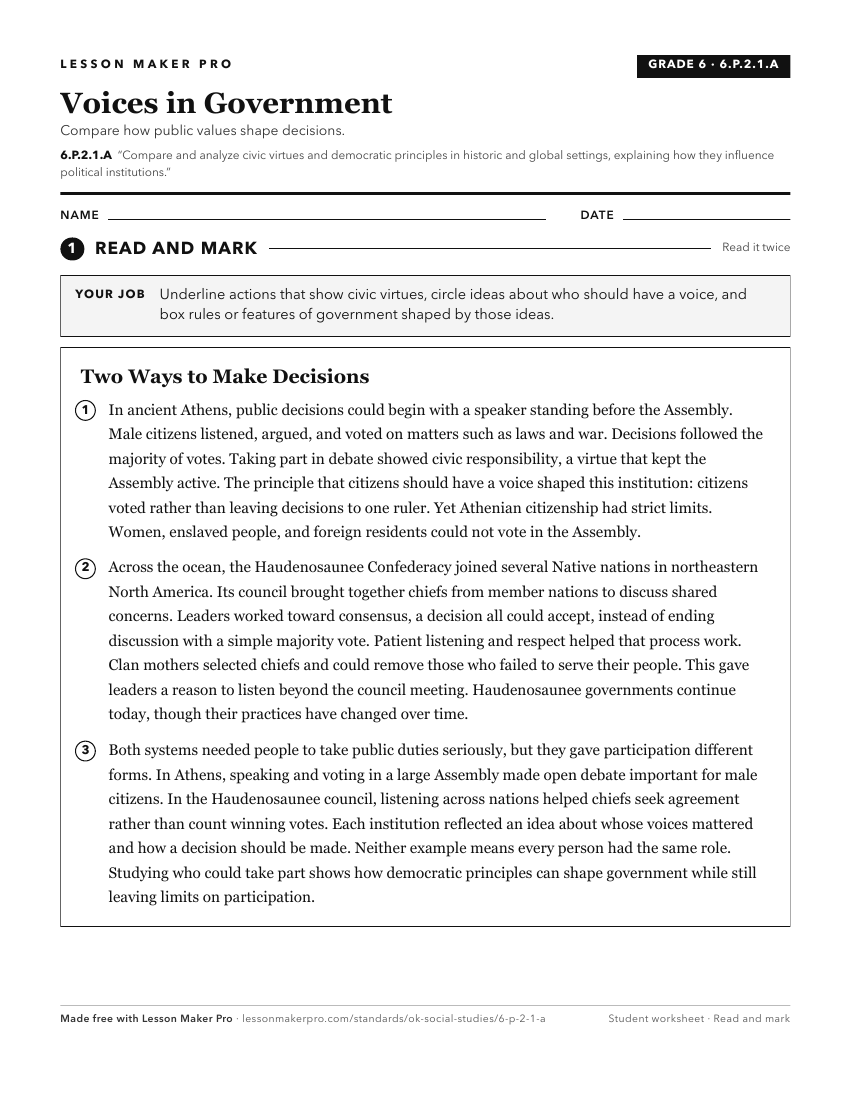
A ready-to-print activity worksheet aligned to 6.P.2.1.A, with an answer key for the teacher on its own page. No account needed.
PDF, US Letter, prints cleanly in black and white.
Download the worksheetKeep exploring
Related Standards
- 8.P.2.1.A
The 8th Grade version of this standard.
- 5.P.2.1.A
Explain democratic principles in historic documents by identifying examples of civic virtues and principles at work in state and national settings.
- 7.P.2.1.A
The 7th Grade version of this standard.
- 4.P.2.1.A
Explain democratic principles in historic documents by identifying examples of civic virtues and principles at work in state and national settings.
Turn this exact standard into a lesson
Grade, subject, topic, and the complete standard are prefilled. Create one free, no account needed.
Also for this standard:Make a WorksheetMake a QuizMake a Sub Lesson