Oklahoma Social Studies 8.P.2.1.A
The Standard
- 8.P.2
- Use interdisciplinary tools to acquire, apply, and evaluate content understanding of the four strands of social studies.
- 8.P.2.1
- Demonstrate an understanding of the principles of government, the benefits of democratic systems, and their responsibilities as citizens.
Compare and analyze civic virtues and democratic principles in historic and global settings, explaining how they influence political institutions.
Oklahoma Academic Standards for Social Studies (2026) · 8.P.2.1
Teacher's field guide
What This Standard Means
What Students Need to Do
- Students tell civic virtues, such as informed participation, from democratic principles, such as political equality. They compare ancient Athens and modern India to explain how those ideas affect voting and political institutions.
What Mastery Looks Like
- A student explains that adult male citizens voted in Athens' assembly, while adult citizens in India elect members of parliament. They use those voting rules to show how each system puts civic participation and political equality into practice.
Common Misconceptions
- Students may treat participation as a voting rule rather than something citizens choose to do. They may assume everyone could vote in Athens, or that Indian voters vote directly on each law.
How to Assess It
- Exit ticket: Who could vote in ancient Athens, and how do voters in India shape parliament? Name one civic virtue and one democratic principle, then explain how each affects an institution.
Lesson moves
Ways to Teach It
Give pairs Athens and India fact cards; have them sort examples of civic virtues and democratic principles, then draw arrows to each voting institution.
Ask: How do voting rules in Athens' assembly and India's parliament show different ideas about political equality?
Play a claim-check game with six statements about participation and voting rights; teams correct false claims using the fact cards.
Use a sample city council ballot to compare electing representatives with voting in Athens' assembly; ask what citizens must do for each system to work.
Free download
Printable 8.P.2.1.A Worksheet
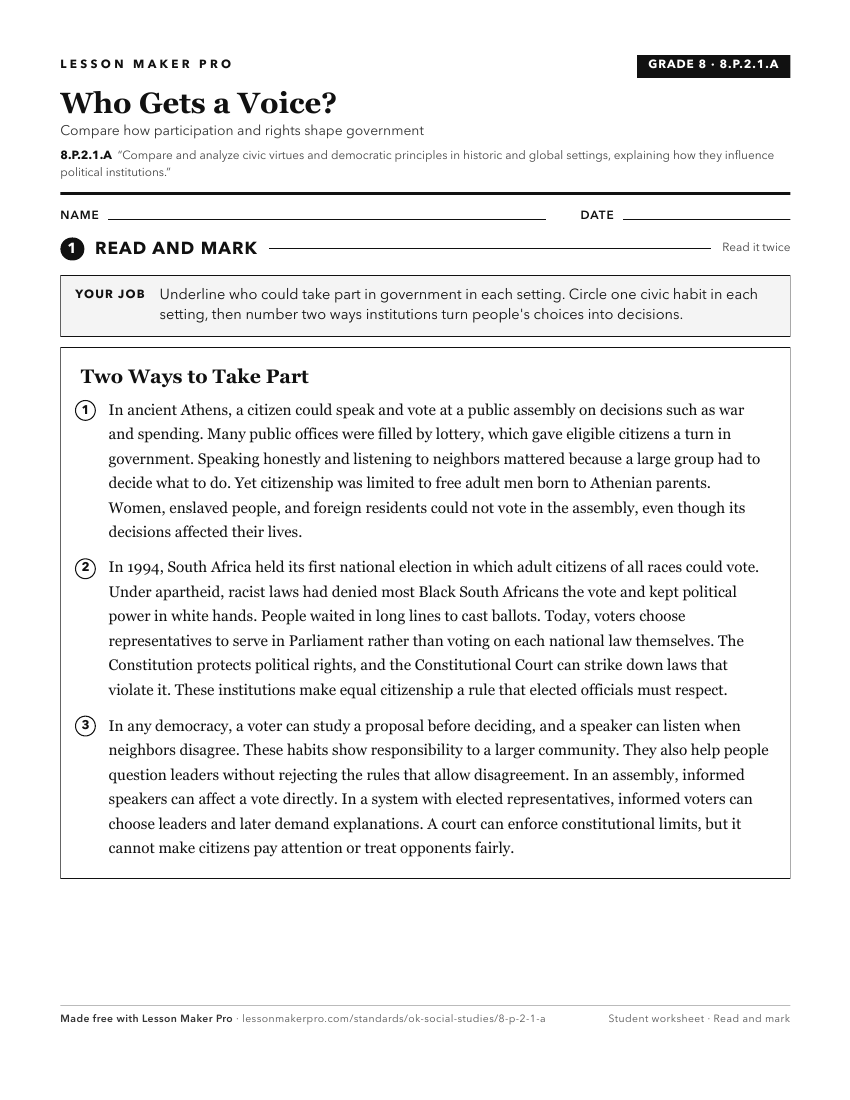
A ready-to-print activity worksheet aligned to 8.P.2.1.A, with an answer key for the teacher on its own page. No account needed.
PDF, US Letter, prints cleanly in black and white.
Download the worksheetKeep exploring
Related Standards
- 5.P.2.1.A
Explain democratic principles in historic documents by identifying examples of civic virtues and principles at work in state and national settings.
- 7.P.2.1.A
The 7th Grade version of this standard.
- 4.P.2.1.A
Explain democratic principles in historic documents by identifying examples of civic virtues and principles at work in state and national settings.
- 6.P.2.1.A
The 6th Grade version of this standard.
Turn this exact standard into a lesson
Grade, subject, topic, and the complete standard are prefilled. Create one free, no account needed.
Also for this standard:Make a WorksheetMake a QuizMake a Sub Lesson