Oklahoma Social Studies 6.C.5
Standard Cluster
Analyze why and how humans develop rules, laws, and governments, including the role of citizens in government. Compare systems of governments. Define and describe the characteristics of limited governments (constitutional republic, constitutional monarchy) and authoritarian systems (dictatorship, oligarchy, absolute monarchy). Compare different forms of constitutional republics, exemplified by the constitutional republic of the United States of America and the constitutional monarchy of Canada. Analyze the historical development of American Indian citizenship and constitutional rights in the United States of America, including the passage of the Indian Citizenship Act of 1924. Examine how tribal sovereignty and United States of America citizenship function within the United States of America. Compare the rights and responsibilities of tribal citizenship with those of state and national citizenship, including the role of laws such as the Indian Civil Rights Act of 1968. Describe how historic struggles for independence in Latin America and the Caribbean were influenced by the American revolution and Constitution, leading to the creation of modern republics. Describe challenges for several Latin American governments and economies, due to a history of political and economic instability. Compare common features of the Constitution of the United States of America to other representative governments of the Western Hemisphere, focusing on the principles of limited government, individual rights and liberties, and the role of the citizen in the selection of government officials.
Oklahoma Academic Standards for Social Studies (2026)
Cluster contents
Standards in This Cluster
6.C.5 is a cluster heading. These are the individual standards under it.
- 6.C.5.1
Compare systems of governments.
- 6.C.5.1.A
Define and describe the characteristics of limited governments (constitutional republic, constitutional monarchy) and authoritarian systems (dictatorship, oliga...
- 6.C.5.1.B
Compare different forms of constitutional republics, exemplified by the constitutional republic of the United States of America and the constitutional monarchy ...
- 6.C.5.1.C
Analyze the historical development of American Indian citizenship and constitutional rights in the United States of America, including the passage of the Indian...
- 6.C.5.1.D
Describe how historic struggles for independence in Latin America and the Caribbean were influenced by the American revolution and Constitution, leading to the ...
- 6.C.5.1.E
Describe challenges for several Latin American governments and economies, due to a history of political and economic instability.
- 6.C.5.2
Compare common features of the Constitution of the United States of America to other representative governments of the Western Hemisphere, focusing on the princ...
Teacher's field guide
What This Cluster Means
What Students Need to Do
- Students explain why people make rules and form governments. They compare who holds power, how leaders are chosen, and what limits governments. They explain tribal sovereignty and citizenship, then trace how U.S. ideas influenced new republics in Latin America and the Caribbean.
What Mastery Looks Like
- A student can explain why the United States and Canada have different forms of limited government and how both differ from authoritarian systems. They can use the 1924 and 1968 laws to explain U.S. citizenship, tribal self-government, and protected rights. They can identify a U.S. influence on Mexico's early republic and name a later challenge it faced.
Common Misconceptions
- Students may call Canada a republic because it elects lawmakers, or assume every monarch has unchecked power. They may think the 1924 law ended tribal sovereignty or that the 1968 law made tribal governments the same as states. They may assume new republics in Latin America and the Caribbean copied the U.S. government exactly.
How to Assess It
- Exit ticket: Explain why Canada is a constitutional monarchy and the United States is a constitutional republic. Name one limit on government power in each.
Lesson moves
Ways to Teach It
Build a classroom government with role cards for voters, lawmakers, and a leader; add a written rule limiting the leader's power.
Give students short summaries of the U.S. Constitution and Mexico's 1824 constitution; ask them to write one shared feature and one difference.
Play Name the System: read a short government profile, then have students hold up a government-type card and cite one clue.
Print Cherokee Nation and Oklahoma election information pages; have students mark who can vote and which government sets each rule.
Free download
Printable 6.C.5 Worksheet
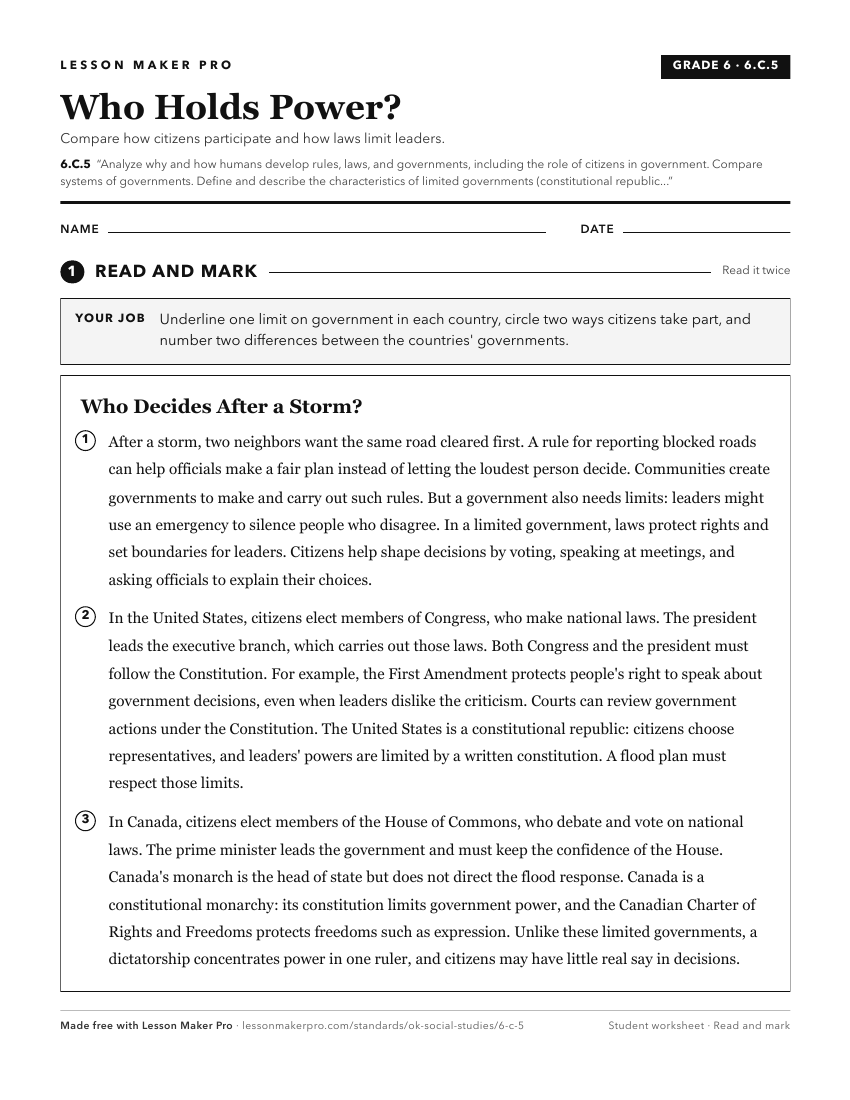
A ready-to-print activity worksheet aligned to 6.C.5, with an answer key for the teacher on its own page. No account needed.
PDF, US Letter, prints cleanly in black and white.
Download the worksheetKeep exploring
Related Standards
- 7.C.6
Analyze systems of government by examining their source of authority, principles, structures, and processes.
- 7.P.2.1.A
Compare and analyze civic virtues and democratic principles in historic and global settings, explaining how they influence political institutions.
- MWH.C.3
Analyze developments in politics, science, and philosophy contributing to human advancement and the rise of modern institutions of self-government.
- 3.C.1
Analyze the purpose of government and traits of responsible citizens.
Turn this cluster into a lesson
Grade, subject, topic, and the complete cluster are prefilled. Create one free, no account needed.
Also for this cluster:Make a WorksheetMake a QuizMake a Sub Lesson