Oklahoma Social Studies 3.C.1
Standard Cluster
Analyze the purpose of government and traits of responsible citizens. Read and describe the principle of a constitutional republic as government by the people. Explain how representatives of the people make and carry out laws in our communities, state, and nation. Explain that the Constitution of the United States of America and the Oklahoma Constitution are written plans for organizing the functions of government, which is composed of both state and national levels of authority. Describe the structure of Oklahoma’s government, including the role of major elected and appointed leaders in each of its three branches, including governor, state legislators, and court justices. Identify basic responsibilities of state and local governments (e.g., public safety, education, public works) and explain how taxes pay for services provided by local and state governments. Read and explain how the Preamble to the Oklahoma Constitution reflects the power of the people and their reliance on spiritual guidance. Describe how American Indian Tribal governments are also based upon written constitutions and exercise the right to govern themselves (sovereignty) by making laws for Tribal lands and citizens, providing for schools and healthcare, and preserving Native culture and traditions. Explain how Oklahomans are united through our heritage, state symbols, and special commemorations that reflect common ideals. Describe the significance of symbols represented on the State Seal and Oklahoma Flag, explaining how the name of Oklahoma is derived from the Choctaw language and reflects the state’s American Indian heritage. Explain how Tribal people and their governments are represented by flags and seals, reflecting the unique culture, history, and traditional symbols of each Tribe. Examine the significance of community, state, and federal holidays. Identify and explain the meaning of the Oklahoma motto, “Labor omnia vincit,” reflecting the importance of hard work and labor. Explain how Oklahomans exhibit the “Oklahoma Standard” when they unite as neighbors during difficult times, including response and recovery from the bombing of the Alfred P. Murrah Federal Building. Define the concepts of civic virtue and examine the responsibilities of citizens. Examine why civility, cooperation, self-reliance, and respect for the law are important civic traits that support our communities, state, nation, and Tribes. Explain the importance of voting in elections and running for public office to the preservation of a constitutional republic. Describe how citizens can serve their community through jury duty and community service. Explain how military service is one of many ways that Oklahomans express their patriotism and sense of duty, exemplified by the Buffalo Soldiers, Native Code Talkers, and the 45th Infantry.
Oklahoma Academic Standards for Social Studies (2026)
Cluster contents
Standards in This Cluster
3.C.1 is a cluster heading. These are the individual standards under it.
- 3.C.1.1
Read and describe the principle of a constitutional republic as government by the people.
- 3.C.1.1.A
Explain how representatives of the people make and carry out laws in our communities, state, and nation.
- 3.C.1.1.B
Explain that the Constitution of the United States of America and the Oklahoma Constitution are written plans for organizing the functions of government, which ...
- 3.C.1.1.C
Describe the structure of Oklahoma’s government, including the role of major elected and appointed leaders in each of its three branches, including governor, st...
- 3.C.1.1.D
Identify basic responsibilities of state and local governments (e.g., public safety, education, public works) and explain how taxes pay for services provided by...
- 3.C.1.1.E
Read and explain how the Preamble to the Oklahoma Constitution reflects the power of the people and their reliance on spiritual guidance.
- 3.C.1.2
Describe how American Indian Tribal governments are also based upon written constitutions and exercise the right to govern themselves (sovereignty) by making la...
- 3.C.1.3
Explain how Oklahomans are united through our heritage, state symbols, and special commemorations that reflect common ideals.
- 3.C.1.3.A
Describe the significance of symbols represented on the State Seal and Oklahoma Flag, explaining how the name of Oklahoma is derived from the Choctaw language a...
- 3.C.1.3.B
Explain how Tribal people and their governments are represented by flags and seals, reflecting the unique culture, history, and traditional symbols of each Trib...
- 3.C.1.3.C
Examine the significance of community, state, and federal holidays.
- 3.C.1.3.D
Identify and explain the meaning of the Oklahoma motto, “Labor omnia vincit,” reflecting the importance of hard work and labor.
- 3.C.1.3.E
Explain how Oklahomans exhibit the “Oklahoma Standard” when they unite as neighbors during difficult times, including response and recovery from the bombing of ...
- 3.C.1.4
Define the concepts of civic virtue and examine the responsibilities of citizens.
- 3.C.1.4.A
Examine why civility, cooperation, self-reliance, and respect for the law are important civic traits that support our communities, state, nation, and Tribes.
- 3.C.1.4.B
Explain the importance of voting in elections and running for public office to the preservation of a constitutional republic.
- 3.C.1.4.C
Describe how citizens can serve their community through jury duty and community service.
- 3.C.1.4.D
Explain how military service is one of many ways that Oklahomans express their patriotism and sense of duty, exemplified by the Buffalo Soldiers, Native Code Ta...
Teacher's field guide
What This Cluster Means
What Students Need to Do
- Students explain how representatives make laws and how taxes pay for services. They compare the written plans for national, Oklahoma, and sovereign Tribal governments. They connect Oklahoma’s name, symbols, holidays, and history to shared values and ways people serve.
What Mastery Looks Like
- Students tell how legislators make laws, the governor carries them out, and justices interpret them. They explain that Tribal governments make laws for their citizens and lands. They explain a flag or motto and name ways to serve, such as voting, jury duty, or helping neighbors.
Common Misconceptions
- Students may think the governor makes laws alone or that roads and schools are free. Some think Tribal governments are departments of the state rather than sovereign governments. Others think voting is the only way citizens can help.
How to Assess It
- Exit ticket: A town needs a new fire truck. Who could decide to buy it, how could taxes help pay for it, and how could residents have a say?
Lesson moves
Ways to Teach It
Place governor, state legislator, and court justice cards on a three-branch chart, then add one job card under each.
Display Oklahoma’s Preamble and ask: Who creates this government, and whose guidance does the text invoke?
Play a card sort: match taxes to schools, fire stations, and roads, then sort voting, jury duty, and community service as citizen actions.
Print the Oklahoma flag and Cherokee Nation seal from official websites; students label the Osage shield and seven-pointed star and explain their meanings.
Free download
Printable 3.C.1 Worksheet
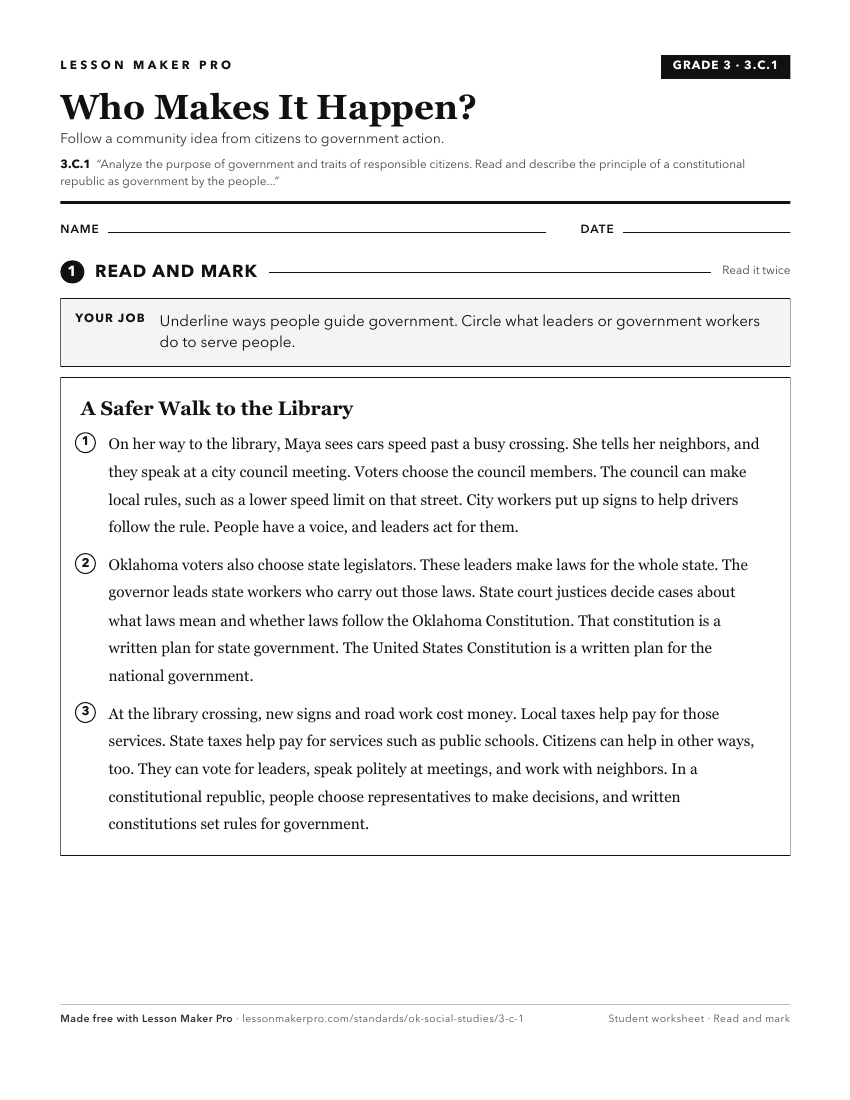
A ready-to-print activity worksheet aligned to 3.C.1, with an answer key for the teacher on its own page. No account needed.
PDF, US Letter, prints cleanly in black and white.
Download the worksheetKeep exploring
Related Standards
- 6.C.5
Analyze why and how humans develop rules, laws, and governments, including the role of citizens in government.
- E.P.2.1
Demonstrate an understanding of the principles of government, the benefits of democratic systems, and their responsibilities as citizens.
- 8.C.4.2.A
Examine the purpose of government, including its responsibilities to citizens, as expressed in the Preamble to the Constitution of the United States of America.
- 1.C.1
Analyze their role as a citizen in a community.
Turn this cluster into a lesson
Grade, subject, topic, and the complete cluster are prefilled. Create one free, no account needed.
Also for this cluster:Make a WorksheetMake a QuizMake a Sub Lesson