Oklahoma Social Studies 6.C.5.1
Standard Cluster
- 6.C.5
- Analyze why and how humans develop rules, laws, and governments, including the role of citizens in government.
Compare systems of governments. Define and describe the characteristics of limited governments (constitutional republic, constitutional monarchy) and authoritarian systems (dictatorship, oligarchy, absolute monarchy). Compare different forms of constitutional republics, exemplified by the constitutional republic of the United States of America and the constitutional monarchy of Canada. Analyze the historical development of American Indian citizenship and constitutional rights in the United States of America, including the passage of the Indian Citizenship Act of 1924. Examine how tribal sovereignty and United States of America citizenship function within the United States of America. Compare the rights and responsibilities of tribal citizenship with those of state and national citizenship, including the role of laws such as the Indian Civil Rights Act of 1968. Describe how historic struggles for independence in Latin America and the Caribbean were influenced by the American revolution and Constitution, leading to the creation of modern republics. Describe challenges for several Latin American governments and economies, due to a history of political and economic instability.
Oklahoma Academic Standards for Social Studies (2026) · 6.C.5
Cluster contents
Standards in This Cluster
6.C.5.1 is a cluster heading. These are the individual standards under it.
- 6.C.5.1.A
Define and describe the characteristics of limited governments (constitutional republic, constitutional monarchy) and authoritarian systems (dictatorship, oliga...
- 6.C.5.1.B
Compare different forms of constitutional republics, exemplified by the constitutional republic of the United States of America and the constitutional monarchy ...
- 6.C.5.1.C
Analyze the historical development of American Indian citizenship and constitutional rights in the United States of America, including the passage of the Indian...
- 6.C.5.1.D
Describe how historic struggles for independence in Latin America and the Caribbean were influenced by the American revolution and Constitution, leading to the ...
- 6.C.5.1.E
Describe challenges for several Latin American governments and economies, due to a history of political and economic instability.
Teacher's field guide
What This Cluster Means
What Students Need to Do
- Students sort governments by who holds power and whether laws limit that power, then compare the U.S. and Canada. They explain how the 1924 citizenship law and the 1968 Indian Civil Rights Act relate to tribal, state, and national citizenship. They connect U.S. revolutionary ideas to independence in Latin America and the Caribbean, then compare later political and economic problems.
What Mastery Looks Like
- Students correctly classify five government types and explain why Canada's monarch does not rule alone. They explain that the 1924 law granted U.S. citizenship without ending tribal citizenship, while the 1968 law placed rights limits on tribal governments. They compare tribal and state voting rules, name an independence movement influenced by U.S. ideas, and describe distinct problems in two Latin American countries.
Common Misconceptions
- Students may call Canada an absolute monarchy because it has a monarch, or assume every republic limits its leaders. They may think U.S. citizenship replaced tribal citizenship in 1924, or that the 1968 law ended tribal authority. They may credit U.S. ideas alone for every independence movement or assume every country faced the same problems afterward.
How to Assess It
- Give a four-box exit ticket: classify Canada and a dictatorship; explain what changed in 1924 and 1968; compare tribal and state voting; connect U.S. ideas to Latin American independence and one later economic problem.
Lesson moves
Ways to Teach It
Sort five government cards by leader, lawmaking power, and limits; place U.S. and Canada cards beside their best matches.
Ask students: Can someone be both a tribal and U.S. citizen? Have them use the 1924 and 1968 laws in a written answer.
Play a fact-card relay: match Mexico and Haiti to independence influences, then Argentina and Venezuela to later political or economic problems.
Read Cherokee Nation voter rules and Oklahoma state voter rules on their official websites; list one difference.
Free download
Printable 6.C.5.1 Worksheet
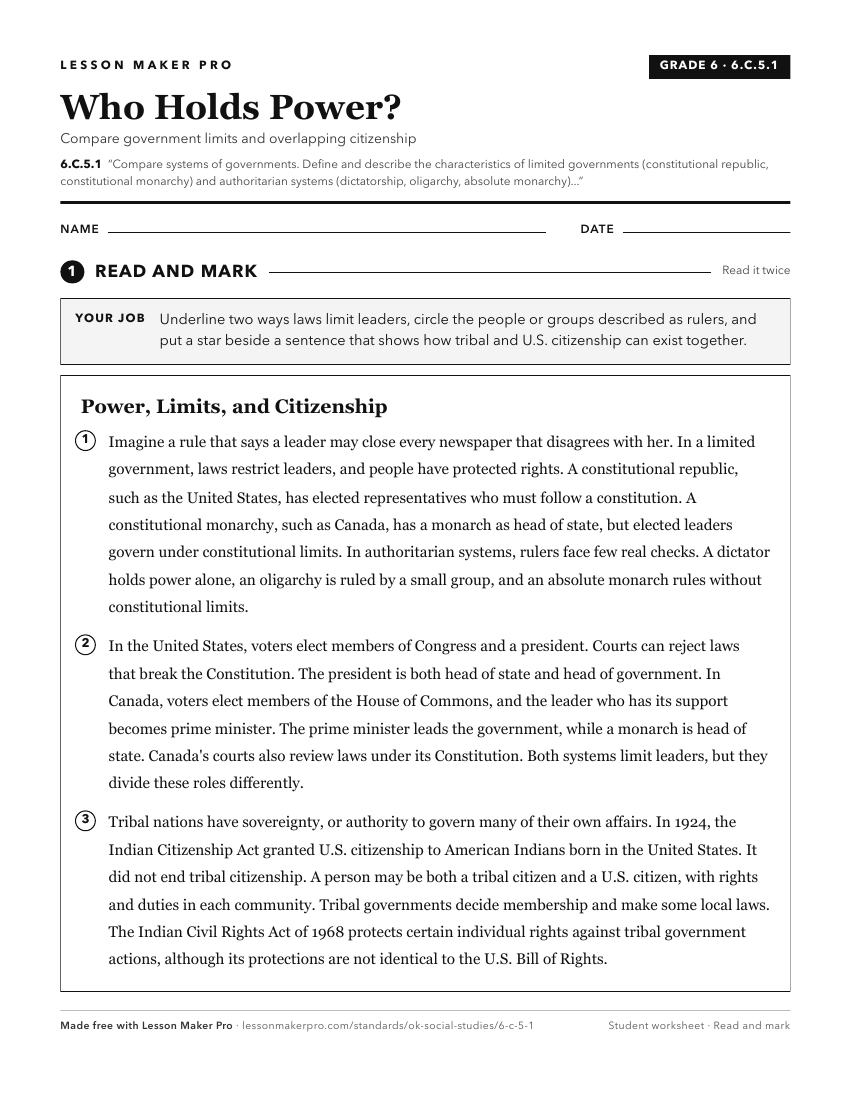
A ready-to-print activity worksheet aligned to 6.C.5.1, with an answer key for the teacher on its own page. No account needed.
PDF, US Letter, prints cleanly in black and white.
Download the worksheetKeep exploring
Related Standards
- 7.C.6
Analyze systems of government by examining their source of authority, principles, structures, and processes.
- USG.C.1.2
Analyze the essential characteristics of limited versus unlimited systems of government.
- USG.C.1.2.A
Compare historic and contemporary examples of unlimited systems of governments (e.g., monarchy, oligarchy, theocracy, autocracy) to examples of limited systems ...
- WG.C.4.2
Compare the world’s political systems of government, based on limited versus unlimited authority, including the rights and opportunities of citizens within each...
Turn this cluster into a lesson
Grade, subject, topic, and the complete cluster are prefilled. Create one free, no account needed.
Also for this cluster:Make a WorksheetMake a QuizMake a Sub Lesson