Oklahoma Social Studies 7.C.6
Standard Cluster
Analyze systems of government by examining their source of authority, principles, structures, and processes. Compare the source of authority and power of representative governments (republic, constitutional monarchy) versus authoritarian systems (dictatorship, absolute monarchy, totalitarian regime, oligarchy, theocracy) using contemporary or historical examples (e.g., the symbolic role of the British crown versus the authority of Saudi Arabia’s monarchy, the republics of western Europe to the Chinese Communist system). Trace the historic roots of constitutional republics. Explain why the government of ancient Athens is considered the beginning of democratic government and examine Greek political concepts, including the “polis” or city-state, rule of law, liberty, civic participation and voting rights, legislative bodies, and written constitutions. Describe the government of the Roman Republic and its contribution to the development of representative self-government, including separation of powers, liberty, the rule of law, and the concept of civic duty. Describe influences of early English tradition related to the principles of limited government and individual rights, such as found in the Magna Carta and established by the English Bill of Rights. Compare the role of the citizen in modern representative governments to authoritarian systems (e.g., United Kingdom to Russia; India to Saudi Arabia; South Africa to China; United States of America to Iran). Describe the involvement of citizens in the selection of government officials and the lawmaking process in different systems of government. Compare civil liberties in representative to authoritarian systems of government, referencing the United States of America’s Bill of Rights. Describe how contemporary authoritarian governments maintain power over citizens (e.g., denial of civil rights, illegitimate elections, restrictions on free speech and the free exercise of religion, refusal of due process protections, corruption of government officials). Analyze issues related to Indigenous sovereignty, including the management of natural resources and the preservation of Indigenous cultures (e.g., Scandinavia’s Saami, Rohingya of Myanmar, Uyghur of China, New Zealand’s Māori).
Oklahoma Academic Standards for Social Studies (2026)
Cluster contents
Standards in This Cluster
7.C.6 is a cluster heading. These are the individual standards under it.
- 7.C.6.1
Compare the source of authority and power of representative governments (republic, constitutional monarchy) versus authoritarian systems (dictatorship, absolute...
- 7.C.6.2
Trace the historic roots of constitutional republics.
- 7.C.6.2.A
Explain why the government of ancient Athens is considered the beginning of democratic government and examine Greek political concepts, including the “polis” or...
- 7.C.6.2.B
Describe the government of the Roman Republic and its contribution to the development of representative self-government, including separation of powers, liberty...
- 7.C.6.2.C
Describe influences of early English tradition related to the principles of limited government and individual rights, such as found in the Magna Carta and estab...
- 7.C.6.3
Compare the role of the citizen in modern representative governments to authoritarian systems (e.g., United Kingdom to Russia; India to Saudi Arabia; South Afri...
- 7.C.6.3.A
Describe the involvement of citizens in the selection of government officials and the lawmaking process in different systems of government.
- 7.C.6.3.B
Compare civil liberties in representative to authoritarian systems of government, referencing the United States of America’s Bill of Rights.
- 7.C.6.3.C
Describe how contemporary authoritarian governments maintain power over citizens (e.g., denial of civil rights, illegitimate elections, restrictions on free spe...
- 7.C.6.4
Analyze issues related to Indigenous sovereignty, including the management of natural resources and the preservation of Indigenous cultures (e.g., Scandinavia’s...
Teacher's field guide
What This Cluster Means
What Students Need to Do
- Students compare who holds power, how laws are made, and what citizens can do in different governments. They trace ideas about voting, representation, and limits on rulers through Athens, Rome, and English rights documents. They examine civil liberties, restrictions on those liberties, and Indigenous authority over resources and culture.
What Mastery Looks Like
- A student can explain why Britain's monarch has a different role from Saudi Arabia's monarch. They can connect Athenian voting, Roman elected offices, and English limits on rulers to modern republics, while naming who was excluded. They can use a specific right or resource decision to show whose voice counts.
Common Misconceptions
- Students may think every monarch has the same political power. They may say everyone could vote in ancient Athens, overlooking women, enslaved people, and noncitizens. Some assume elections always protect rights or mistake Indigenous sovereignty for cultural celebration alone.
How to Assess It
- On an exit ticket, ask: How do people in Britain and Saudi Arabia select national leaders, and what happens if they criticize the government? Name one idea from Athens, Rome, or England that limits a ruler's power.
Lesson moves
Ways to Teach It
Give pairs Athens, Rome, Britain, and Saudi Arabia fact cards; sort by who chooses leaders, who makes laws, and who votes.
Ask: Why does a vote not always mean citizens control government? Use one example of restricted speech or an unfair election.
In teams, match rights excerpts from Magna Carta, the English Bill of Rights, and the U.S. Bill of Rights to powers each limits.
Read a paragraph about Māori and Crown guardians of the Whanganui River; underline who represents the river and how Māori views shape management.
Free download
Printable 7.C.6 Worksheet
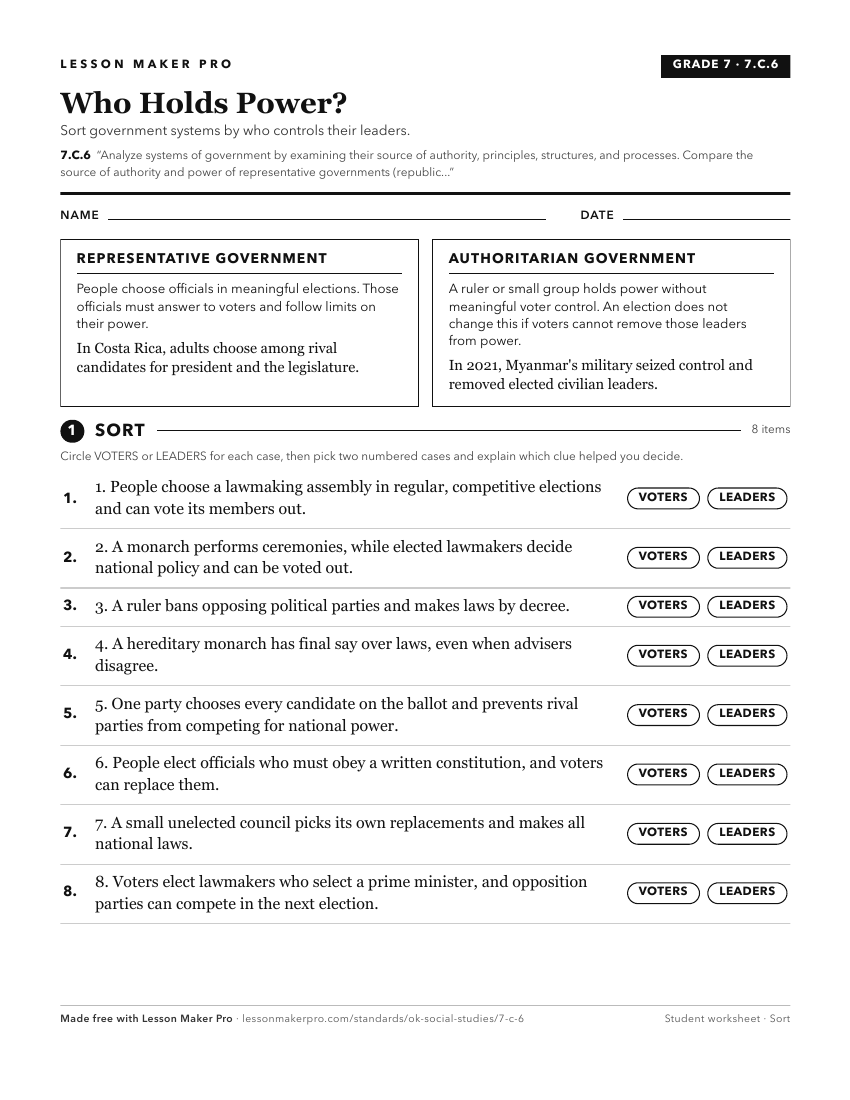
A ready-to-print activity worksheet aligned to 7.C.6, with an answer key for the teacher on its own page. No account needed.
PDF, US Letter, prints cleanly in black and white.
Download the worksheetKeep exploring
Related Standards
- TOT.P.2.1.B
Evaluate the impact of the structure and powers exercised by governmental systems on public policy, using historical and contemporary examples.
- MWH.C.3.1
Compare theories and forms of government regarding sources of authority and legitimacy.
- OKH.P.2.1.B
Evaluate the impact of the structure and powers exercised by governmental systems on public policy, using historical and contemporary examples.
- AWH.P.2.1.B
Evaluate the impact of the structure and powers exercised by governmental systems on public policy, using historical and contemporary examples.
Turn this cluster into a lesson
Grade, subject, topic, and the complete cluster are prefilled. Create one free, no account needed.
Also for this cluster:Make a WorksheetMake a QuizMake a Sub Lesson