Oklahoma Social Studies 7.C.6.1
The Standard
- 7.C.6
- Analyze systems of government by examining their source of authority, principles, structures, and processes.
Compare the source of authority and power of representative governments (republic, constitutional monarchy) versus authoritarian systems (dictatorship, absolute monarchy, totalitarian regime, oligarchy, theocracy) using contemporary or historical examples (e.g., the symbolic role of the British crown versus the authority of Saudi Arabia’s monarchy, the republics of western Europe to the Chinese Communist system).
Oklahoma Academic Standards for Social Studies (2026) · 7.C.6
Teacher's field guide
What This Standard Means
What Students Need to Do
- Students identify who holds power and where that authority comes from. They compare elected representatives with hereditary rulers, single leaders, ruling parties, small groups, and religious leaders. They use countries or past states as evidence.
What Mastery Looks Like
- A student can explain that UK voters elect lawmakers, while the monarch has a mainly ceremonial role. They can contrast this with Saudi Arabia, where the king inherits authority and makes major government decisions. Given another example, they can identify who holds power and how they gained it.
Common Misconceptions
- Students may think every monarch runs the government or every republic holds free elections. They may call every authoritarian system a dictatorship, missing rule by a party, religious leaders, or a small group. They may miss how a totalitarian regime tries to control daily life.
How to Assess It
- Exit ticket: Compare the UK and Saudi Arabia. Who makes major governing decisions in each, and where does that authority come from?
Lesson moves
Ways to Teach It
Hand pairs cards labeled UK, France, Saudi Arabia, China, Iran, North Korea, and historic Venice; sort by who governs and why.
Ask: Why does the British king have less governing power than the Saudi king? Use one detail about each country's lawmakers.
Play authority match: pair 'king with final say' with absolute monarchy and 'monarch with elected lawmakers' with constitutional monarchy; explain both matches.
Show two news headlines, a UK Parliament vote and a Saudi royal decree; students underline each decision maker and write how each gained power.
Free download
Printable 7.C.6.1 Worksheet
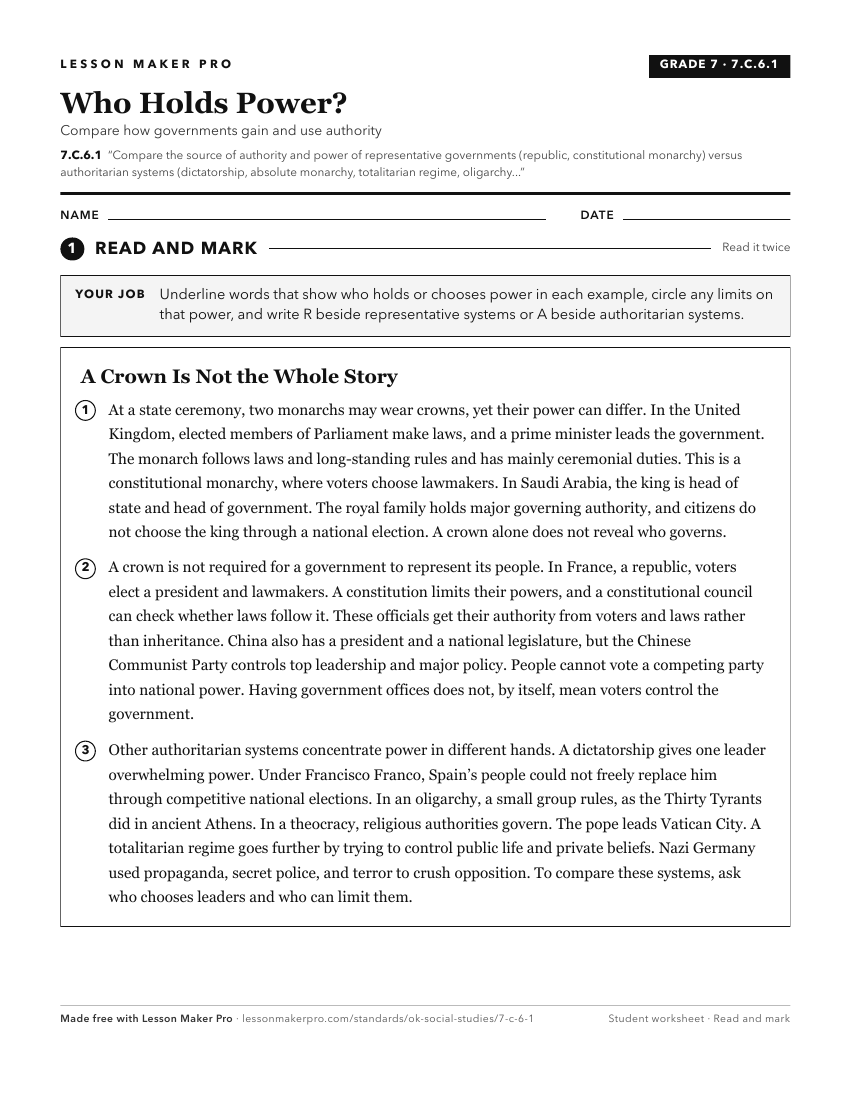
A ready-to-print activity worksheet aligned to 7.C.6.1, with an answer key for the teacher on its own page. No account needed.
PDF, US Letter, prints cleanly in black and white.
Download the worksheetKeep exploring
Related Standards
- 6.C.5.1.A
Define and describe the characteristics of limited governments (constitutional republic, constitutional monarchy) and authoritarian systems (dictatorship, oliga...
- USG.C.1.2.A
Compare historic and contemporary examples of unlimited systems of governments (e.g., monarchy, oligarchy, theocracy, autocracy) to examples of limited systems ...
- 7.C.6.3
Compare the role of the citizen in modern representative governments to authoritarian systems (e.g., United Kingdom to Russia; India to Saudi Arabia; South Afri...
- WG.C.4.2
Compare the world’s political systems of government, based on limited versus unlimited authority, including the rights and opportunities of citizens within each...
Turn this exact standard into a lesson
Grade, subject, topic, and the complete standard are prefilled. Create one free, no account needed.
Also for this standard:Make a WorksheetMake a QuizMake a Sub Lesson