Oklahoma Social Studies 7.C.6.3
Standard Cluster
- 7.C.6
- Analyze systems of government by examining their source of authority, principles, structures, and processes.
Compare the role of the citizen in modern representative governments to authoritarian systems (e.g., United Kingdom to Russia; India to Saudi Arabia; South Africa to China; United States of America to Iran). Describe the involvement of citizens in the selection of government officials and the lawmaking process in different systems of government. Compare civil liberties in representative to authoritarian systems of government, referencing the United States of America’s Bill of Rights. Describe how contemporary authoritarian governments maintain power over citizens (e.g., denial of civil rights, illegitimate elections, restrictions on free speech and the free exercise of religion, refusal of due process protections, corruption of government officials).
Oklahoma Academic Standards for Social Studies (2026) · 7.C.6
Cluster contents
Standards in This Cluster
7.C.6.3 is a cluster heading. These are the individual standards under it.
- 7.C.6.3.A
Describe the involvement of citizens in the selection of government officials and the lawmaking process in different systems of government.
- 7.C.6.3.B
Compare civil liberties in representative to authoritarian systems of government, referencing the United States of America’s Bill of Rights.
- 7.C.6.3.C
Describe how contemporary authoritarian governments maintain power over citizens (e.g., denial of civil rights, illegitimate elections, restrictions on free spe...
Teacher's field guide
What This Cluster Means
What Students Need to Do
- Students compare how people choose leaders and influence laws in representative and authoritarian governments. They use the U.S. Bill of Rights to examine protections for speech, religion, and fair treatment. They explain how leaders can limit opposition through restricted elections and censorship.
What Mastery Looks Like
- Given facts about the U.S. and Russia, a student identifies who makes laws and how citizens can try to influence them. The student explains why holding an election does not always give voters a fair choice.
Common Misconceptions
- Students may assume any country that holds elections gives voters a real choice. Some think citizens vote directly on every law. Others think the U.S. Bill of Rights applies in every country.
How to Assess It
- Exit ticket: Both the U.S. and Russia hold elections. Explain one difference in how citizens can influence laws, and name one Bill of Rights protection that helps Americans criticize government.
Lesson moves
Ways to Teach It
Give pairs printed U.S. and Russia election and rights cards; have them build a two-column chart and explain two placements.
Ask: If a country holds elections but blocks opposition candidates, how much say do voters have in its laws? Use one card as evidence.
Play rights bingo with speech, religion, petition, and due process squares; call scenarios such as a banned protest or detention without a hearing.
Compare public-comment instructions on a local city council agenda with a news report on Russian protest restrictions; list how residents can object.
Free download
Printable 7.C.6.3 Worksheet
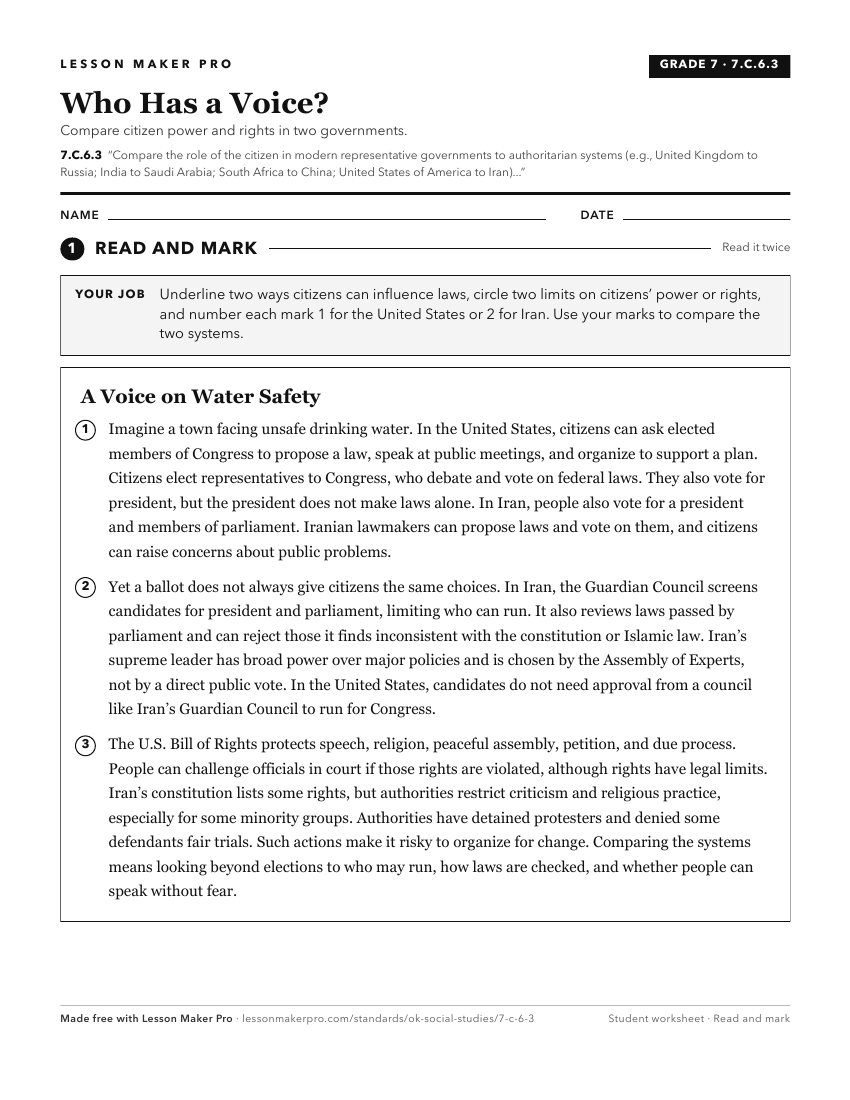
A ready-to-print activity worksheet aligned to 7.C.6.3, with an answer key for the teacher on its own page. No account needed.
PDF, US Letter, prints cleanly in black and white.
Download the worksheetKeep exploring
Related Standards
- 6.P.2.1.B
Compare the powers and responsibilities of the United States of America’s government to other forms of government, including the roles and rights of citizens.
- WG.C.4.2
Compare the world’s political systems of government, based on limited versus unlimited authority, including the rights and opportunities of citizens within each...
- 7.C.6.1
Compare the source of authority and power of representative governments (republic, constitutional monarchy) versus authoritarian systems (dictatorship, absolute...
Turn this cluster into a lesson
Grade, subject, topic, and the complete cluster are prefilled. Create one free, no account needed.
Also for this cluster:Make a WorksheetMake a QuizMake a Sub Lesson