Oklahoma Social Studies MWH.C.3.1
Standard Cluster
- MWH.C.3
- Analyze developments in politics, science, and philosophy contributing to human advancement and the rise of modern institutions of self-government.
Compare theories and forms of government regarding sources of authority and legitimacy. Distinguish between limited and unlimited forms of government, including the role of the citizen and the concept of individual liberty. Examine the Dynastic Cycle (Chinese Mandate of Heaven) by explaining its principle that virtuous rulers are bestowed power from a heavenly mandate, yet subject to rebellion if abusive. Describe the theory of Absolutism which supports the exercise of unlimited power according to an inherited divine right to rule (e.g., Louis XIV). Examine rule by enlightened monarchs and how the ideas of the Enlightenment tempered Absolutism (e.g., Joseph II, Frederick the Great, Catherine the Great). Analyze government's source of authority under a constitutional monarchy by explaining how and why powers are limited by a written or unwritten constitution (e.g., English Parliament).
Oklahoma Academic Standards for Social Studies (2026) · MWH.C.3
Cluster contents
Standards in This Cluster
MWH.C.3.1 is a cluster heading. These are the individual standards under it.
- MWH.C.3.1.A
Distinguish between limited and unlimited forms of government, including the role of the citizen and the concept of individual liberty.
- MWH.C.3.1.B
Examine the Dynastic Cycle (Chinese Mandate of Heaven) by explaining its principle that virtuous rulers are bestowed power from a heavenly mandate, yet subject ...
- MWH.C.3.1.C
Describe the theory of Absolutism which supports the exercise of unlimited power according to an inherited divine right to rule (e.g., Louis XIV).
- MWH.C.3.1.D
Examine rule by enlightened monarchs and how the ideas of the Enlightenment tempered Absolutism (e.g., Joseph II, Frederick the Great, Catherine the Great).
- MWH.C.3.1.E
Analyze government's source of authority under a constitutional monarchy by explaining how and why powers are limited by a written or unwritten constitution (e....
Teacher's field guide
What This Cluster Means
What Students Need to Do
- Students compare where rulers claim their power comes from and who can limit it. They explain why a Chinese emperor could lose the Mandate of Heaven, while Louis XIV claimed an inherited right to rule. They compare an enlightened monarch's reforms with the limits Parliament places on an English monarch.
What Mastery Looks Like
- Given short ruler profiles, a student can name each ruler's claim to authority and identify any checks on their power. They can explain why abuse could justify rebellion against a Chinese emperor, but not under Louis XIV's theory of rule. They can tell a reform granted by a ruler from a right protected by law.
Common Misconceptions
- Students may treat the Mandate of Heaven like divine right and miss that abuse could cost a ruler legitimacy. They may assume Joseph II's reforms gave citizens a way to limit his power. They may think England has no constitution because it lacks a single constitutional document.
How to Assess It
- Exit ticket: Compare Joseph II's religious reforms with Parliament's control over an English monarch's taxes. Which gives citizens a more lasting check on power, and why?
Lesson moves
Ways to Teach It
Give pairs ruler cards for a Chinese emperor, Louis XIV, Joseph II, and an English monarch; have them place each on a limited-to-unlimited line.
Ask students to write: If Joseph II allows religious tolerance but can revoke it, is it a protected right or a ruler's permission?
Play four corners with claims such as 'Heaven withdraws support after abuse'; students choose the matching form of rule and explain their choice.
Read the U.S. Constitution's First Amendment; ask how the right to criticize leaders differs from the position of Louis XIV's subjects.
Free download
Printable MWH.C.3.1 Worksheet
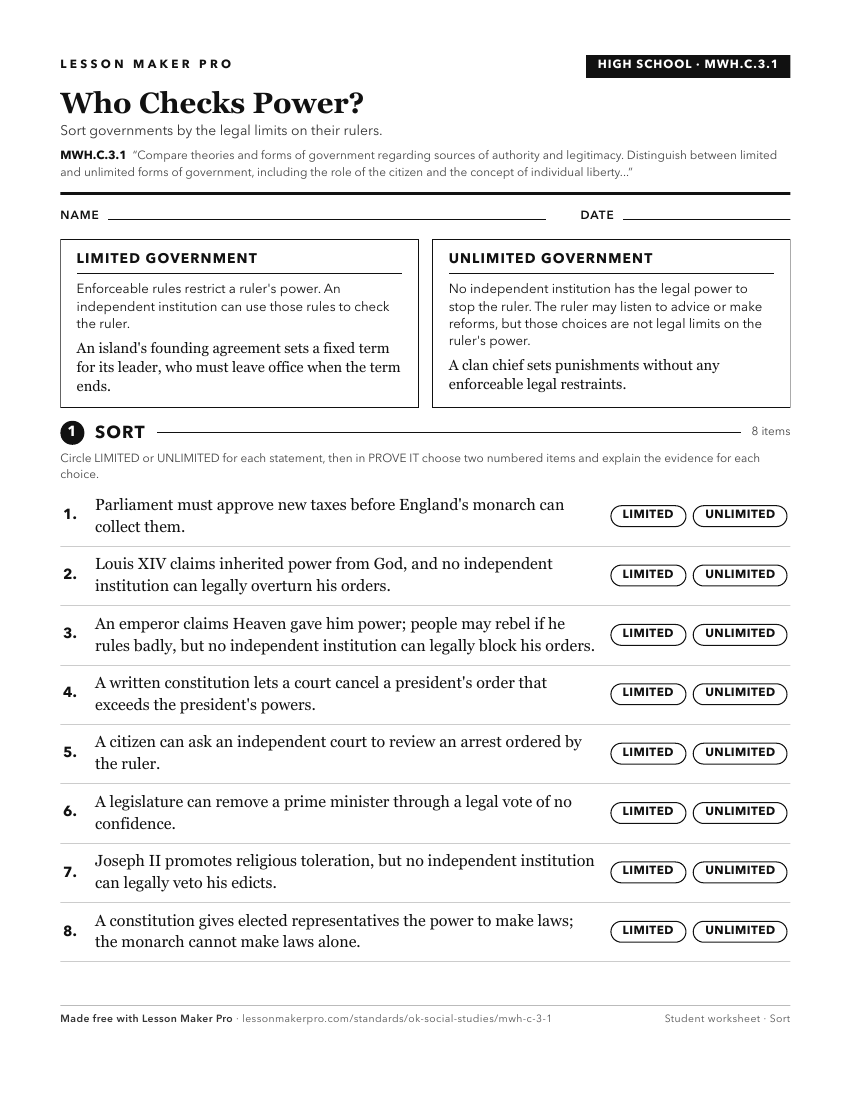
A ready-to-print activity worksheet aligned to MWH.C.3.1, with an answer key for the teacher on its own page. No account needed.
PDF, US Letter, prints cleanly in black and white.
Download the worksheetKeep exploring
Related Standards
- 7.C.6
Analyze systems of government by examining their source of authority, principles, structures, and processes.
- USG.C.1
Compare the formation of contemporary governments in terms of access, use, and justification of power.
- WG.C.4.2
Compare the world’s political systems of government, based on limited versus unlimited authority, including the rights and opportunities of citizens within each...
- 7.C.6.1
Compare the source of authority and power of representative governments (republic, constitutional monarchy) versus authoritarian systems (dictatorship, absolute...
Turn this cluster into a lesson
Grade, subject, topic, and the complete cluster are prefilled. Create one free, no account needed.
Also for this cluster:Make a WorksheetMake a QuizMake a Sub Lesson