Oklahoma Social Studies USG.C.1
Standard Cluster
Compare the formation of contemporary governments in terms of access, use, and justification of power. Examine the purposes and functions of government, including the establishment of justice, promotion of general welfare, and liberty as stated in the Preamble to the Constitution of the United States. Analyze the essential characteristics of limited versus unlimited systems of government. Compare historic and contemporary examples of unlimited systems of governments (e.g., monarchy, oligarchy, theocracy, autocracy) to examples of limited systems (e.g., direct democracy, constitutional republic, constitutional monarchy). Describe common characteristics of representative democracies (e.g., idea of natural rights and liberties, the rule of law, equality of all citizens under the law, majority rule with minority rights, the necessity of compromise). Examine the founding principles of the United States of America’s constitutional republic. Explain the principle of popular sovereignty which asserts that governments are created and sustained by the consent of the people who are the legitimate source of all political authority. Analyze how the United States of America’s government reflects both a democracy and a republic. Explain how the Constitution of the United States of America reflects a balance between a concern for the public good and a concern for the protection of individual rights. Evaluate how religious traditions, moral philosophy, and enlightenment principles contributed to the development of key American founding ideas, such as natural rights, liberty, and limited government during the drafting of the Constitution of the United States. Compare the advantages and disadvantages of ways in which governmental power can be distributed. Describe the structures of unitary, federal, and confederal systems, including contemporary examples of the presidential versus parliamentary systems. Compare structural differences in terms of effectiveness, prevention of abusive power, and responsiveness to the popular will. Examine the role of government in a nation’s economy. Compare the role of government in a market versus command economic systems. Describe the United States of America government’s role in a market system including the promotion of competition, protection of private property and consumer rights, and access to public goods and services. Examine how government policies in a market system can be used to stabilize and stimulate economic growth.
Oklahoma Academic Standards for Social Studies (2026)
Cluster contents
Standards in This Cluster
USG.C.1 is a cluster heading. These are the individual standards under it.
- USG.C.1.1
Examine the purposes and functions of government, including the establishment of justice, promotion of general welfare, and liberty as stated in the Preamble to...
- USG.C.1.2
Analyze the essential characteristics of limited versus unlimited systems of government.
- USG.C.1.2.A
Compare historic and contemporary examples of unlimited systems of governments (e.g., monarchy, oligarchy, theocracy, autocracy) to examples of limited systems ...
- USG.C.1.2.B
Describe common characteristics of representative democracies (e.g., idea of natural rights and liberties, the rule of law, equality of all citizens under the l...
- USG.C.1.3
Examine the founding principles of the United States of America’s constitutional republic.
- USG.C.1.3.A
Explain the principle of popular sovereignty which asserts that governments are created and sustained by the consent of the people who are the legitimate source...
- USG.C.1.3.B
Analyze how the United States of America’s government reflects both a democracy and a republic.
- USG.C.1.3.C
Explain how the Constitution of the United States of America reflects a balance between a concern for the public good and a concern for the protection of indivi...
- USG.C.1.3.D
Evaluate how religious traditions, moral philosophy, and enlightenment principles contributed to the development of key American founding ideas, such as natural...
- USG.C.1.4
Compare the advantages and disadvantages of ways in which governmental power can be distributed.
- USG.C.1.4.A
Describe the structures of unitary, federal, and confederal systems, including contemporary examples of the presidential versus parliamentary systems.
- USG.C.1.4.B
Compare structural differences in terms of effectiveness, prevention of abusive power, and responsiveness to the popular will.
- USG.C.1.5
Examine the role of government in a nation’s economy.
- USG.C.1.5.A
Compare the role of government in a market versus command economic systems.
- USG.C.1.5.B
Describe the United States of America government’s role in a market system including the promotion of competition, protection of private property and consumer r...
- USG.C.1.5.C
Examine how government policies in a market system can be used to stabilize and stimulate economic growth.
Teacher's field guide
What This Cluster Means
What Students Need to Do
- Students compare who holds power, how leaders gain it, and what gives them authority. They explain how consent, rights, and the Constitution limit and divide power in the U.S. They compare ways governments are structured and how governments act in market and command economies.
What Mastery Looks Like
- Given two country profiles, students can name who holds power and what, if anything, can stop its leaders. They can connect a founding idea to an earlier source and explain how a U.S. policy could serve the public while protecting individual rights. They can explain one trade-off between federal and unitary power and one difference between market and command economies.
Common Misconceptions
- Students may call any government with elections a democracy, even when leaders face no real limits. They may think majority rule allows voters to take away minority rights, or that a republic leaves voters out. They also confuse federalism with separation of powers and assume a market economy has no government role.
How to Assess It
- Exit ticket: Country A elects lawmakers, courts can block its leaders, and businesses set prices. Country B’s ruler chooses lawmakers, ignores courts, and sets prices. Identify the limited government, name its check on power, and identify its economic system.
Lesson moves
Ways to Teach It
Hand groups voter, ruler, legislature, and court cards; have them arrange two power maps and mark where a decision could be blocked.
Give students Genesis 1:27, a Locke excerpt, and the Declaration of Independence; ask which ideas about human worth and rights the founders used.
Use two card decks, one for unitary, federal, and confederal clues and one for presidential and parliamentary clues; partners sort and explain one trade-off.
Bring a city road budget, a product recall notice, and a Federal Reserve rate announcement; have students label each government's economic role.
Free download
Printable USG.C.1 Worksheet
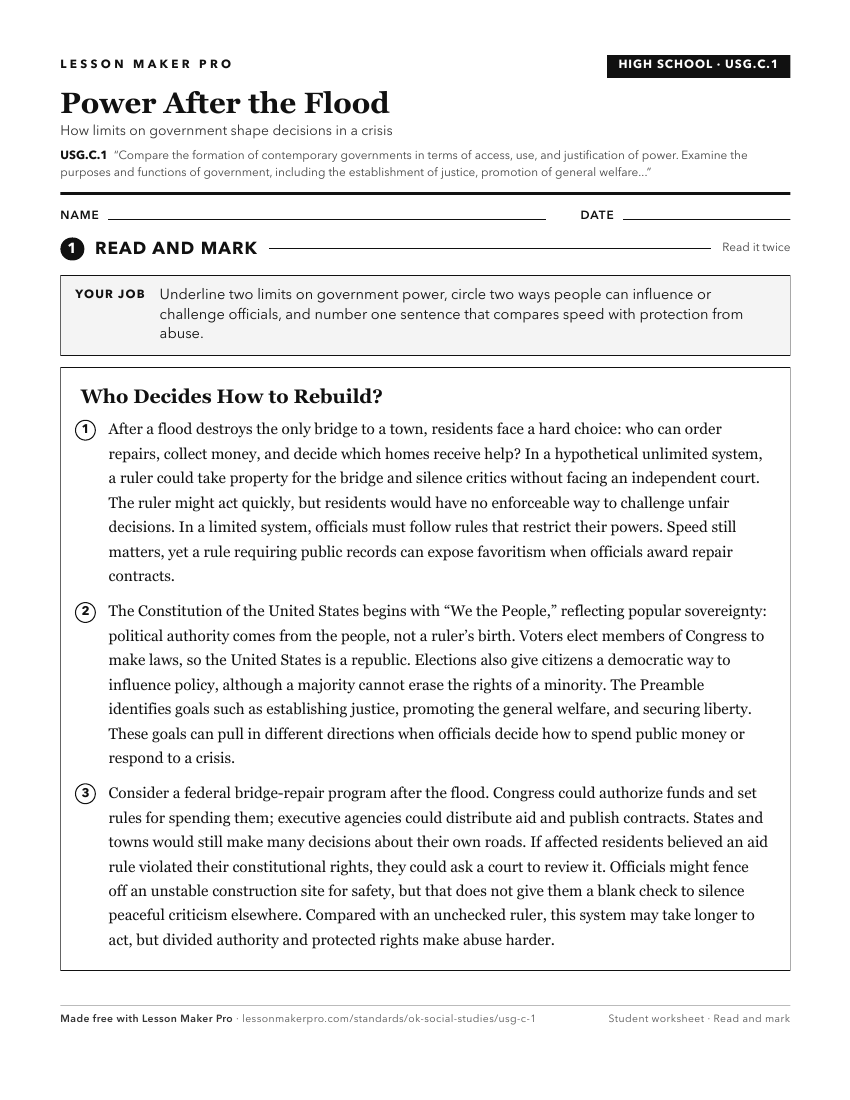
A ready-to-print activity worksheet aligned to USG.C.1, with an answer key for the teacher on its own page. No account needed.
PDF, US Letter, prints cleanly in black and white.
Download the worksheetKeep exploring
Related Standards
- TOT.P.2.1.B
Evaluate the impact of the structure and powers exercised by governmental systems on public policy, using historical and contemporary examples.
- MWH.C.3.1
Compare theories and forms of government regarding sources of authority and legitimacy.
- OKH.P.2.1.B
Evaluate the impact of the structure and powers exercised by governmental systems on public policy, using historical and contemporary examples.
- AWH.P.2.1.B
Evaluate the impact of the structure and powers exercised by governmental systems on public policy, using historical and contemporary examples.
Turn this cluster into a lesson
Grade, subject, topic, and the complete cluster are prefilled. Create one free, no account needed.
Also for this cluster:Make a WorksheetMake a QuizMake a Sub Lesson