Oklahoma Social Studies USG.C.1.4.A
The Standard
- USG.C.1
- Compare the formation of contemporary governments in terms of access, use, and justification of power.
- USG.C.1.4
- Compare the advantages and disadvantages of ways in which governmental power can be distributed.
Describe the structures of unitary, federal, and confederal systems, including contemporary examples of the presidential versus parliamentary systems.
Oklahoma Academic Standards for Social Studies (2026) · USG.C.1.4
Teacher's field guide
What This Standard Means
What Students Need to Do
- Students compare where authority sits in unitary, federal, and confederal systems. They explain how presidents and prime ministers get their jobs, using the U.S. and U.K. as current examples.
What Mastery Looks Like
- A student can explain why the U.S. is federal and presidential, while the U.K. is unitary and parliamentary. They can describe the Articles of Confederation as a confederal system and identify confederal features in the EU without calling it a country.
Common Misconceptions
- Students may think federal always means presidential and unitary always means parliamentary. Some assume unitary countries have no local governments or that the EU is a country.
How to Assess It
- Exit ticket: For the U.S. and U.K., explain where authority sits and how the head of government is chosen. How did the Articles of Confederation divide authority differently?
Lesson moves
Ways to Teach It
Have pairs match four clue cards to the U.S., U.K., Articles of Confederation, and EU, then explain who holds authority in each.
Ask: Could a federal country have a prime minister? Use Germany and the U.S. to defend your answer.
Play four corners with U.S., U.K., Germany, and Articles of Confederation signs; read clues and have students move to the matching sign.
Show recent headlines about the U.K. prime minister and U.S. president; students write how each leader got the job.
Free download
Printable USG.C.1.4.A Worksheet
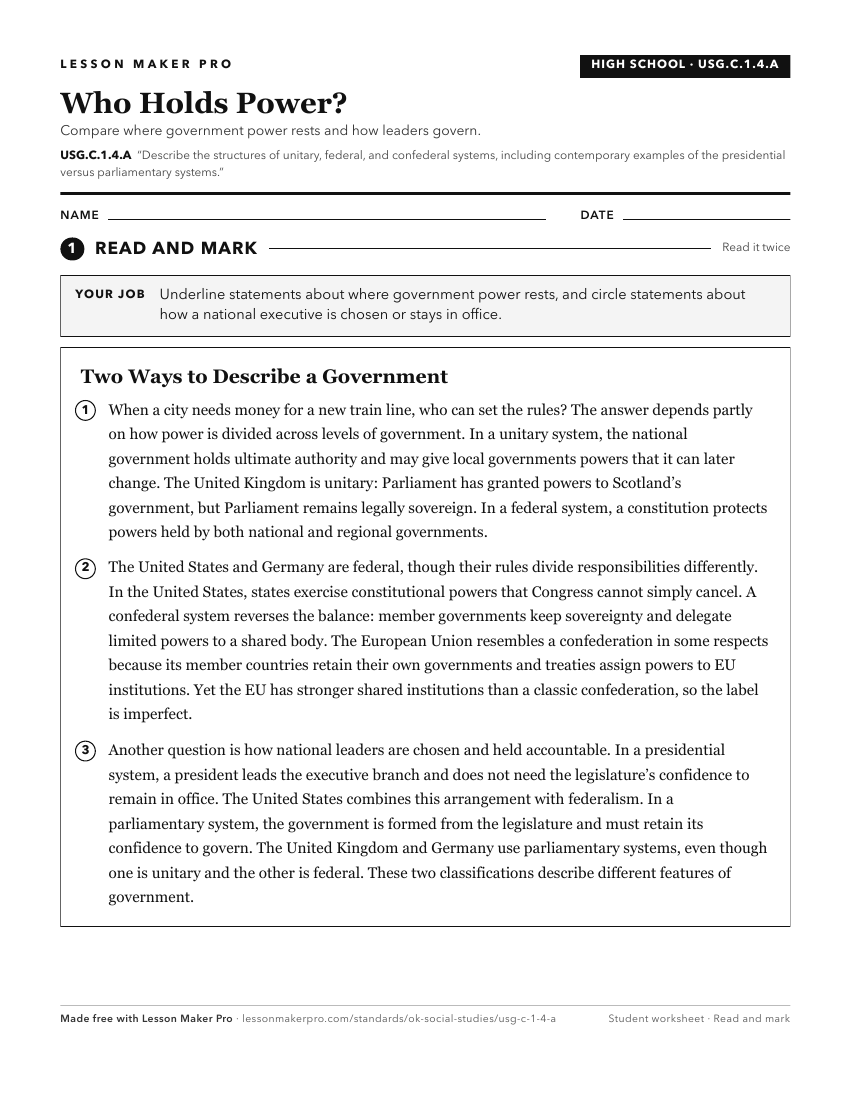
A ready-to-print activity worksheet aligned to USG.C.1.4.A, with an answer key for the teacher on its own page. No account needed.
PDF, US Letter, prints cleanly in black and white.
Download the worksheetKeep exploring
Related Standards
- USG.C.1.2.A
Compare historic and contemporary examples of unlimited systems of governments (e.g., monarchy, oligarchy, theocracy, autocracy) to examples of limited systems ...
- 8.C.4.2.E
Describe the concept of federalism (shared power) and identify specific types of powers (e.g., express, concurrent, reserved) exercised by the state versus nati...
- 8.C.4.2.C
Identify the constitutional powers granted to Congress, the President, and the Supreme Court, using historical and contemporary examples.
- 6.C.5.1
Compare systems of governments.
Turn this exact standard into a lesson
Grade, subject, topic, and the complete standard are prefilled. Create one free, no account needed.
Also for this standard:Make a WorksheetMake a QuizMake a Sub Lesson