Oklahoma Social Studies USG.C.1.5
Standard Cluster
- USG.C.1
- Compare the formation of contemporary governments in terms of access, use, and justification of power.
Examine the role of government in a nation’s economy. Compare the role of government in a market versus command economic systems. Describe the United States of America government’s role in a market system including the promotion of competition, protection of private property and consumer rights, and access to public goods and services. Examine how government policies in a market system can be used to stabilize and stimulate economic growth.
Oklahoma Academic Standards for Social Studies (2026) · USG.C.1
Cluster contents
Standards in This Cluster
USG.C.1.5 is a cluster heading. These are the individual standards under it.
- USG.C.1.5.A
Compare the role of government in a market versus command economic systems.
- USG.C.1.5.B
Describe the United States of America government’s role in a market system including the promotion of competition, protection of private property and consumer r...
- USG.C.1.5.C
Examine how government policies in a market system can be used to stabilize and stimulate economic growth.
Teacher's field guide
What This Cluster Means
What Students Need to Do
- Students compare who decides what gets made and sold in market and command economies. They explain how U.S. government protects competition, property, and consumers, while providing shared services. They connect taxes, spending, and interest rates to efforts to steady or grow the economy.
What Mastery Looks Like
- Given two economies, students can identify who controls production and prices. They can explain why the government might challenge a merger, record property deeds, require food labels, or fund streetlights. They can describe how public spending during a recession might increase jobs and demand.
Common Misconceptions
- Students may think a market economy has no government rules. They may think a command economy leaves every decision to officials. They may also call anything free a public good or assume government spending always creates growth.
How to Assess It
- Exit ticket: In one system, officials set factory output; in another, firms decide output. Name each system, then explain how the U.S. could address a monopoly and a recession.
Lesson moves
Ways to Teach It
Give pairs cards showing state-set output, store-set prices, deed records, and city streetlights; have them sort by economic system and government role.
Have students write whether the government should block a large company from buying its only rival, using prices and choice as evidence.
Read four problems aloud: a monopoly, an unsafe toy, a recession, and unlit roads; teams choose a government response for each.
Bring a local sales tax receipt and city budget page; have students trace a tax payment to a listed public service.
Free download
Printable USG.C.1.5 Worksheet
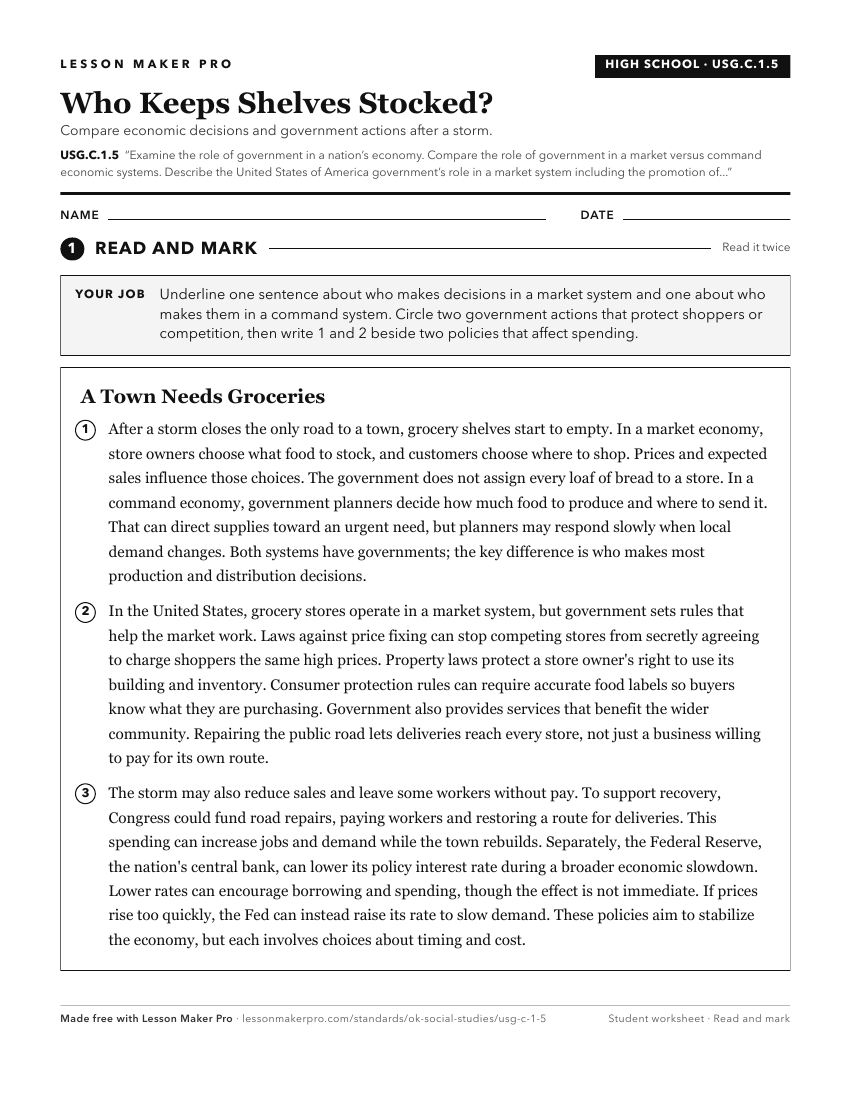
A ready-to-print activity worksheet aligned to USG.C.1.5, with an answer key for the teacher on its own page. No account needed.
PDF, US Letter, prints cleanly in black and white.
Download the worksheetKeep exploring
Related Standards
- USG.C.7.1.D
Examine how the government can influence the stability and growth of the economy through fiscal and monetary policy.
- 6.C.6.2.B
Describe how government policies affect economic activities within a nation, as well as determine trade relationships.
- 7.C.7.6
Analyze the role of government to finance a nation’s development (e.g., infrastructure, social programs, and education).
- E.C.3.5
Evaluate the role of the government within the economy as it relates to defining, establishing, and enforcing property rights.
Turn this cluster into a lesson
Grade, subject, topic, and the complete cluster are prefilled. Create one free, no account needed.
Also for this cluster:Make a WorksheetMake a QuizMake a Sub Lesson