Oklahoma Social Studies USG.C.1.4
Standard Cluster
- USG.C.1
- Compare the formation of contemporary governments in terms of access, use, and justification of power.
Compare the advantages and disadvantages of ways in which governmental power can be distributed. Describe the structures of unitary, federal, and confederal systems, including contemporary examples of the presidential versus parliamentary systems. Compare structural differences in terms of effectiveness, prevention of abusive power, and responsiveness to the popular will.
Oklahoma Academic Standards for Social Studies (2026) · USG.C.1
Cluster contents
Standards in This Cluster
USG.C.1.4 is a cluster heading. These are the individual standards under it.
Teacher's field guide
What This Cluster Means
What Students Need to Do
- Students map which level of government holds power in unitary, federal, and confederal arrangements. They compare how presidents and prime ministers gain and keep office. They explain trade-offs in speed, checks on power, and voter influence.
What Mastery Looks Like
- A student can explain that France holds most authority nationally, the U.S. shares power with states, and EU members give some powers to shared institutions. They can contrast a U.S. president elected separately from Congress with a U.K. prime minister who needs Parliament's support. They can explain why shared power may slow decisions but limit abuse.
Common Misconceptions
- Students may think a unitary country has no local government, or that federal means the national government controls everything. They may call the EU a full confederation or assume every presidential system is federal and every parliamentary system is unitary.
How to Assess It
- Exit ticket: Label the U.S. and France as federal or unitary, and name one confederal feature of the EU. Then explain how a U.K. prime minister can lose office and give one trade-off of shared power.
Lesson moves
Ways to Teach It
Give groups France, U.S., and EU cards; have them draw arrows showing where national, state, and member governments get their authority.
Ask students to write: Which could respond to a flood faster, centralized or shared power, and which better limits abuse?
Play a sorting relay with U.S. president and U.K. prime minister cards showing how each takes office and can be removed.
Hand out excerpts from U.S. state and French national education websites; students highlight who sets school policies in each place.
Free download
Printable USG.C.1.4 Worksheet
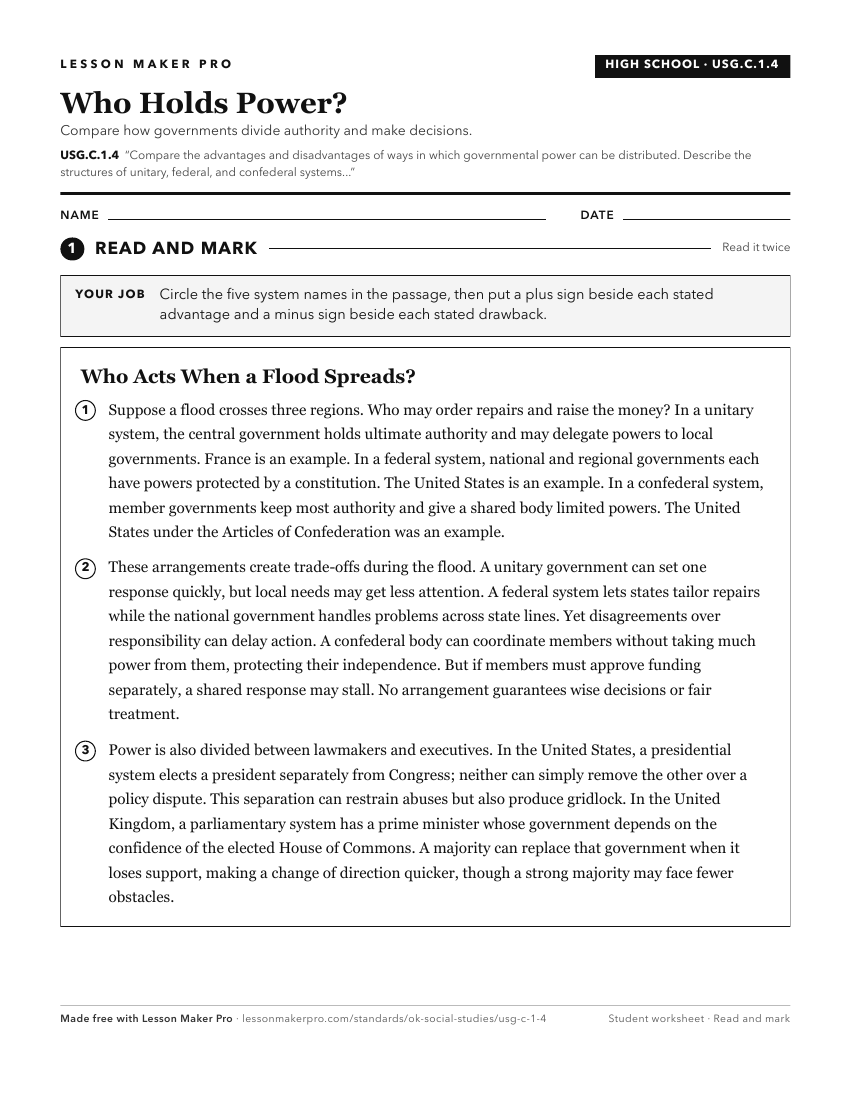
A ready-to-print activity worksheet aligned to USG.C.1.4, with an answer key for the teacher on its own page. No account needed.
PDF, US Letter, prints cleanly in black and white.
Download the worksheetKeep exploring
Related Standards
- USG.C.1.2
Analyze the essential characteristics of limited versus unlimited systems of government.
- 6.C.5.1
Compare systems of governments.
- USG.C.1
Compare the formation of contemporary governments in terms of access, use, and justification of power.
- WG.C.4.2
Compare the world’s political systems of government, based on limited versus unlimited authority, including the rights and opportunities of citizens within each...
Turn this cluster into a lesson
Grade, subject, topic, and the complete cluster are prefilled. Create one free, no account needed.
Also for this cluster:Make a WorksheetMake a QuizMake a Sub Lesson