Oklahoma Social Studies USG.C.1.2
Standard Cluster
- USG.C.1
- Compare the formation of contemporary governments in terms of access, use, and justification of power.
Analyze the essential characteristics of limited versus unlimited systems of government. Compare historic and contemporary examples of unlimited systems of governments (e.g., monarchy, oligarchy, theocracy, autocracy) to examples of limited systems (e.g., direct democracy, constitutional republic, constitutional monarchy). Describe common characteristics of representative democracies (e.g., idea of natural rights and liberties, the rule of law, equality of all citizens under the law, majority rule with minority rights, the necessity of compromise).
Oklahoma Academic Standards for Social Studies (2026) · USG.C.1
Cluster contents
Standards in This Cluster
USG.C.1.2 is a cluster heading. These are the individual standards under it.
- USG.C.1.2.A
Compare historic and contemporary examples of unlimited systems of governments (e.g., monarchy, oligarchy, theocracy, autocracy) to examples of limited systems ...
- USG.C.1.2.B
Describe common characteristics of representative democracies (e.g., idea of natural rights and liberties, the rule of law, equality of all citizens under the l...
Teacher's field guide
What This Cluster Means
What Students Need to Do
- Students compare who holds power, who can check leaders, and what rights the law protects. They use those facts to sort past and present governments by how much power rulers have. They explain how representative governments use majority rule while protecting rights and making room for compromise.
What Mastery Looks Like
- Given descriptions of Louis XIV's France and today's United Kingdom, a student can identify which ruler faces more limits and cite a check on power. They can explain why elected leaders must obey the law and why a majority cannot vote away protected rights. They can suggest a compromise that still protects a dissenting group.
Common Misconceptions
- Students may assume every monarchy gives the ruler unlimited power. They may think elections alone make a government limited, or that a majority vote can remove minority rights. Some mistake compromise for giving up legal protections.
How to Assess It
- Exit ticket: The UK monarch cannot make laws alone; Saudi Arabia's king holds broad executive power. Which ruler faces more limits, and what evidence supports your answer? Explain why a majority vote cannot remove a protected minority right.
Lesson moves
Ways to Teach It
Sort cards describing Louis XIV's France, today's Saudi Arabia, the United Kingdom, and the United States; circle the checks on each leader.
Ask: A class votes to ban one student's club. Should the vote stand? Explain using majority rule and minority rights.
Play Power Check: read short government scenarios, then have teams hold up limited or unlimited cards and name one clue.
Read a city council agenda, find a proposed rule, and identify how residents can speak against it before council members vote.
Free download
Printable USG.C.1.2 Worksheet
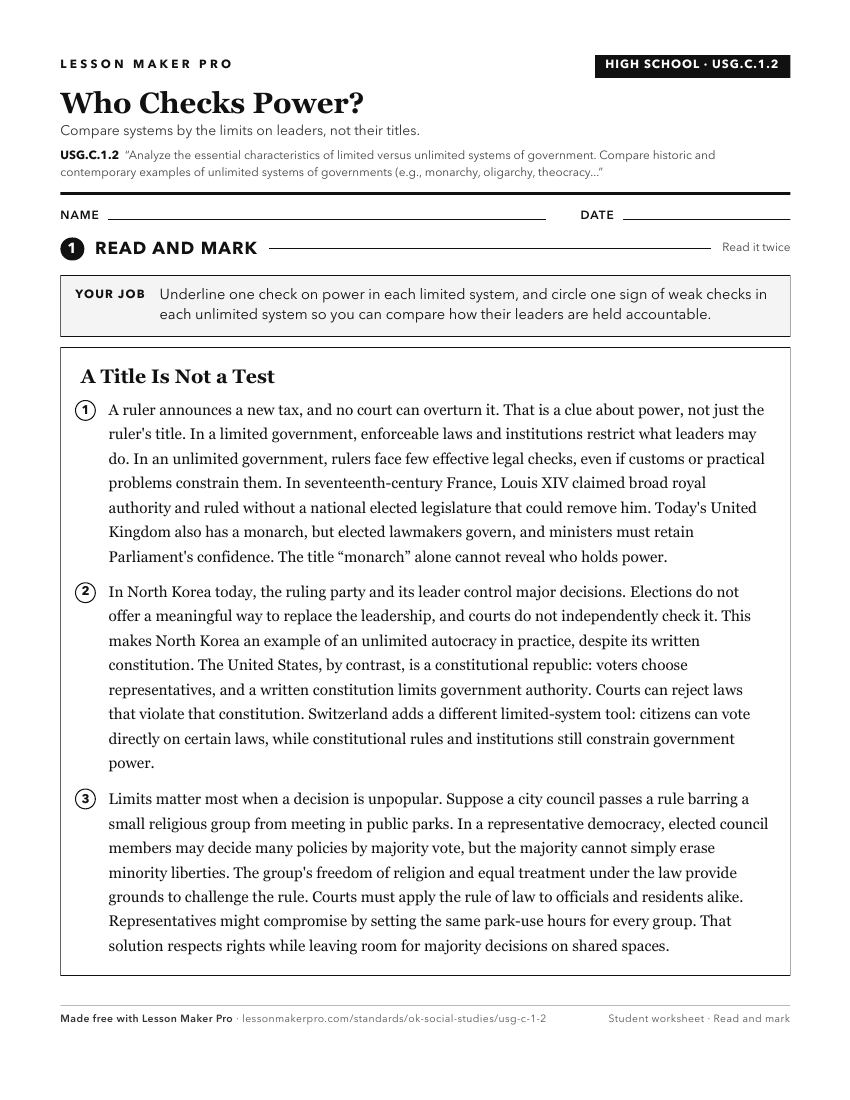
A ready-to-print activity worksheet aligned to USG.C.1.2, with an answer key for the teacher on its own page. No account needed.
PDF, US Letter, prints cleanly in black and white.
Download the worksheetKeep exploring
Related Standards
- MWH.C.3.1.A
Distinguish between limited and unlimited forms of government, including the role of the citizen and the concept of individual liberty.
- 6.C.5.1.A
Define and describe the characteristics of limited governments (constitutional republic, constitutional monarchy) and authoritarian systems (dictatorship, oliga...
- WG.C.4.2
Compare the world’s political systems of government, based on limited versus unlimited authority, including the rights and opportunities of citizens within each...
Turn this cluster into a lesson
Grade, subject, topic, and the complete cluster are prefilled. Create one free, no account needed.
Also for this cluster:Make a WorksheetMake a QuizMake a Sub Lesson