Oklahoma Social Studies MWH.C.3.1.A
The Standard
- MWH.C.3
- Analyze developments in politics, science, and philosophy contributing to human advancement and the rise of modern institutions of self-government.
- MWH.C.3.1
- Compare theories and forms of government regarding sources of authority and legitimacy.
Distinguish between limited and unlimited forms of government, including the role of the citizen and the concept of individual liberty.
Oklahoma Academic Standards for Social Studies (2026) · MWH.C.3.1
Teacher's field guide
What This Standard Means
What Students Need to Do
- Students decide whether laws and other institutions can check a ruler’s power. They explain what citizens can do when they disagree with leaders and which freedoms the government must respect.
What Mastery Looks Like
- Given a short case, a student can name a check on the ruler or explain why no check exists. They can connect that difference to a citizen’s ability to speak, petition, or challenge an arrest.
Common Misconceptions
- Students may think a limited government is weak or that an unlimited government has no laws. They may assume every king had unlimited power, or that everyone in a limited government could vote.
How to Assess It
- Give an exit ticket: “A ruler taxes without lawmakers’ approval and jails people who criticize her. Is her power limited or unlimited? Explain what citizens can do and which liberty is at risk.”
Lesson moves
Ways to Teach It
Give pairs cards showing Parliament approving taxes, a ruler setting taxes alone, citizens petitioning, and critics being jailed; sort by checks on power.
Ask students to write: In 1689 England, Parliament checked the monarch, but many people could not vote. Whose voice was missing?
Play L or U: read cases about a rejected tax, jailed critics, a blocked arrest, and banned petitions; students show cards and explain.
Read a local city council agenda; find where residents can comment, then explain how that channel lets them challenge officials.
Free download
Printable MWH.C.3.1.A Worksheet
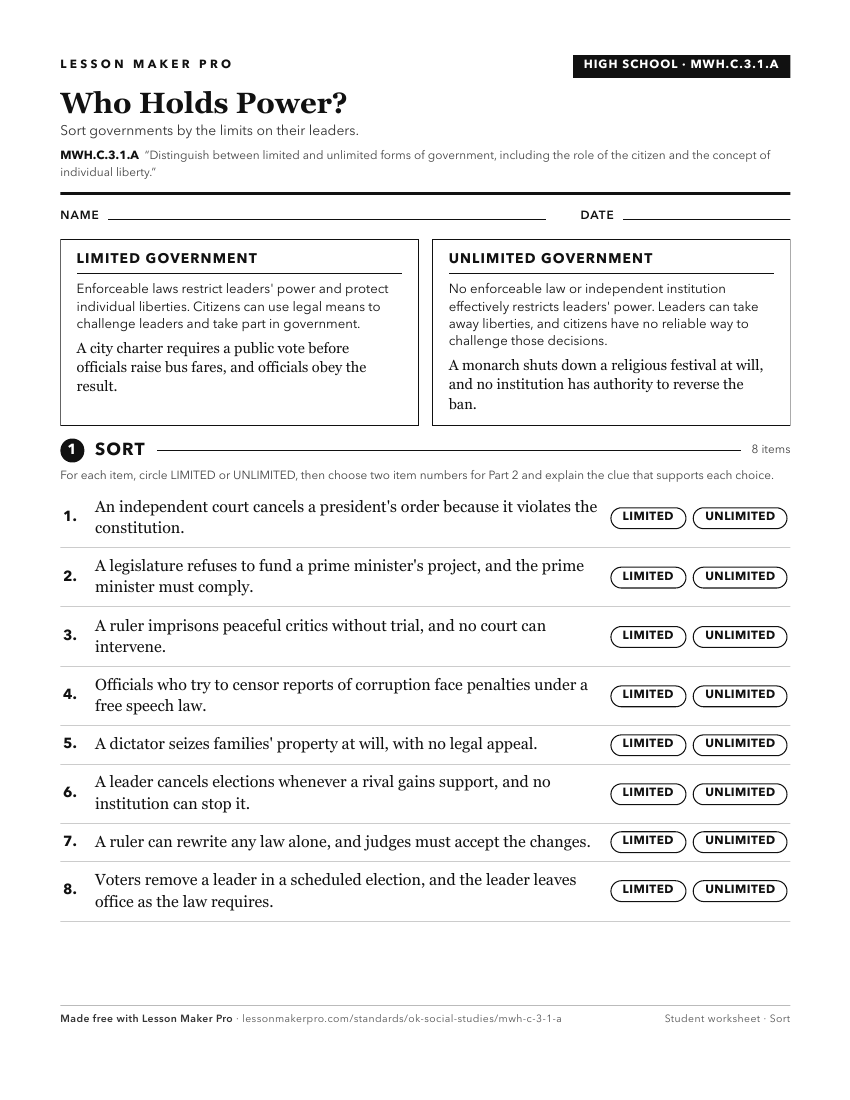
A ready-to-print activity worksheet aligned to MWH.C.3.1.A, with an answer key for the teacher on its own page. No account needed.
PDF, US Letter, prints cleanly in black and white.
Download the worksheetKeep exploring
Related Standards
- USG.C.1.2
Analyze the essential characteristics of limited versus unlimited systems of government.
- 6.C.5.1.A
Define and describe the characteristics of limited governments (constitutional republic, constitutional monarchy) and authoritarian systems (dictatorship, oliga...
- USG.C.1.2.A
Compare historic and contemporary examples of unlimited systems of governments (e.g., monarchy, oligarchy, theocracy, autocracy) to examples of limited systems ...
- WG.C.4.2
Compare the world’s political systems of government, based on limited versus unlimited authority, including the rights and opportunities of citizens within each...
Turn this exact standard into a lesson
Grade, subject, topic, and the complete standard are prefilled. Create one free, no account needed.
Also for this standard:Make a WorksheetMake a QuizMake a Sub Lesson