Oklahoma Social Studies 3.C.3.1.E
The Standard
- 3.C.3
- Analyze the significant historical events and people contributing to the development of Oklahoma.
- 3.C.3.1
- Examine the state’s earliest peoples and the significance of their interactions.
Explain that today Oklahoma is the home to thirty-nine American Indian Nations with unique traditions and ways of life, by comparing Tribal cultures.
Oklahoma Academic Standards for Social Studies (2026) · 3.C.3.1
Teacher's field guide
What This Standard Means
What Students Need to Do
- Students name two of Oklahoma’s 39 Tribal Nations. They use information from each Nation to compare traditions people practice today.
What Mastery Looks Like
- A student uses a page from the Cherokee Nation and a page from the Chickasaw Nation to name one similarity and one difference. They describe both as living communities with distinct traditions.
Common Misconceptions
- Students may treat all Tribal Nations as one group with the same language and customs. They may also talk about traditions only in the past.
How to Assess It
- Give students one printed page from each Nation. Ask them to name one similarity and one difference, using a detail from each page.
Lesson moves
Ways to Teach It
Give pairs printed culture pages from the Cherokee Nation and Chickasaw Nation, then have them sort facts into two labeled columns and a shared column.
Ask: What do these Nations share, and what is different? Have students support each answer with a detail from the printed pages.
Read six facts from the printed pages; students hold up Cherokee Nation, Chickasaw Nation, or Both cards.
Mark Tahlequah and Ada on an Oklahoma map, then label the Cherokee Nation and Chickasaw Nation headquarters in those cities.
Free download
Printable 3.C.3.1.E Worksheet
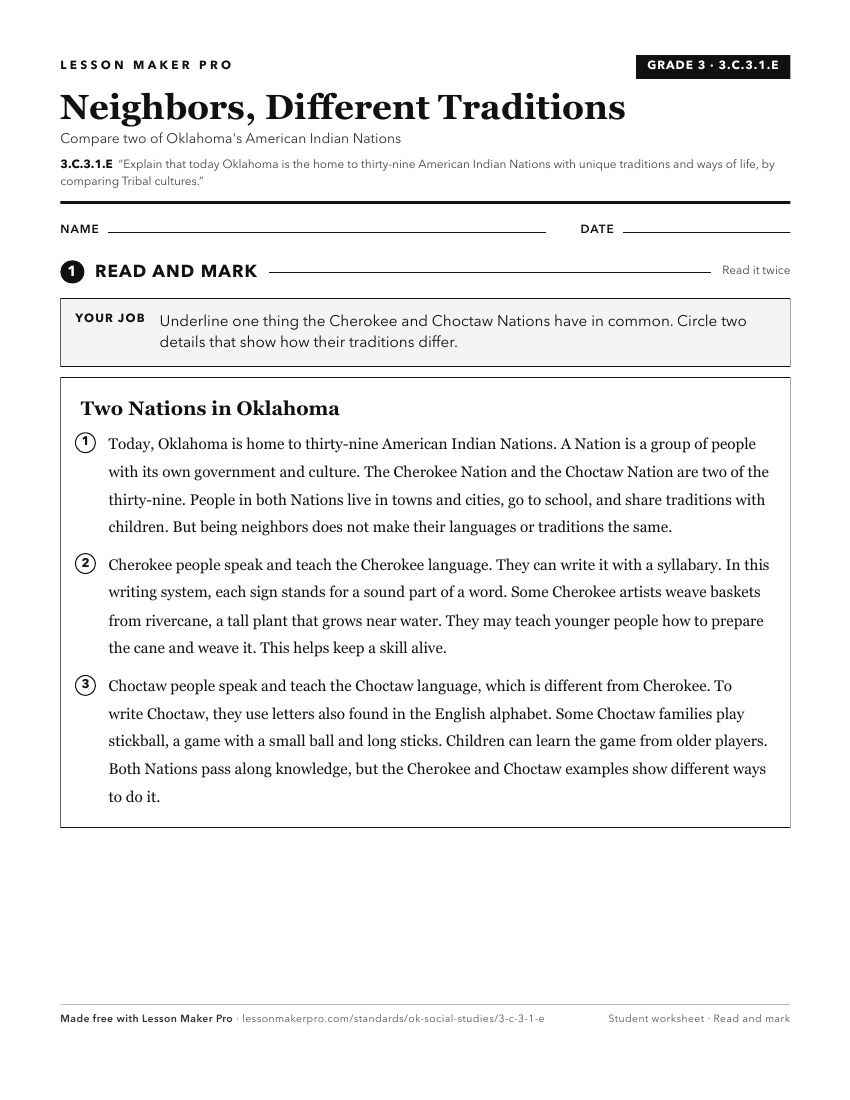
A ready-to-print activity worksheet aligned to 3.C.3.1.E, with an answer key for the teacher on its own page. No account needed.
PDF, US Letter, prints cleanly in black and white.
Download the worksheetKeep exploring
Related Standards
- USH.C.4.3.F
Explain how the Indian Reorganization Act intended to reverse federal policy by restoring lands to Tribal trust status and endorsing Tribal constitutions, which...
- OKH.C.8.3
Analyze the historical and contemporary relationship between the State of Oklahoma and Oklahoma’s thirty-nine federally recognized Tribal governments.
- 3.C.1.3
Explain how Oklahomans are united through our heritage, state symbols, and special commemorations that reflect common ideals.
- 1.C.2.5
Explain how American Indians lived in environments and communities of their original homelands and thrive in Tribal communities today.
Turn this exact standard into a lesson
Grade, subject, topic, and the complete standard are prefilled. Create one free, no account needed.
Also for this standard:Make a WorksheetMake a QuizMake a Sub Lesson