Oklahoma Social Studies 4.C.3.1
Standard Cluster
- 4.C.3
- Analyze how geography has impacted cultures and interactions during the early history of our nation.
Examine the various American Indian cultures inhabiting the nation prior to European explorations. Explain that North America is the home to well-developed societies and cultures (e.g., Inuit, Puebloan, Mississippian, Haudenosaunee) who flourished prior to European arrival. Describe American Indian groups and compare cultural characteristics (e.g., use of natural resources, food, shelter, customs) according to the geographic location of their original homelands (e.g., Eastern Woodlands, Southeast, Great Plains, Southwest, Great Basin, California, Northwest Coast). Explain how museums, national parks, and heritage centers attempt to preserve American Indian cultural heritage (e.g., Mesa Verde, Cahokia Mounds, Chaco Canyon).
Oklahoma Academic Standards for Social Studies (2026) · 4.C.3
Cluster contents
Standards in This Cluster
4.C.3.1 is a cluster heading. These are the individual standards under it.
- 4.C.3.1.A
Explain that North America is the home to well-developed societies and cultures (e.g., Inuit, Puebloan, Mississippian, Haudenosaunee) who flourished prior to Eu...
- 4.C.3.1.B
Describe American Indian groups and compare cultural characteristics (e.g., use of natural resources, food, shelter, customs) according to the geographic locati...
- 4.C.3.1.C
Explain how museums, national parks, and heritage centers attempt to preserve American Indian cultural heritage (e.g., Mesa Verde, Cahokia Mounds, Chaco Canyon)...
Teacher's field guide
What This Cluster Means
What Students Need to Do
- Students locate several American Indian homelands on a map. They explain how people used local resources for food and homes before Europeans arrived. They also describe how parks and museums protect sites and objects, while Native communities keep traditions alive.
What Mastery Looks Like
- A student can place Haudenosaunee communities in the Eastern Woodlands and ancestral Pueblo communities in the Southwest. They can explain why bark was used for longhouses and stone or adobe for pueblo homes. They can describe how Chaco Canyon protects buildings with guidance from descendant Pueblo communities.
Common Misconceptions
- Students may picture every group living in tipis and hunting buffalo. They may think these societies were simple or that their descendants no longer exist. They may think saving buildings alone preserves a culture, without Native people guiding how sites are cared for.
How to Assess It
- Exit ticket: Compare a Haudenosaunee home with an ancestral Pueblo home, using each homeland to explain the building materials. Name one way Chaco Canyon's park protects heritage.
Lesson moves
Ways to Teach It
Use paper strips and clay to model a Haudenosaunee longhouse and an ancestral Pueblo home; label each homeland and building material.
Show forest and desert photos, then ask students to write why builders might choose bark in one place and stone or adobe in another.
Run a card match with photos of longhouses, pueblos, and Cahokia's earthen mounds; students pair each with a homeland and explain their clues.
Show a Chaco Canyon photo and a stay-on-trail sign; students explain how the rule helps protect the site.
Free download
Printable 4.C.3.1 Worksheet
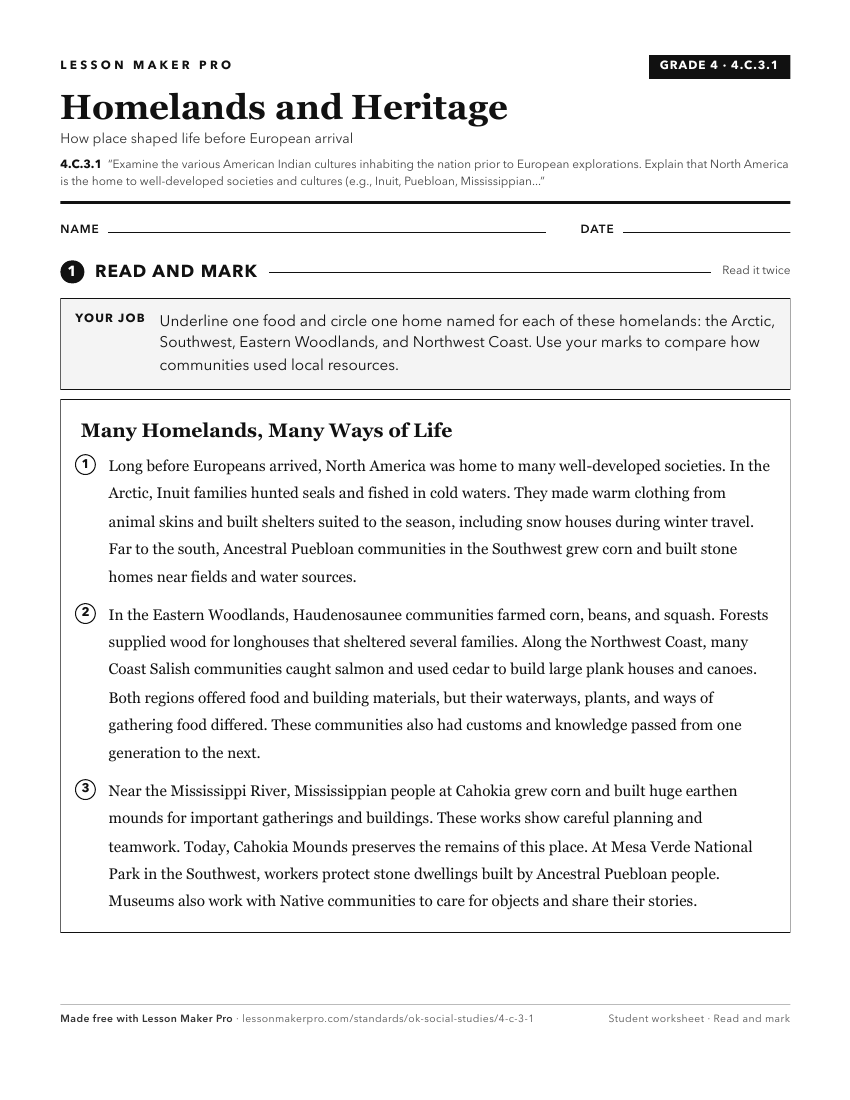
A ready-to-print activity worksheet aligned to 4.C.3.1, with an answer key for the teacher on its own page. No account needed.
PDF, US Letter, prints cleanly in black and white.
Download the worksheetKeep exploring
Related Standards
- 6.C.3.5.B
Compare the cultures of Native peoples of the United States of America and Canada (e.g., Ancestral Puebloan, Mississippian, First Nations, Inuit, Metis).
- OKH.C.6.2
Examine government policies impacting American Indian identity, culture, economy, Tribal government, and sovereignty.
- OKH.C.1.6
Compare cultural perspectives of American Indians and settlers regarding land ownership, social structures (e.g., matrilineal vs. patrilineal), religion, spirit...
- 3.C.3.1
Examine the state’s earliest peoples and the significance of their interactions.
Turn this cluster into a lesson
Grade, subject, topic, and the complete cluster are prefilled. Create one free, no account needed.
Also for this cluster:Make a WorksheetMake a QuizMake a Sub Lesson