Oklahoma Social Studies 4.C.3.1.B
The Standard
- 4.C.3
- Analyze how geography has impacted cultures and interactions during the early history of our nation.
- 4.C.3.1
- Examine the various American Indian cultures inhabiting the nation prior to European explorations.
Describe American Indian groups and compare cultural characteristics (e.g., use of natural resources, food, shelter, customs) according to the geographic location of their original homelands (e.g., Eastern Woodlands, Southeast, Great Plains, Southwest, Great Basin, California, Northwest Coast).
Oklahoma Academic Standards for Social Studies (2026) · 4.C.3.1
Teacher's field guide
What This Standard Means
What Students Need to Do
- Students locate the original homelands of named American Indian peoples on a map. They compare foods, homes, and customs, and connect some differences to local resources.
What Mastery Looks Like
- A student can place the Hopi in the Southwest and the Tlingit on the Northwest Coast. They can compare Hopi corn farming and stone pueblos with Tlingit salmon fishing and cedar plank houses, using map clues to explain the differences.
Common Misconceptions
- Students may think all American Indian peoples lived in tipis or ate the same foods. They may think a historical homeland map shows the only places these peoples live today. Some may assume geography explains every custom.
How to Assess It
- On a blank map, mark the Hopi and Tlingit homelands. Name one food and one type of home for each, then use a map clue to explain one difference.
Lesson moves
Ways to Teach It
Give pairs a map and cards showing Hopi corn fields and stone pueblos, and Tlingit salmon and cedar plank houses; have them place and explain each card.
Ask students to write: Why were corn farming and salmon fishing useful in these two homelands? Use one map clue for each.
Play a matching game with homeland, resource, food, and home cards; require students to explain each completed set.
Use a grocery ad to find corn and salmon, then discuss how Hopi farming and Tlingit fishing connected to their homelands.
Free download
Printable 4.C.3.1.B Worksheet
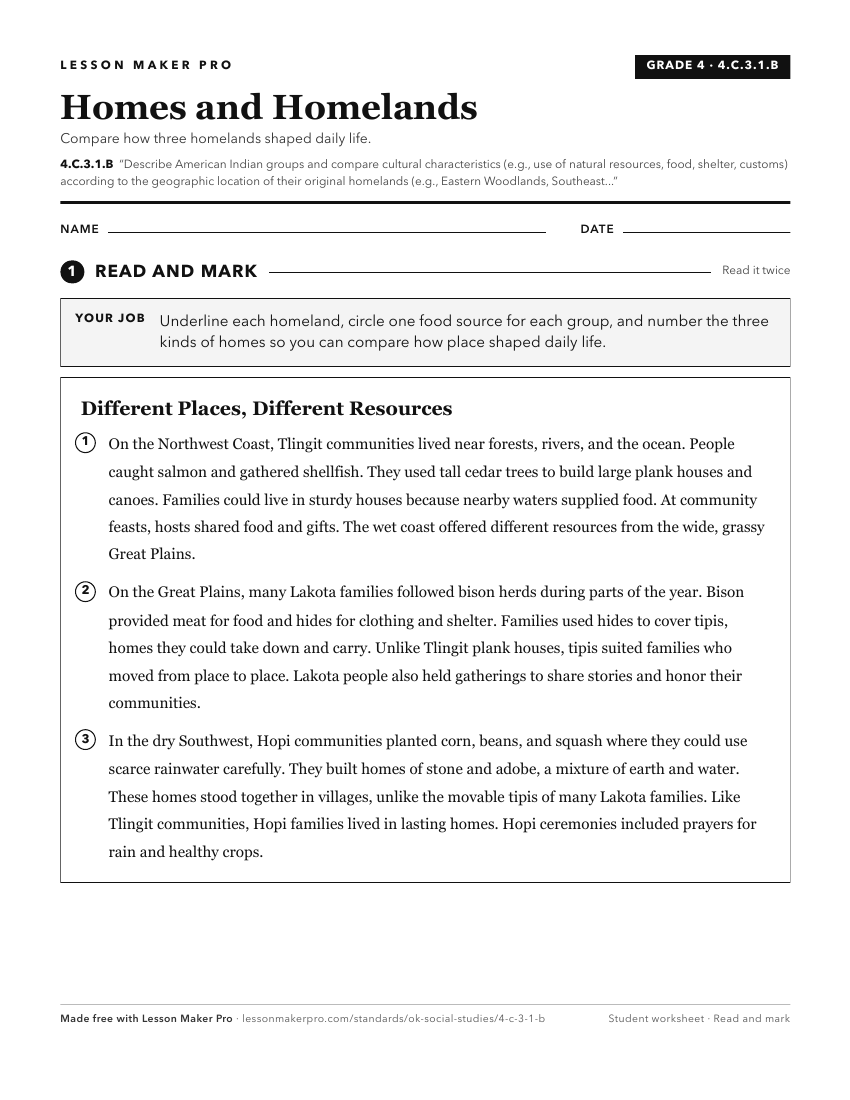
A ready-to-print activity worksheet aligned to 4.C.3.1.B, with an answer key for the teacher on its own page. No account needed.
PDF, US Letter, prints cleanly in black and white.
Download the worksheetKeep exploring
Related Standards
- 6.C.3.5.B
Compare the cultures of Native peoples of the United States of America and Canada (e.g., Ancestral Puebloan, Mississippian, First Nations, Inuit, Metis).
- 4.C.3.1
Examine the various American Indian cultures inhabiting the nation prior to European explorations.
- OKH.C.1.6
Compare cultural perspectives of American Indians and settlers regarding land ownership, social structures (e.g., matrilineal vs. patrilineal), religion, spirit...
- 4.C.2.4.A
Identify the characteristics of culture (e.g., language, customs, religious beliefs, food, clothing, shelter) and compare cultural characteristics of different ...
Turn this exact standard into a lesson
Grade, subject, topic, and the complete standard are prefilled. Create one free, no account needed.
Also for this standard:Make a WorksheetMake a QuizMake a Sub Lesson