Oklahoma Social Studies 4.C.2.4.A
The Standard
- 4.C.2
- Apply the tools and concepts of geography to examine the physical and human geography of the United States of America.
- 4.C.2.4
- Examine the concept of culture, including the distribution and complexity of major cultural groups of the United States of America.
Identify the characteristics of culture (e.g., language, customs, religious beliefs, food, clothing, shelter) and compare cultural characteristics of different regions, including the influence of Native peoples and immigrants to each region and how they contribute to a shared American culture.
Oklahoma Academic Standards for Social Studies (2026) · 4.C.2.4
Teacher's field guide
What This Standard Means
What Students Need to Do
- Students identify features of culture, such as language, food, homes, customs, clothing, and beliefs. They compare two U.S. regions and explain how Native peoples and immigrants have shaped life in each region and across the country.
What Mastery Looks Like
- A student can place Pueblo and Mexican immigrant examples in the Southwest, and Haudenosaunee and Italian immigrant examples in the Northeast. They can compare a feature, such as food, and explain how one tradition is enjoyed beyond its original community.
Common Misconceptions
- Students may treat all Native nations as one culture or assume everyone in a region follows the same customs. Some think culture means only food and holidays, or that immigrant traditions replaced Native traditions.
How to Assess It
- Exit ticket: Use the four photo cards to name one Native nation and one immigrant community in each region. Compare one food tradition between the regions and explain how one is shared beyond its community.
Lesson moves
Ways to Teach It
Sort four labeled photo cards onto Southwest and Northeast maps: Pueblo blue corn dishes, Mexican immigrant tortilla recipes, Haudenosaunee maple syrup, Italian immigrant pasta recipes.
Ask: How do Pueblo blue corn dishes and Haudenosaunee maple gathering show different ways communities use local plants?
Play a card match with Pueblo adobe homes, historic Haudenosaunee longhouses, and Spanish and Italian language cards; match each to its community.
Find tortillas and maple syrup in a grocery flyer; label the linked communities and explain why people outside those communities buy them.
Free download
Printable 4.C.2.4.A Worksheet
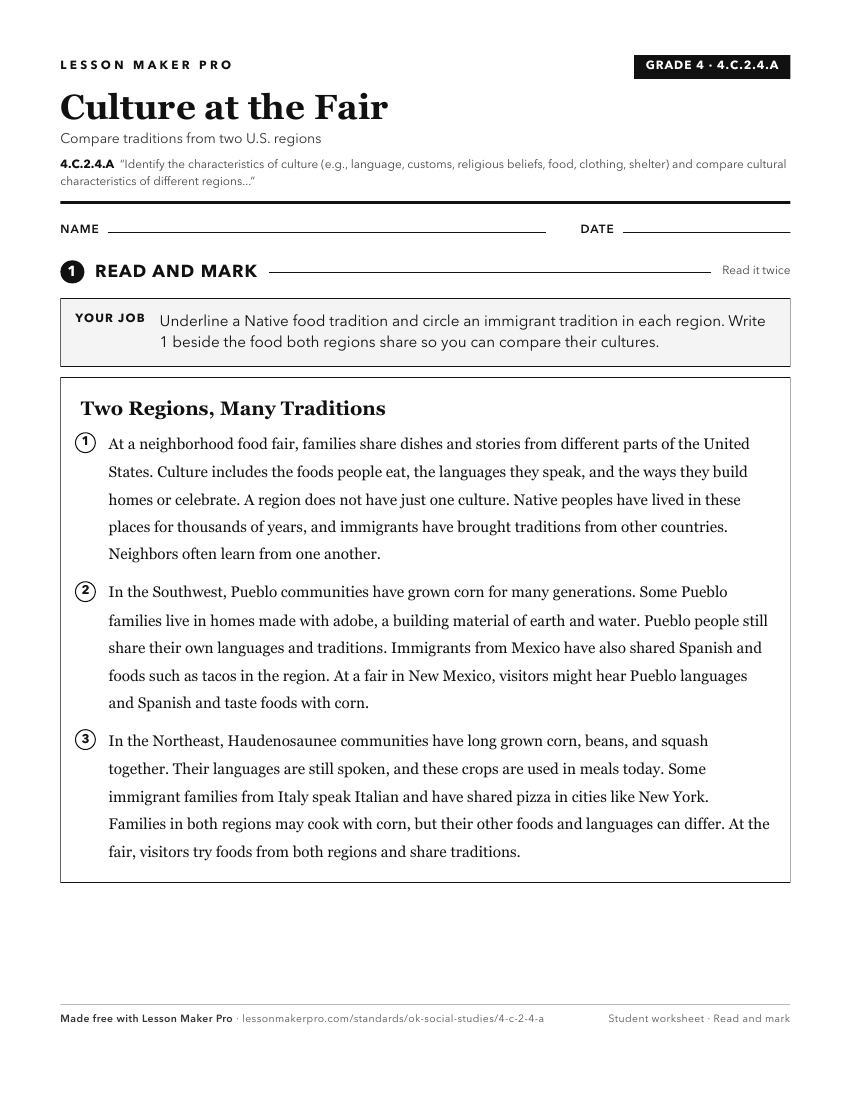
A ready-to-print activity worksheet aligned to 4.C.2.4.A, with an answer key for the teacher on its own page. No account needed.
PDF, US Letter, prints cleanly in black and white.
Download the worksheetKeep exploring
Related Standards
- 2.C.3.10
Examine cultural traits of families and communities, understanding that while culture makes us unique all cultures share common features (e.g., language, custom...
- 6.C.7.3
Identify examples of man-made regions sharing common characteristics related to culture, human settlement, history, economic activities, and governments (e.g., ...
- 4.C.3.1.B
Describe American Indian groups and compare cultural characteristics (e.g., use of natural resources, food, shelter, customs) according to the geographic locati...
- 6.C.3.2.A
Identify and describe cultural traits (e.g., language, ethnic heritage, religion, traditions, the arts) which are unique to a people and region.
Turn this exact standard into a lesson
Grade, subject, topic, and the complete standard are prefilled. Create one free, no account needed.
Also for this standard:Make a WorksheetMake a QuizMake a Sub Lesson