Oklahoma Social Studies 6.C.3.2.A
The Standard
- 6.C.3
- Identify the characteristics, distribution, and demographic patterns of human populations and systems of the Western Hemisphere.
- 6.C.3.2
- Analyze how the characteristics of culture impact people and places.
Identify and describe cultural traits (e.g., language, ethnic heritage, religion, traditions, the arts) which are unique to a people and region.
Oklahoma Academic Standards for Social Studies (2026) · 6.C.3.2
Teacher's field guide
What This Standard Means
What Students Need to Do
- Students use maps, photos, and short accounts to identify cultural traits such as language, arts, and traditions. They describe a trait using evidence and connect it to a particular people and region.
What Mastery Looks Like
- A student can use a map and a photo to explain how Diné language and weaving are connected to the Navajo Nation. They do not assume every Diné person weaves or speaks the language.
Common Misconceptions
- Students may confuse language with ancestry, or assume everyone in a region follows the same traditions. They may also think weaving belongs to only one people.
How to Assess It
- Show a map of the Navajo Nation and photos of a Diné-language sign and a captioned Diné rug. Ask students to name two cultural traits and describe one using a detail from a photo.
Lesson moves
Ways to Teach It
Give pairs a Navajo Nation map, a Diné-language sign photo, and a Diné weaving photo; have them label the cultural traits shown.
Ask: What do the sign and weaving show about Diné culture, and why would it be wrong to say every Diné person weaves?
Give students three cards about Diné language, weaving, and the Navajo Nation Fair; have them match each to language, arts, or traditions.
Compare the Diné-language sign with a photo of a bilingual street sign; have students explain what each reveals about language in a place.
Free download
Printable 6.C.3.2.A Worksheet
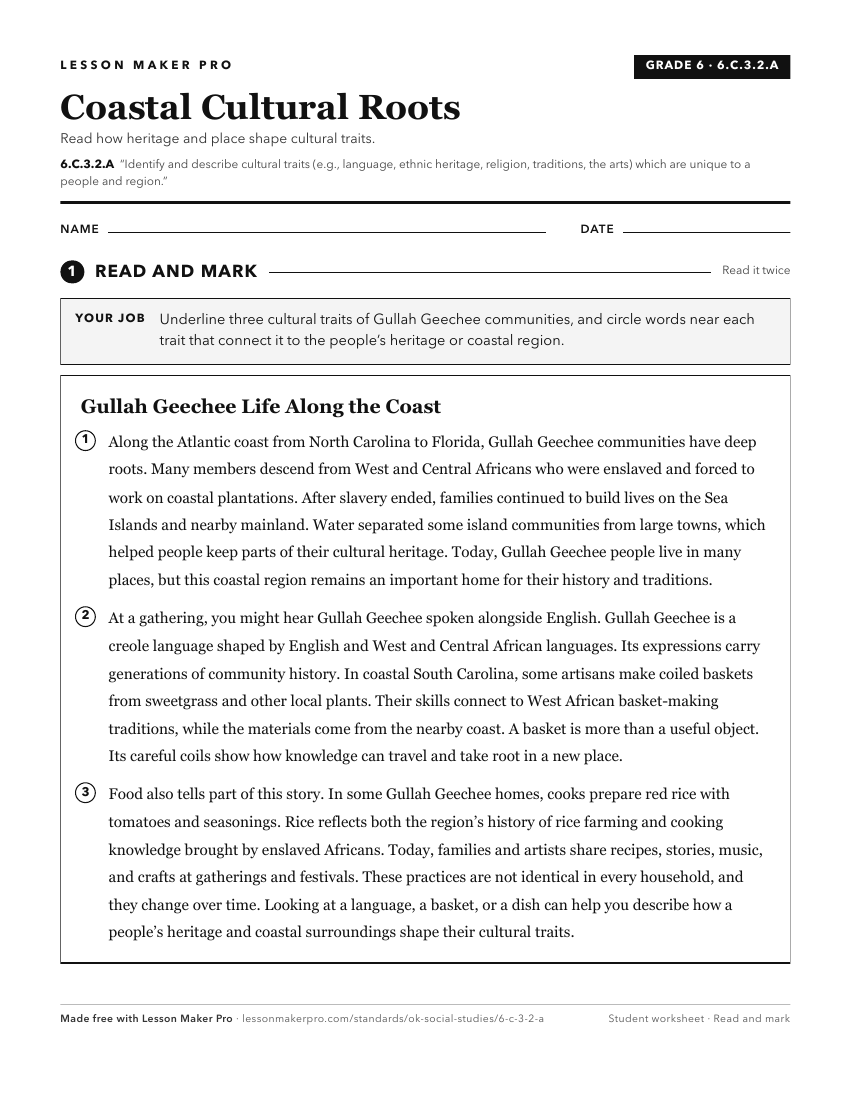
A ready-to-print activity worksheet aligned to 6.C.3.2.A, with an answer key for the teacher on its own page. No account needed.
PDF, US Letter, prints cleanly in black and white.
Download the worksheetKeep exploring
Related Standards
- 2.C.3.10
Examine cultural traits of families and communities, understanding that while culture makes us unique all cultures share common features (e.g., language, custom...
- 1.C.3.10
Define culture and identify the elements of culture (e.g., language, customs, religion, food, clothing), using examples relevant to student experiences.
- 4.C.2.4.A
Identify the characteristics of culture (e.g., language, customs, religious beliefs, food, clothing, shelter) and compare cultural characteristics of different ...
- 7.C.5.2
Define and describe the legacy of the world’s major cultural hearths on a region’s ethnic heritage and history.
Turn this exact standard into a lesson
Grade, subject, topic, and the complete standard are prefilled. Create one free, no account needed.
Also for this standard:Make a WorksheetMake a QuizMake a Sub Lesson