Oklahoma Social Studies 7.C.5.2
Standard Cluster
- 7.C.5
- Evaluate the development and impact of culture on the major regions and peoples of the Eastern Hemisphere.
Define and describe the legacy of the world’s major cultural hearths on a region’s ethnic heritage and history. Examine how and why major cultural hearths developed along major river valleys and crossroads of trade (e.g., Mesopotamia's Fertile Crescent; the Nile, Indus, Huang He and Yangtze River Valleys; the kingdoms of Ghana, Mali, and Songhai). Explain that complex societies and civilizations in different regions share common characteristics (e.g., agricultural innovations, written language, and early systems of law and government).
Oklahoma Academic Standards for Social Studies (2026) · 7.C.5
Cluster contents
Standards in This Cluster
7.C.5.2 is a cluster heading. These are the individual standards under it.
- 7.C.5.2.A
Examine how and why major cultural hearths developed along major river valleys and crossroads of trade (e.g., Mesopotamia's Fertile Crescent; the Nile, Indus, H...
- 7.C.5.2.B
Explain that complex societies and civilizations in different regions share common characteristics (e.g., agricultural innovations, written language, and early ...
Teacher's field guide
What This Cluster Means
What Students Need to Do
- Students locate early cultural centers on a map. They explain how rivers and trade helped societies grow, compare features such as farming and government, and trace lasting cultural influences.
What Mastery Looks Like
- A student can explain how Nile floods helped farming and how trade routes helped Mali grow. They can name a feature both societies shared and describe a lasting influence, such as Islam in West Africa.
Common Misconceptions
- Students may think every early society grew beside a river, or that water alone made a society grow. They may assume all societies had the same laws and writing, or that trade erased local cultures.
How to Assess It
- Give students a map marking the Nile valley and medieval Mali. Ask them to name one growth advantage for each place, one feature the societies shared, and one lasting cultural influence of trade.
Lesson moves
Ways to Teach It
Give pairs a blank map and blue yarn to trace the Nile and Niger, then place paper towns where water meets trade routes.
Ask students to write: Why did Mali grow near the Niger and trade routes, and how did those links shape West African cultures?
Give pairs place, feature, and evidence cards, such as Mesopotamia, irrigation, and canals; award a point for each justified set.
Show a photo of Timbuktu's preserved manuscripts and ask how trade shaped written records that people in Mali protect today.
Free download
Printable 7.C.5.2 Worksheet
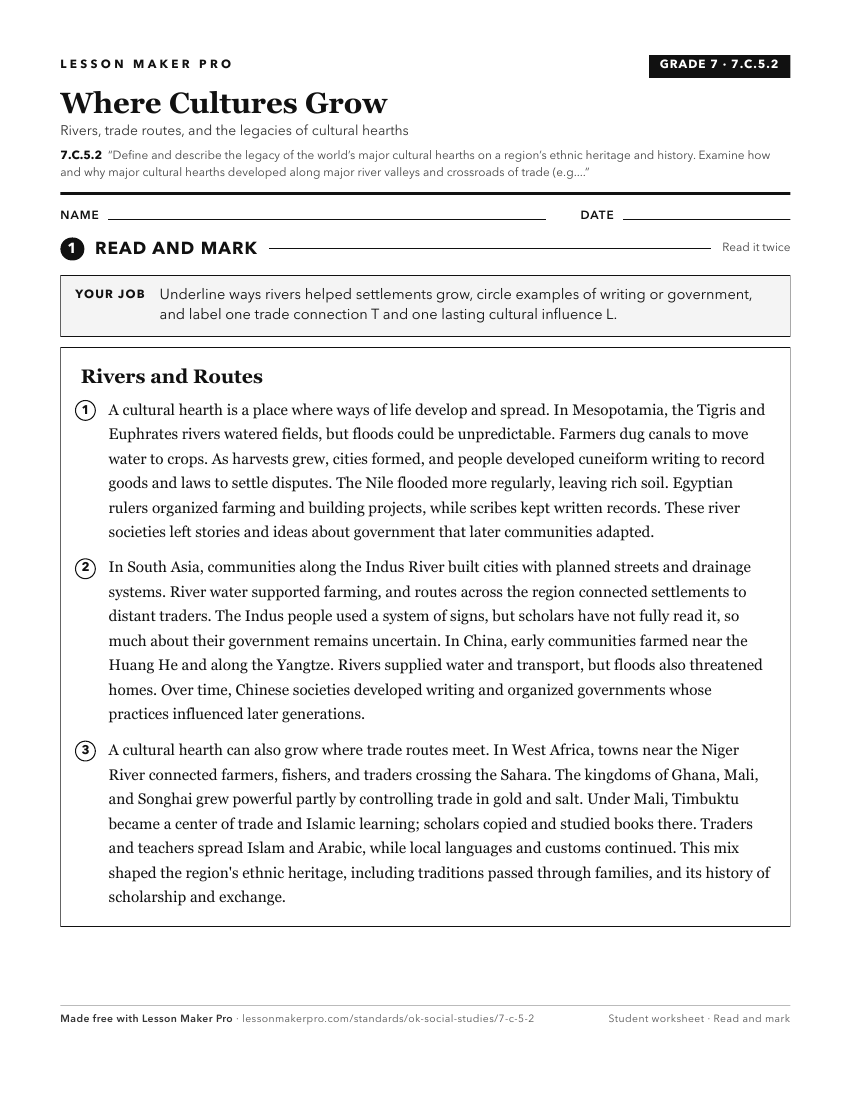
A ready-to-print activity worksheet aligned to 7.C.5.2, with an answer key for the teacher on its own page. No account needed.
PDF, US Letter, prints cleanly in black and white.
Download the worksheetKeep exploring
Related Standards
- 6.C.3.2.A
Identify and describe cultural traits (e.g., language, ethnic heritage, religion, traditions, the arts) which are unique to a people and region.
- 6.C.3.6
Describe the cultural interactions between American Indian cultures and European settlers which impacted the heritage and history of major regions of the Wester...
- 7.C.5
Evaluate the development and impact of culture on the major regions and peoples of the Eastern Hemisphere.
Turn this cluster into a lesson
Grade, subject, topic, and the complete cluster are prefilled. Create one free, no account needed.
Also for this cluster:Make a WorksheetMake a QuizMake a Sub Lesson