Oklahoma Social Studies 6.C.3.6
Standard Cluster
- 6.C.3
- Identify the characteristics, distribution, and demographic patterns of human populations and systems of the Western Hemisphere.
Describe the cultural interactions between American Indian cultures and European settlers which impacted the heritage and history of major regions of the Western Hemisphere. Identify examples of cultural diffusion (e.g., Columbian Exchange: availability of new commodities and technology; assimilation of American Indian into colonial societies). Describe the impact of English and French settlement of North America on cultural characteristics such as language, customs, and principles of self-government. Examine Spanish colonialism of Latin America and its influence on language, religion, and customs, including the practices of privateering and mercantilism. Explain the effects of plantation agriculture and the importation of enslaved labor on the economic development and cultural heritage of regions. Identify the major regions of the Western Hemisphere that received enslaved Africans and explain how European imperial expansion, colonial labor demands, and Atlantic trade networks produced the trans-Atlantic slave trade.
Oklahoma Academic Standards for Social Studies (2026) · 6.C.3
Cluster contents
Standards in This Cluster
6.C.3.6 is a cluster heading. These are the individual standards under it.
- 6.C.3.6.A
Identify examples of cultural diffusion (e.g., Columbian Exchange: availability of new commodities and technology; assimilation of American Indian into colonial...
- 6.C.3.6.B
Describe the impact of English and French settlement of North America on cultural characteristics such as language, customs, and principles of self-government.
- 6.C.3.6.C
Examine Spanish colonialism of Latin America and its influence on language, religion, and customs, including the practices of privateering and mercantilism.
- 6.C.3.6.D
Explain the effects of plantation agriculture and the importation of enslaved labor on the economic development and cultural heritage of regions.
- 6.C.3.6.E
Identify the major regions of the Western Hemisphere that received enslaved Africans and explain how European imperial expansion, colonial labor demands, and At...
Teacher's field guide
What This Cluster Means
What Students Need to Do
- Students trace how crops, technology, languages, and customs moved between Indigenous peoples and European settlers. They compare English, French, and Spanish colonies, including government and trade practices. They map where enslaved Africans were taken and explain how plantation labor and Atlantic trade shaped those regions.
What Mastery Looks Like
- A student can show where horses and maize moved across the Atlantic and explain why forced assimilation was not a fair exchange. They can compare English colonial assemblies, French language in Quebec, and Spanish language and Catholicism in Latin America. They can locate Brazil and the Caribbean and connect plantation demand to the forced transport of enslaved Africans.
Common Misconceptions
- Students may describe the slave trade as voluntary migration or assume most enslaved Africans went to what became the United States. They may think English, French, and Spanish colonies had the same language and government. Some confuse mercantilism with free trade and privateering with piracy that had no government approval.
How to Assess It
- Give students a blank Atlantic map. Ask them to draw one crop's route, circle Brazil and the Caribbean, and write two sentences explaining why enslaved Africans were forced there.
Lesson moves
Ways to Teach It
Give pairs an Atlantic map and cards for maize, horses, sugarcane, and enslaved Africans; have them draw routes and label forced movement.
Show maps of Quebec and Mexico; ask, "What language clues show different colonial histories, and what do these maps leave out?"
Run four corners labeled mercantilism, privateering, assimilation, and cultural diffusion; read an example and ask students to defend their choice.
Use a current language map to mark Spanish-speaking Mexico, French-speaking Quebec, and English-speaking Jamaica, then connect each to colonial settlement.
Free download
Printable 6.C.3.6 Worksheet
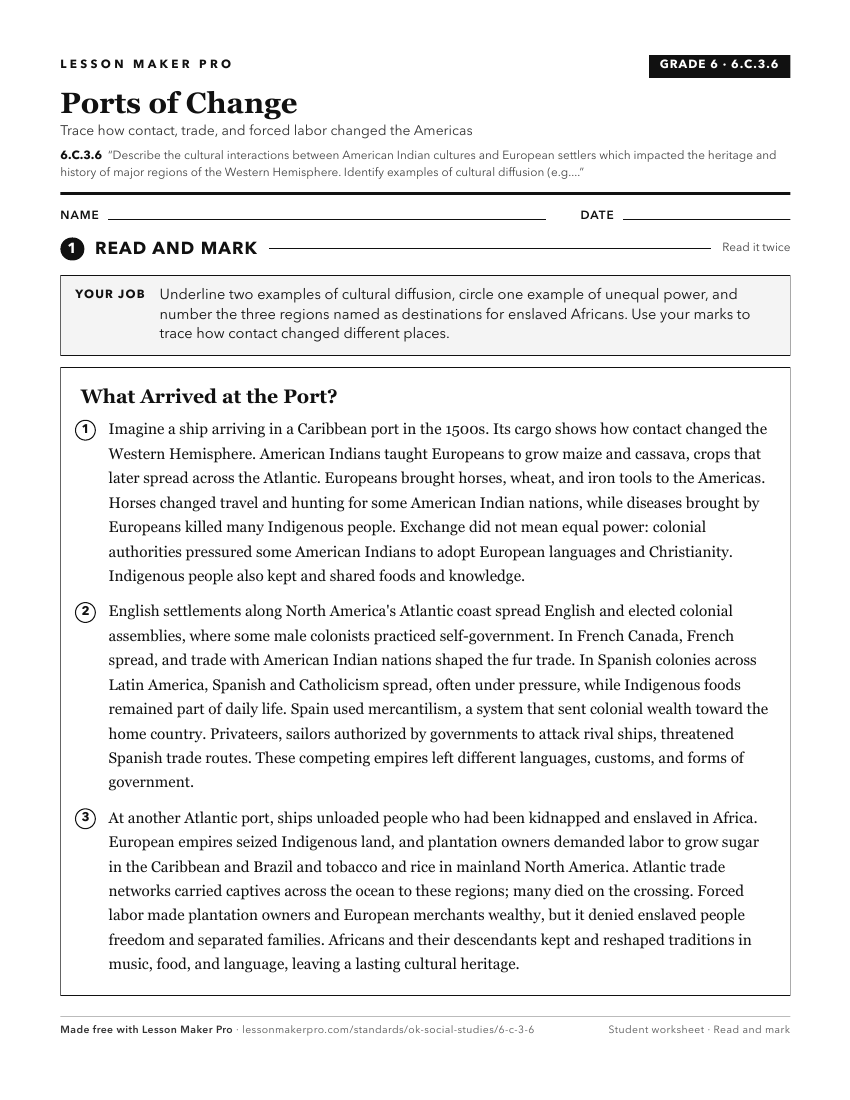
A ready-to-print activity worksheet aligned to 6.C.3.6, with an answer key for the teacher on its own page. No account needed.
PDF, US Letter, prints cleanly in black and white.
Download the worksheetKeep exploring
Related Standards
- 4.C.3.1
Examine the various American Indian cultures inhabiting the nation prior to European explorations.
- 4.C.3.2.C
Explain interactions between American Indians, Spanish explorations, French fur traders, and early European settlers, comparing different perspectives toward la...
- 6.C.3.5
Describe the ethnic heritage of Indigenous cultures of the Western Hemisphere.
- 8.C.9.2.E
Describe the impact of westward migration on American Indian culture, homelands, Tribal sovereignty, and the growing sectional tensions regarding the expansion ...
Turn this cluster into a lesson
Grade, subject, topic, and the complete cluster are prefilled. Create one free, no account needed.
Also for this cluster:Make a WorksheetMake a QuizMake a Sub Lesson