Oklahoma Social Studies 6.C.3.5
Standard Cluster
- 6.C.3
- Identify the characteristics, distribution, and demographic patterns of human populations and systems of the Western Hemisphere.
Describe the ethnic heritage of Indigenous cultures of the Western Hemisphere. Explain that various complex societies, economic, and political systems developed on the North and South American continents, each known for unique achievements and contributions prior to the arrival of Europeans. Compare the cultures of Native peoples of the United States of America and Canada (e.g., Ancestral Puebloan, Mississippian, First Nations, Inuit, Metis). Explain how the Olmec and Maya adapted to and modified their environment to develop advanced civilizations in Mesoamerica, featuring advancements in science, architecture, the development of a writing system, and regional trade. Describe how the Aztec conquest of other Indigenous peoples created extensive trade networks and wealth. Explain how the Inca were able to control an expansive empire in the Andes, developing a strong central government and innovations in agriculture.
Oklahoma Academic Standards for Social Studies (2026) · 6.C.3
Cluster contents
Standards in This Cluster
6.C.3.5 is a cluster heading. These are the individual standards under it.
- 6.C.3.5.A
Explain that various complex societies, economic, and political systems developed on the North and South American continents, each known for unique achievements...
- 6.C.3.5.B
Compare the cultures of Native peoples of the United States of America and Canada (e.g., Ancestral Puebloan, Mississippian, First Nations, Inuit, Metis).
- 6.C.3.5.C
Explain how the Olmec and Maya adapted to and modified their environment to develop advanced civilizations in Mesoamerica, featuring advancements in science, ar...
- 6.C.3.5.D
Describe how the Aztec conquest of other Indigenous peoples created extensive trade networks and wealth.
- 6.C.3.5.E
Explain how the Inca were able to control an expansive empire in the Andes, developing a strong central government and innovations in agriculture.
Teacher's field guide
What This Cluster Means
What Students Need to Do
- Students use maps and images to compare Ancestral Puebloan, Mississippian, Inuit, and specific First Nations communities. They explain how Olmec and Maya peoples used local resources, how Aztec tribute built wealth, and how Inca roads and terraces supported their empire. They place Métis culture after European contact.
What Mastery Looks Like
- A student can identify a Mississippian mound, Maya glyphs, and an Inca terrace, then explain what each was used for. They can describe Maya achievements in astronomy and architecture and explain how Aztec conquest expanded tribute and trade.
Common Misconceptions
- Students may treat First Nations as one culture or assume all these societies existed at the same time. Some place Métis culture before European contact or think Indigenous peoples had no writing or long-distance trade.
How to Assess It
- Give students a blank map of the Americas. Ask them to locate the Maya, Aztec, and Inca, then write how one used the land and how another built power.
Lesson moves
Ways to Teach It
Give pairs a blank map, society cards, and landform cards; have them place each card and justify two placements.
Ask: How did Inuit hunting methods and Ancestral Puebloan farming fit their environments? Write two sentences using map evidence.
Play a matching relay with Maya glyphs, Aztec tribute, Inca terraces, and Mississippian mounds; teams explain each match before scoring.
Show a current photo of Andean terrace farms; students label how the steps hold soil and compare them with Inca terraces.
Free download
Printable 6.C.3.5 Worksheet
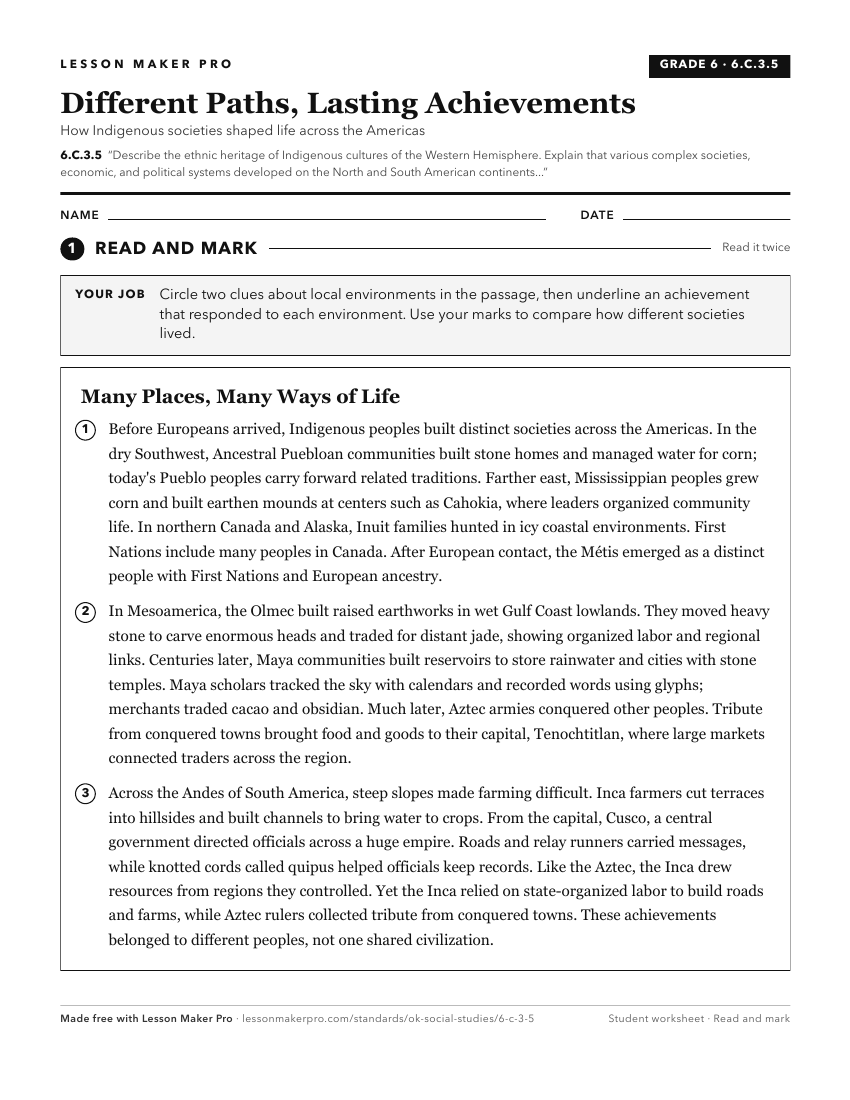
A ready-to-print activity worksheet aligned to 6.C.3.5, with an answer key for the teacher on its own page. No account needed.
PDF, US Letter, prints cleanly in black and white.
Download the worksheetKeep exploring
Related Standards
- 6.C.3.6
Describe the cultural interactions between American Indian cultures and European settlers which impacted the heritage and history of major regions of the Wester...
- 6.C.3.2.C
Compare major cultural groups of the Western Hemisphere (e.g., American Indian, Indigenous peoples of Canada and Amazonia, French-speaking Canadians, Hispanic L...
- 7.C.5.2
Define and describe the legacy of the world’s major cultural hearths on a region’s ethnic heritage and history.
Turn this cluster into a lesson
Grade, subject, topic, and the complete cluster are prefilled. Create one free, no account needed.
Also for this cluster:Make a WorksheetMake a QuizMake a Sub Lesson