Oklahoma Social Studies 6.C.3.5.A
The Standard
- 6.C.3
- Identify the characteristics, distribution, and demographic patterns of human populations and systems of the Western Hemisphere.
- 6.C.3.5
- Describe the ethnic heritage of Indigenous cultures of the Western Hemisphere.
Explain that various complex societies, economic, and political systems developed on the North and South American continents, each known for unique achievements and contributions prior to the arrival of Europeans.
Oklahoma Academic Standards for Social Studies (2026) · 6.C.3.5
Teacher's field guide
What This Standard Means
What Students Need to Do
- Students locate complex societies in North and South America before Europeans arrived. They explain how people governed, worked, and traded, and name achievements that set each society apart.
What Mastery Looks Like
- A student can place Cahokia, Maya city-states, and the Inca Empire on a map. They can describe Cahokia's trade and mounds, Maya rulers and writing, and Inca state labor and roads.
Common Misconceptions
- Students may assume everyone lived in small villages without cities or governments. They may confuse the Maya with the Inca or think these achievements began after Europeans arrived.
How to Assess It
- Exit ticket: Compare Cahokia and the Inca Empire. For each, give its location, a form of leadership, a way people got or exchanged goods, and one achievement.
Lesson moves
Ways to Teach It
Give pairs a blank Americas map and fact cards for Cahokia, the Maya, and the Inca to place and annotate.
Ask: How did Maya city-states and the Inca Empire differ in who ruled and how people provided goods or labor?
Play a card sort matching Cahokia chiefs, Maya kings, and the Inca emperor with trade, writing, mounds, and roads.
Compare an Inca road map with a current Peru road map, then discuss how roads move food between towns.
Free download
Printable 6.C.3.5.A Worksheet
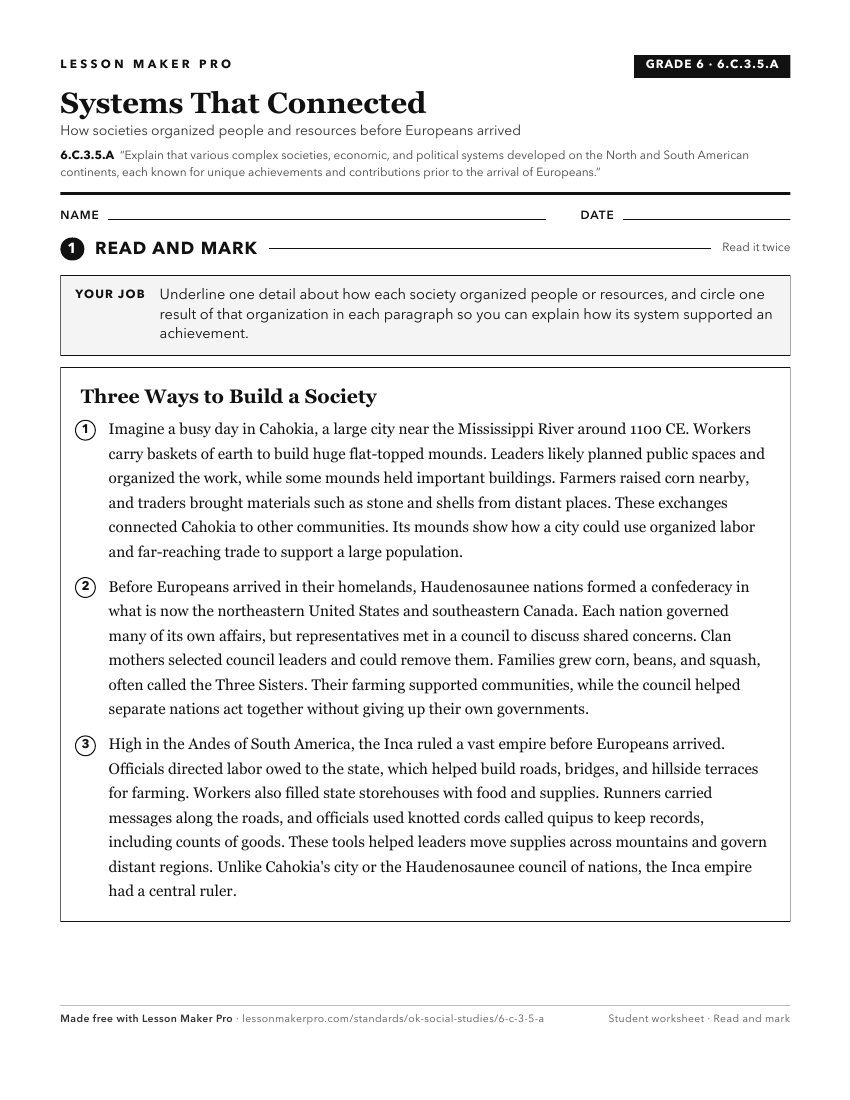
A ready-to-print activity worksheet aligned to 6.C.3.5.A, with an answer key for the teacher on its own page. No account needed.
PDF, US Letter, prints cleanly in black and white.
Download the worksheetKeep exploring
Related Standards
- 7.C.5.2.B
Explain that complex societies and civilizations in different regions share common characteristics (e.g., agricultural innovations, written language, and early ...
- 4.C.3.1.A
Explain that North America is the home to well-developed societies and cultures (e.g., Inuit, Puebloan, Mississippian, Haudenosaunee) who flourished prior to Eu...
- MWH.C.2.5.A
Explain the economic and religious motivations that prompted European exploratory expeditions into the Western Hemisphere and describe how these expeditions led...
- 6.C.3.6
Describe the cultural interactions between American Indian cultures and European settlers which impacted the heritage and history of major regions of the Wester...
Turn this exact standard into a lesson
Grade, subject, topic, and the complete standard are prefilled. Create one free, no account needed.
Also for this standard:Make a WorksheetMake a QuizMake a Sub Lesson