Oklahoma Social Studies 6.C.3.2.C
The Standard
- 6.C.3
- Identify the characteristics, distribution, and demographic patterns of human populations and systems of the Western Hemisphere.
- 6.C.3.2
- Analyze how the characteristics of culture impact people and places.
Compare major cultural groups of the Western Hemisphere (e.g., American Indian, Indigenous peoples of Canada and Amazonia, French-speaking Canadians, Hispanic Latin America).
Oklahoma Academic Standards for Social Studies (2026) · 6.C.3.2
Teacher's field guide
What This Standard Means
What Students Need to Do
- Students locate cultural communities across the Western Hemisphere. They compare languages, traditions, and histories using specific examples. They recognize that people within a community do not all live alike.
What Mastery Looks Like
- A student can compare Diné communities in the U.S. Southwest, francophone communities in Quebec, and Yanomami communities in Amazonia using accurate details. They can name a similarity and a difference without making claims about every member of a group.
Common Misconceptions
- Students may treat Indigenous peoples as one culture or assume everyone in Latin America speaks Spanish. They may think all French-speaking Canadians live in Quebec or that traditions never change.
How to Assess It
- Exit ticket: “Some Diné people speak Diné Bizaad and English. Some Quebec francophones speak French and English. Name one similarity and one difference in the languages they speak.”
Lesson moves
Ways to Teach It
Pairs place cards for Diné in Arizona, Cree in Manitoba, Yanomami in Amazonia, Quebec francophones, and Mexican Spanish speakers on a map.
Ask: How do the languages spoken by Diné communities and Quebec francophones differ, and what role can language play in identity?
Match Diné Bizaad, French, and Spanish language cards with Diné, Quebec francophone, and Mexican Spanish-speaking community cards.
Compare language options on the Canadian Museum of History and Mexico's National Museum of Anthropology websites; discuss which visitors each serves.
Free download
Printable 6.C.3.2.C Worksheet
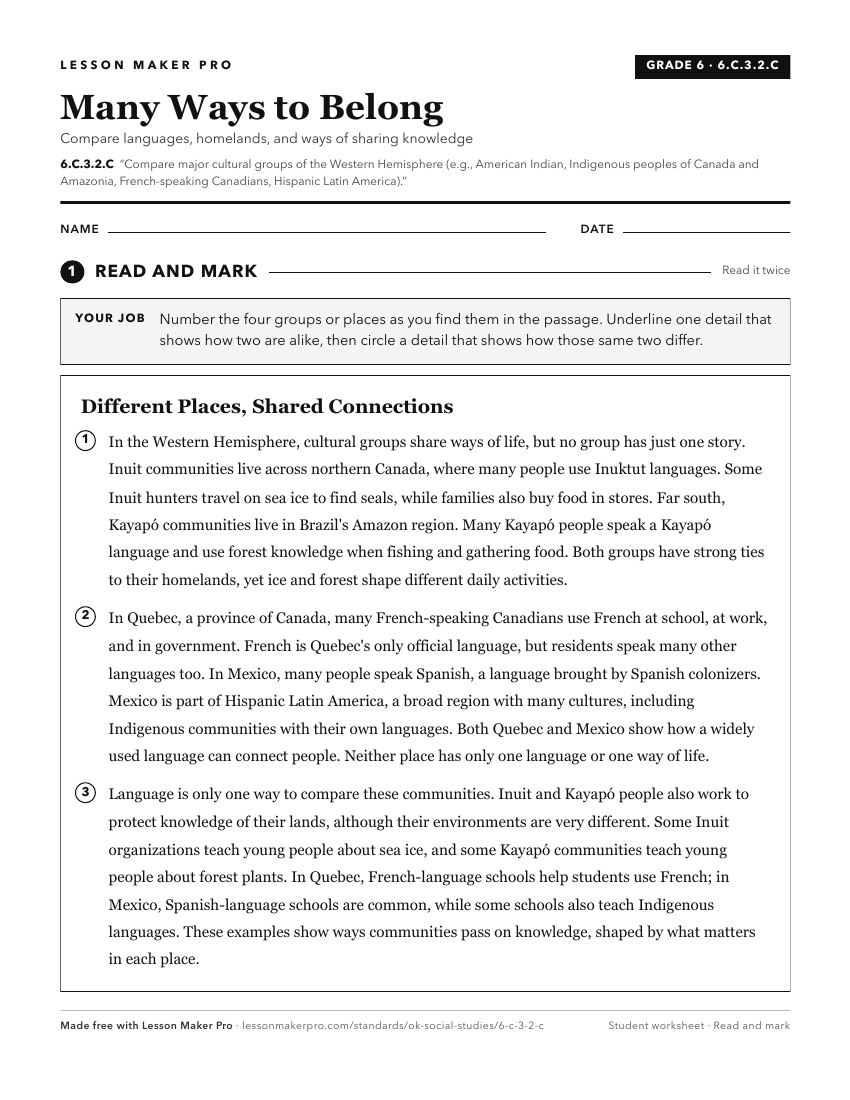
A ready-to-print activity worksheet aligned to 6.C.3.2.C, with an answer key for the teacher on its own page. No account needed.
PDF, US Letter, prints cleanly in black and white.
Download the worksheetKeep exploring
Related Standards
- 4.C.3.1.B
Describe American Indian groups and compare cultural characteristics (e.g., use of natural resources, food, shelter, customs) according to the geographic locati...
- 6.C.3.5.B
Compare the cultures of Native peoples of the United States of America and Canada (e.g., Ancestral Puebloan, Mississippian, First Nations, Inuit, Metis).
- 6.C.3.6
Describe the cultural interactions between American Indian cultures and European settlers which impacted the heritage and history of major regions of the Wester...
- 6.C.3.5
Describe the ethnic heritage of Indigenous cultures of the Western Hemisphere.
Turn this exact standard into a lesson
Grade, subject, topic, and the complete standard are prefilled. Create one free, no account needed.
Also for this standard:Make a WorksheetMake a QuizMake a Sub Lesson