Oklahoma Social Studies 6.C.3.6.E
The Standard
- 6.C.3
- Identify the characteristics, distribution, and demographic patterns of human populations and systems of the Western Hemisphere.
- 6.C.3.6
- Describe the cultural interactions between American Indian cultures and European settlers which impacted the heritage and history of major regions of the Western Hemisphere.
Identify the major regions of the Western Hemisphere that received enslaved Africans and explain how European imperial expansion, colonial labor demands, and Atlantic trade networks produced the trans-Atlantic slave trade.
Oklahoma Academic Standards for Social Studies (2026) · 6.C.3.6
Teacher's field guide
What This Standard Means
What Students Need to Do
- Students locate the Caribbean, Brazil, Spanish mainland colonies, and British North America on an Atlantic map. They explain how European colonization created demand for forced labor on plantations and in mines. They show how Atlantic trade routes carried enslaved Africans to those colonies.
What Mastery Looks Like
- A student marks Brazil and the Caribbean as major destinations and identifies other mainland destinations. They explain how European expansion, colonial labor demands, and Atlantic shipping worked together to produce the trade.
Common Misconceptions
- Many students assume most enslaved Africans were taken to what is now the United States. Some mistake forced transport for voluntary migration. Others see the routes as trade alone, without connecting them to labor demands in European colonies.
How to Assess It
- On a blank Atlantic map, have students label the Caribbean, Brazil, Spanish mainland colonies, and British North America as destinations. Ask them to write two sentences linking European colonization, forced labor, and Atlantic trade routes.
Lesson moves
Ways to Teach It
Give pairs an Atlantic map and colored pencils to mark destinations and draw routes showing where enslaved Africans were forcibly taken.
Ask: How did European colonies' sugar plantations and mines drive the forced transport of Africans? Write two linked cause-and-effect sentences.
Hand out cards labeled Brazil, Caribbean, Spanish colonies, sugar, mines, West Africa, forced labor, and Atlantic ships; pairs build two cause-and-effect chains.
Read a sugar bag label, map its country of origin, then compare that place with colonial sugar regions in Brazil and the Caribbean.
Free download
Printable 6.C.3.6.E Worksheet
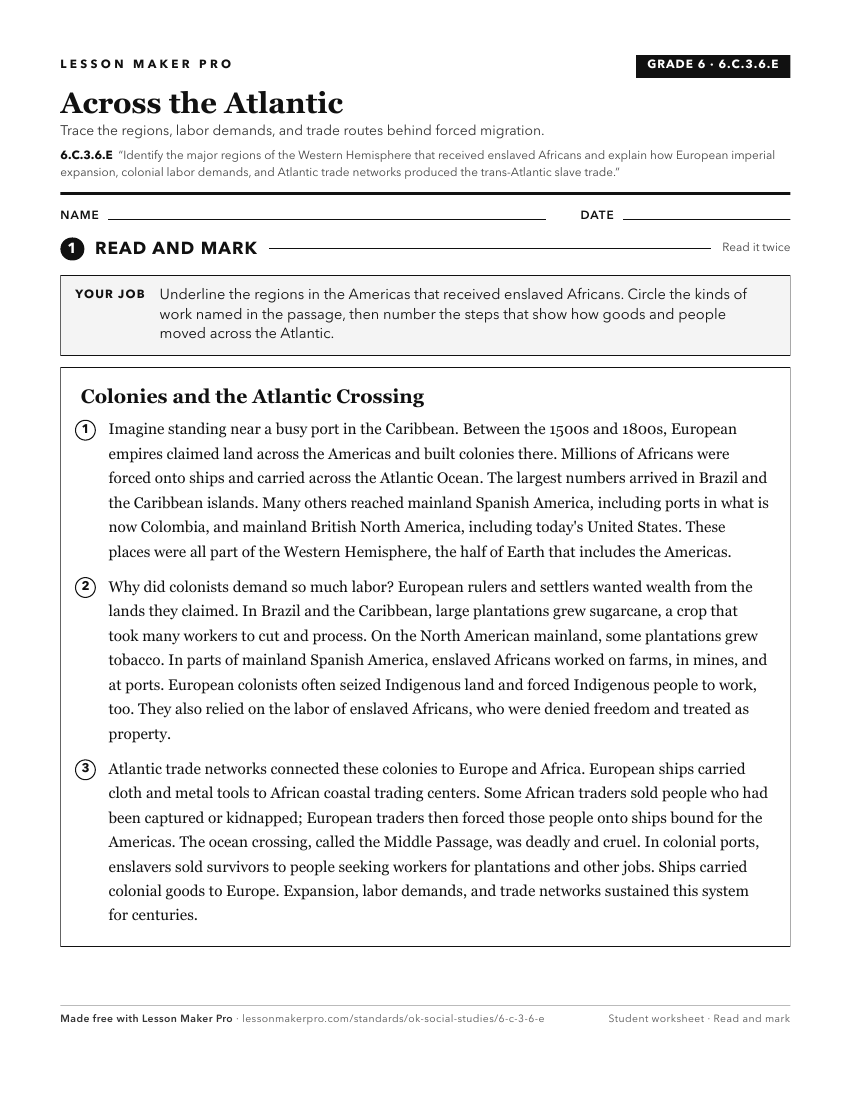
A ready-to-print activity worksheet aligned to 6.C.3.6.E, with an answer key for the teacher on its own page. No account needed.
PDF, US Letter, prints cleanly in black and white.
Download the worksheetKeep exploring
Related Standards
- 6.C.7.4
Describe patterns of economic interdependence and trade linking regions of the Western Hemisphere.
- 5.C.2.3
Explain the economic and cultural interactions resulting from the triangular trade routes, including the forced migration of Africans through the Transatlantic ...
- MWH.C.2.5.E
Explain how overseas expansion led to the development of the trans-Atlantic slave trade.
- MWH.C.2.5.D
Describe the major economic and cultural effects of the Columbian Exchange and explain how the enslavement of Indigenous peoples and Africans was used for the d...
Turn this exact standard into a lesson
Grade, subject, topic, and the complete standard are prefilled. Create one free, no account needed.
Also for this standard:Make a WorksheetMake a QuizMake a Sub Lesson