Oklahoma Social Studies 6.C.7.4
Standard Cluster
- 6.C.7
- Analyze the common characteristics of regions which create a sense of identity and unity, influencing the interactions among people and nations of the Western Hemisphere.
Describe patterns of economic interdependence and trade linking regions of the Western Hemisphere. Define basic concepts related to trade, including exports and imports, tariffs, free trade, and balance of trade. Explain economic interdependence as it relates to the outsourcing of jobs to developing regions.
Oklahoma Academic Standards for Social Studies (2026) · 6.C.7
Cluster contents
Standards in This Cluster
6.C.7.4 is a cluster heading. These are the individual standards under it.
Teacher's field guide
What This Cluster Means
What Students Need to Do
- Students trace goods moving among countries in the Americas and label imports and exports from each country's view. They explain how tariffs and free trade affect trade, and calculate a trade balance. They explain why companies move jobs to lower-cost regions and how that links workers and consumers across borders.
What Mastery Looks Like
- Given a map and trade figures, a student traces a product's route and labels what each country buys and sells. They subtract imports from exports and identify a surplus or deficit. They explain how a tariff could change prices and how moving a factory could change jobs in both countries.
Common Misconceptions
- Students may call a product an export from both countries instead of switching viewpoints at the border. Some think a trade deficit means a country sells nothing, or that free trade means goods cost nothing. Others think moving jobs abroad affects only the country losing jobs.
How to Assess It
- Exit ticket: The U.S. buys $80 of shirts from Honduras, sells $50 of wheat there, and moves sewing jobs to Honduras. Label the U.S. import and export, calculate its trade balance, and explain why jobs moved and how a tariff could affect shirt prices.
Lesson moves
Ways to Teach It
Have pairs tape yarn onto a map to trace U.S. wheat to Mexico, Mexican car parts to the U.S., and Brazilian coffee to Canada.
Ask: If a U.S. clothing company moves sewing jobs to Honduras, who gains work, who might lose work, and why?
Deal pairs trade cards showing sales between Canada and Mexico; students mark imports or exports, subtract totals, then compare answers.
Have students check food labels for country of origin, then compare an import's $5 price under free trade with its $7 price after a tariff.
Free download
Printable 6.C.7.4 Worksheet
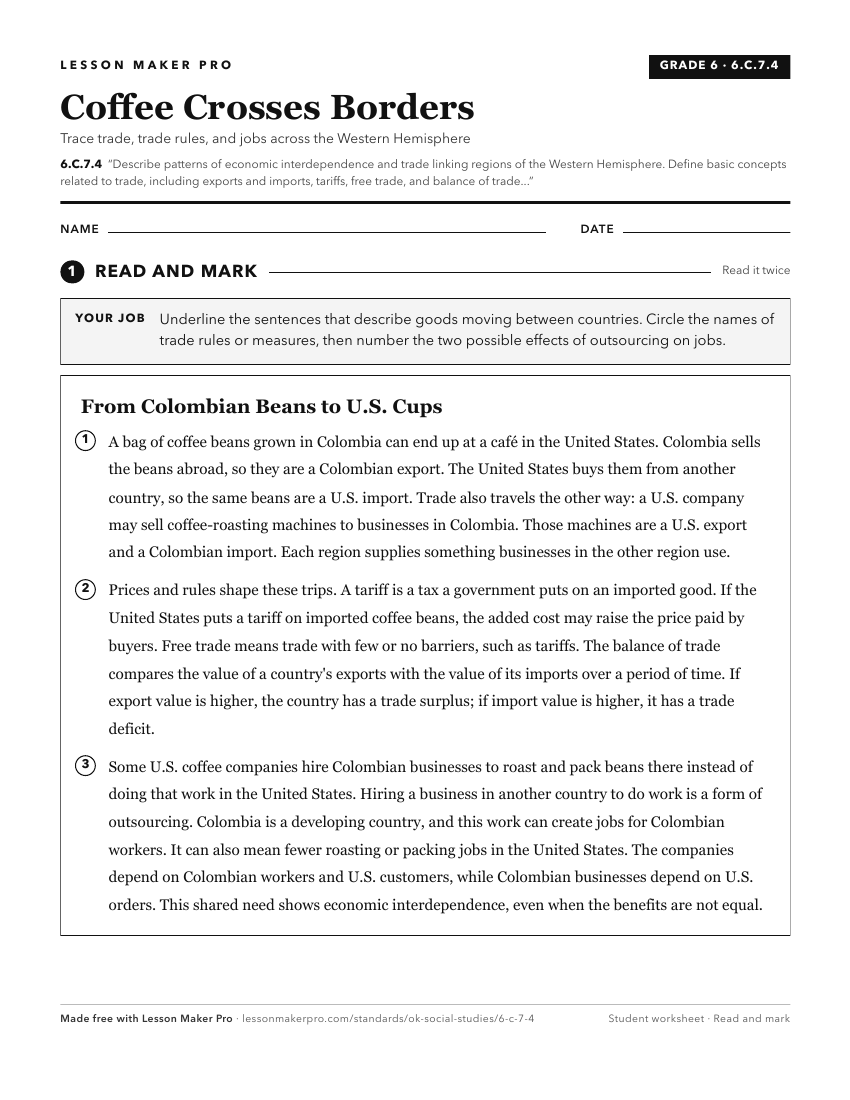
A ready-to-print activity worksheet aligned to 6.C.7.4, with an answer key for the teacher on its own page. No account needed.
PDF, US Letter, prints cleanly in black and white.
Download the worksheetKeep exploring
Related Standards
- 4.C.4.3
Describe the patterns and networks of economic interdependence among regions and the world.
- 7.C.8.4
Examine indicators of economic interdependence and world trade, including why nations are concerned with the balance of trade, and explain major trade patterns ...
- 6.C.7
Analyze the common characteristics of regions which create a sense of identity and unity, influencing the interactions among people and nations of the Western H...
- 6.C.7.5
Explain reasons for cooperation among nations of the Western Hemisphere.
Turn this cluster into a lesson
Grade, subject, topic, and the complete cluster are prefilled. Create one free, no account needed.
Also for this cluster:Make a WorksheetMake a QuizMake a Sub Lesson