Oklahoma Social Studies 6.C.7.5
Standard Cluster
- 6.C.7
- Analyze the common characteristics of regions which create a sense of identity and unity, influencing the interactions among people and nations of the Western Hemisphere.
Explain reasons for cooperation among nations of the Western Hemisphere. Describe how the people of different regions cooperate to address common concerns and how such cooperation impacts global interdependence (e.g., the United States-Mexico-Canada Agreement, Mercosur). Examine how supranational organizations (e.g., Organization of American States, Arctic Council) create cooperative political, economic, defense, and cultural regions.
Oklahoma Academic Standards for Social Studies (2026) · 6.C.7
Cluster contents
Standards in This Cluster
6.C.7.5 is a cluster heading. These are the individual standards under it.
- 6.C.7.5.A
Describe how the people of different regions cooperate to address common concerns and how such cooperation impacts global interdependence (e.g., the United Stat...
- 6.C.7.5.B
Examine how supranational organizations (e.g., Organization of American States, Arctic Council) create cooperative political, economic, defense, and cultural re...
Teacher's field guide
What This Cluster Means
What Students Need to Do
- Students explain why countries in the Americas work together on trade, security, culture, and shared problems. They compare groups and agreements, then trace how cooperation affects people across borders.
What Mastery Looks Like
- A student can explain that USMCA sets trade rules, the OAS coordinates work on elections and security, and the Arctic Council shares research on Arctic problems. They can trace how a trade delay or pollution problem affects more than one country.
Common Misconceptions
- Students may think every group can make laws that its members must follow, or that the Arctic Council runs a shared military. They may mix up USMCA's three countries with Mercosur's South American members.
How to Assess It
- On an exit ticket, choose USMCA or the Arctic Council. Name one shared goal, one action members take together, and one effect across a border.
Lesson moves
Ways to Teach It
Give pairs an Americas map and member lists for USMCA and Mercosur; have them shade members and draw a possible trade route.
Ask partners: Why might countries share Arctic ice data instead of collecting it alone? Have each pair name one effect beyond the Arctic.
Play a card match with USMCA trade rules, Mercosur trade, OAS election observers, and Arctic Council pollution research; partners explain each match.
Show a photo of an avocado label reading 'Product of Mexico'; students trace its route to a U.S. store and predict a border delay.
Free download
Printable 6.C.7.5 Worksheet
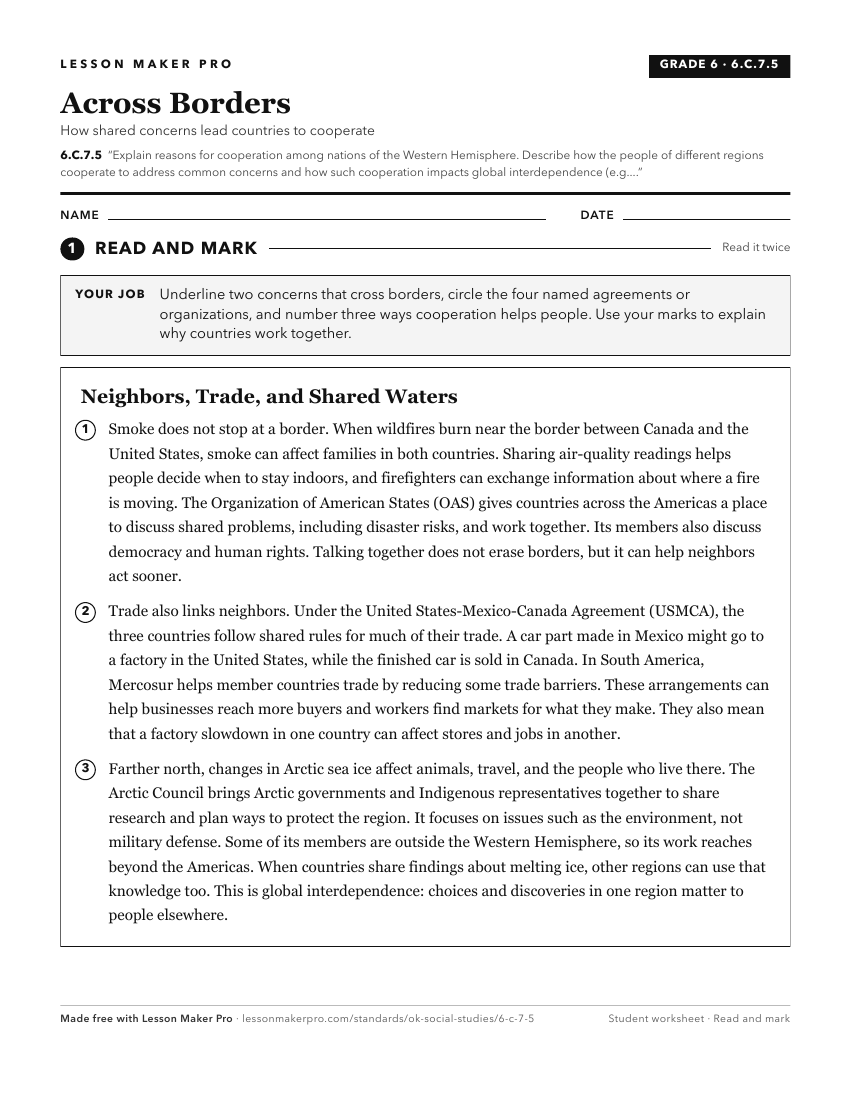
A ready-to-print activity worksheet aligned to 6.C.7.5, with an answer key for the teacher on its own page. No account needed.
PDF, US Letter, prints cleanly in black and white.
Download the worksheetKeep exploring
Related Standards
- 6.C.7.4
Describe patterns of economic interdependence and trade linking regions of the Western Hemisphere.
- 6.C.7.6
Explain reasons for conflict between regions of the Western Hemisphere, such as territorial disputes, access to natural resources, and ethnic differences (e.g.,...
- 6.C.7
Analyze the common characteristics of regions which create a sense of identity and unity, influencing the interactions among people and nations of the Western H...
Turn this cluster into a lesson
Grade, subject, topic, and the complete cluster are prefilled. Create one free, no account needed.
Also for this cluster:Make a WorksheetMake a QuizMake a Sub Lesson