Oklahoma Social Studies 6.C.7
Standard Cluster
Analyze the common characteristics of regions which create a sense of identity and unity, influencing the interactions among people and nations of the Western Hemisphere. Define the concept of region as an area sharing common characteristics and explain how regions can be categorized in many ways, such as political, physical, cultural, and economic. Identify examples of physical regions sharing common features of landforms, climate, vegetation, and natural resources (e.g., Great Plains, New England, Amazonia, Canadian Shield, Altiplano, sun belt, tornado alley). Identify examples of man-made regions sharing common characteristics related to culture, human settlement, history, economic activities, and governments (e.g., Latin America, corn belt, Northeast megalopolis, Silicon Valley, British Commonwealth, barrio, suburb). Describe patterns of economic interdependence and trade linking regions of the Western Hemisphere. Define basic concepts related to trade, including exports and imports, tariffs, free trade, and balance of trade. Explain economic interdependence as it relates to the outsourcing of jobs to developing regions. Explain reasons for cooperation among nations of the Western Hemisphere. Describe how the people of different regions cooperate to address common concerns and how such cooperation impacts global interdependence (e.g., the United States-Mexico-Canada Agreement, Mercosur). Examine how supranational organizations (e.g., Organization of American States, Arctic Council) create cooperative political, economic, defense, and cultural regions. Explain reasons for conflict between regions of the Western Hemisphere, such as territorial disputes, access to natural resources, and ethnic differences (e.g., boundary and mineral claims of the Arctic, Indigenous sovereignty over oil and gas reserves in Bolivia, immigration across the United States of America -Mexico border).
Oklahoma Academic Standards for Social Studies (2026)
Cluster contents
Standards in This Cluster
6.C.7 is a cluster heading. These are the individual standards under it.
- 6.C.7.1
Define the concept of region as an area sharing common characteristics and explain how regions can be categorized in many ways, such as political, physical, cul...
- 6.C.7.2
Identify examples of physical regions sharing common features of landforms, climate, vegetation, and natural resources (e.g., Great Plains, New England, Amazoni...
- 6.C.7.3
Identify examples of man-made regions sharing common characteristics related to culture, human settlement, history, economic activities, and governments (e.g., ...
- 6.C.7.4
Describe patterns of economic interdependence and trade linking regions of the Western Hemisphere.
- 6.C.7.4.A
Define basic concepts related to trade, including exports and imports, tariffs, free trade, and balance of trade.
- 6.C.7.4.B
Explain economic interdependence as it relates to the outsourcing of jobs to developing regions.
- 6.C.7.5
Explain reasons for cooperation among nations of the Western Hemisphere.
- 6.C.7.5.A
Describe how the people of different regions cooperate to address common concerns and how such cooperation impacts global interdependence (e.g., the United Stat...
- 6.C.7.5.B
Examine how supranational organizations (e.g., Organization of American States, Arctic Council) create cooperative political, economic, defense, and cultural re...
- 6.C.7.6
Explain reasons for conflict between regions of the Western Hemisphere, such as territorial disputes, access to natural resources, and ethnic differences (e.g.,...
Teacher's field guide
What This Cluster Means
What Students Need to Do
- Students use maps to group places into physical, cultural, political, and economic regions by shared features. They trace products and outsourced jobs across borders while explaining imports, exports, tariffs, free trade, and trade balances. They explain how shared interests can bring countries together, while borders and resources can cause conflict.
What Mastery Looks Like
- A student can explain why the Great Plains is a physical region and Latin America is a cultural region, even where they overlap. They can trace a product and an outsourced job between countries and calculate a trade balance. They can explain why countries join a trade agreement while still disagreeing over resources.
Common Misconceptions
- Students may think regions must follow national borders or cannot overlap. They may reverse imports and exports or assume tariffs are paid by the exporting government. They may think free trade means no rules, or that trade agreements end disputes over land and resources.
How to Assess It
- Show a map with the Great Plains shaded and the U.S., Canada, and Mexico marked as trade partners. Add, 'Canada sells wheat to the U.S.,' then ask students what defines each region, who imports the wheat, and one reason these countries might cooperate or clash.
Lesson moves
Ways to Teach It
Give pairs tracing paper and two maps; have them outline the Great Plains and Latin America, then list what each area shares.
Show a map of the Colorado River and ask, 'Why might the U.S. and Mexico both cooperate and disagree over its water?'
Give teams six priced trade cards; have them sort imports from exports, then subtract import totals from export totals to find trade balance.
Bring a 'Product of Mexico' food label; have students sketch its possible trip to town and name the importing and exporting countries.
Free download
Printable 6.C.7 Worksheet
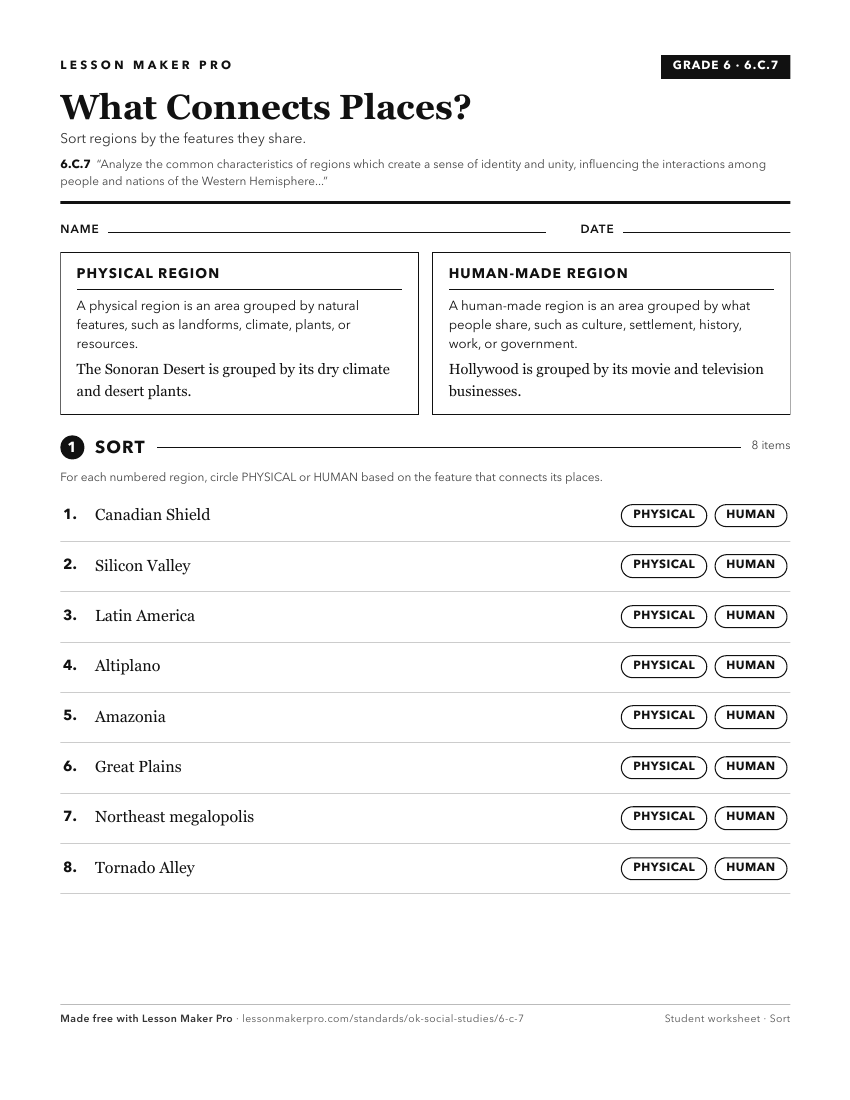
A ready-to-print activity worksheet aligned to 6.C.7, with an answer key for the teacher on its own page. No account needed.
PDF, US Letter, prints cleanly in black and white.
Download the worksheetKeep exploring
Related Standards
- 7.C.8
Analyze the physical and human characteristics of regions which create uniqueness and influence people’s perceptions of the Eastern Hemisphere.
- 6.C.1.3
Compare characteristics of major regions of the Western Hemisphere through the regular use of strategies, such as the Five Themes of Geography (location, place,...
- 6.C.4
Analyze the interactions of humans and their environment in the Western Hemisphere.
Turn this cluster into a lesson
Grade, subject, topic, and the complete cluster are prefilled. Create one free, no account needed.
Also for this cluster:Make a WorksheetMake a QuizMake a Sub Lesson