Oklahoma Social Studies 7.C.8
Standard Cluster
Analyze the physical and human characteristics of regions which create uniqueness and influence people’s perceptions of the Eastern Hemisphere. Define the concept of region and explain how regions change over time through physical and human processes, such as land use, urban growth, population, natural disasters, and trade. Explain and summarize how common physical or human characteristics can link as well as divide regions (e.g., manmade canals linking European trading centers, the Sahara Desert as both a physical and cultural division of the African continent, religious and political differences leading to armed conflict in Southwest Asia). Explain patterns of global interdependence, including the impact of changing technology on trade routes, dependence on resources, use of low-cost labor, and the outsourcing of technological and manufacturing jobs to developing regions. Examine indicators of economic interdependence and world trade, including why nations are concerned with the balance of trade, and explain major trade patterns among regions of the Eastern Hemisphere. Explain why countries enter into global trade agreements (e.g., Organization of Petroleum Exporting Countries [OPEC], the Association of Southeast Asian Nations [ASEAN] and the African Continental Free Trade Area [AfCFTA]). Describe how political, economic, and cultural forces (e.g., civil wars, terrorism, genocide, ethnic separatism) have challenged political arrangements (e.g., political status of Taiwan to China, the division of Sudan and South Sudan). Analyze reasons for conflict and cooperation among regions, evaluating the advantages and disadvantages of international organizations and alliances (e.g., European Union, North Atlantic Treaty Organization, International Red Cross) as they relate to mutual defense, the resolution of disputes, and the response to humanitarian needs.
Oklahoma Academic Standards for Social Studies (2026)
Cluster contents
Standards in This Cluster
7.C.8 is a cluster heading. These are the individual standards under it.
- 7.C.8.1
Define the concept of region and explain how regions change over time through physical and human processes, such as land use, urban growth, population, natural ...
- 7.C.8.2
Explain and summarize how common physical or human characteristics can link as well as divide regions (e.g., manmade canals linking European trading centers, th...
- 7.C.8.3
Explain patterns of global interdependence, including the impact of changing technology on trade routes, dependence on resources, use of low-cost labor, and the...
- 7.C.8.4
Examine indicators of economic interdependence and world trade, including why nations are concerned with the balance of trade, and explain major trade patterns ...
- 7.C.8.5
Explain why countries enter into global trade agreements (e.g., Organization of Petroleum Exporting Countries [OPEC], the Association of Southeast Asian Nations...
- 7.C.8.6
Describe how political, economic, and cultural forces (e.g., civil wars, terrorism, genocide, ethnic separatism) have challenged political arrangements (e.g., p...
- 7.C.8.7
Analyze reasons for conflict and cooperation among regions, evaluating the advantages and disadvantages of international organizations and alliances (e.g., Euro...
Teacher's field guide
What This Cluster Means
What Students Need to Do
- Students use shared features, such as landforms and languages, to describe regions and explain how cities, disasters, or trade can change them. They trace how resources, jobs, and trade connect places, and how conflicts can divide them. They compare how maps and news stories can give different impressions of a region.
What Mastery Looks Like
- Given two dated maps, students explain how urban growth changes a region. They use import and export figures to calculate a trade balance and explain a resource or labor link between countries. They name one benefit and one limit of an international group's response to a conflict.
Common Misconceptions
- Students may treat regional boundaries as fixed or assume a desert stops all travel and trade. They may think a trade deficit means a country exports nothing, or that joining an alliance ends a conflict.
How to Assess It
- On an exit ticket, ask: "How can the Sahara divide communities and still connect them through trade? Name one change that could alter those connections."
Lesson moves
Ways to Teach It
Give pairs tracing paper and two maps of Shanghai from different decades; have them outline the built-up area on each.
Ask: "Does the Sahara divide communities more than trade connects them?" Have students support both sides with a climate map and a trade-route map.
Give pairs import and export cards for India, Saudi Arabia, and South Korea; have them match trade partners and calculate each country's balance.
Use a Red Cross report on Sudan; have students mark aid routes on a map and name one limit of outside aid.
Free download
Printable 7.C.8 Worksheet
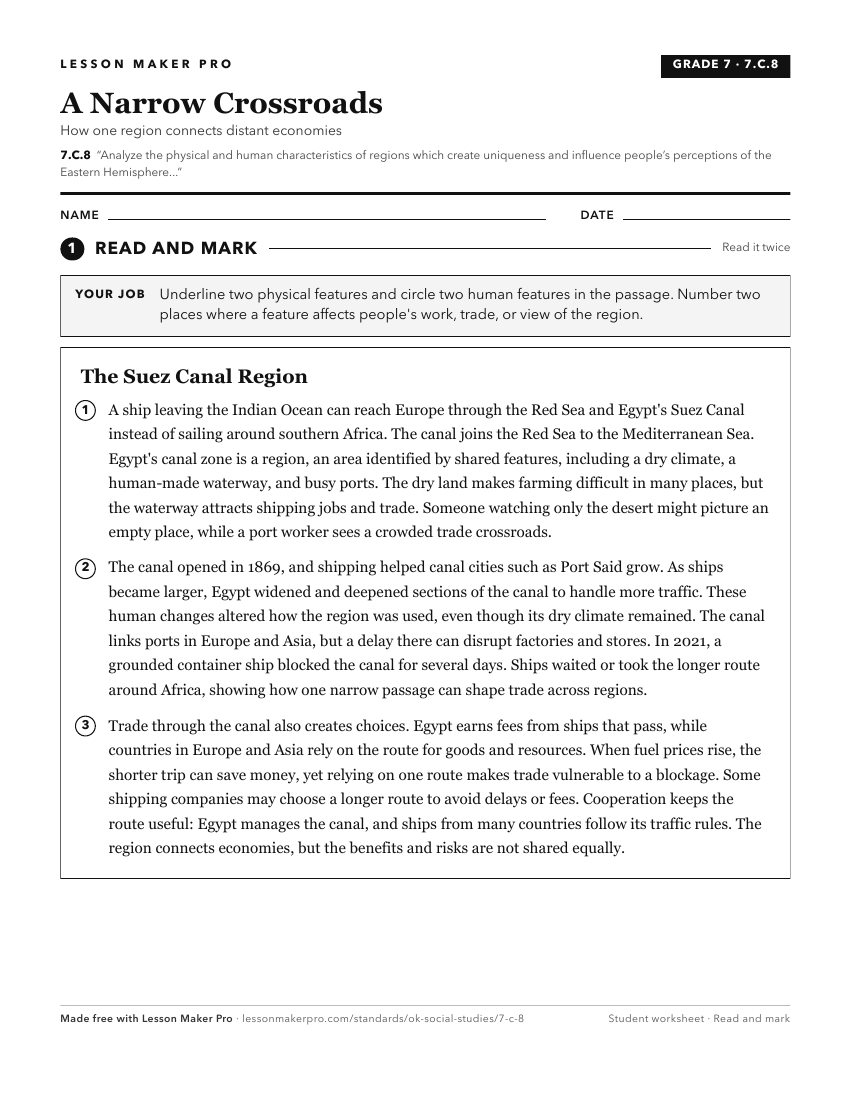
A ready-to-print activity worksheet aligned to 7.C.8, with an answer key for the teacher on its own page. No account needed.
PDF, US Letter, prints cleanly in black and white.
Download the worksheetKeep exploring
Related Standards
- 7.C.2
Analyze the physical systems of the major regions of the Eastern Hemisphere.
- 7.C.3
Identify the distribution and demographic patterns of human populations of the Eastern Hemisphere.
- 7.C.5
Evaluate the development and impact of culture on the major regions and peoples of the Eastern Hemisphere.
- 6.C.7
Analyze the common characteristics of regions which create a sense of identity and unity, influencing the interactions among people and nations of the Western H...
Turn this cluster into a lesson
Grade, subject, topic, and the complete cluster are prefilled. Create one free, no account needed.
Also for this cluster:Make a WorksheetMake a QuizMake a Sub Lesson