Oklahoma Social Studies 6.C.7.3
The Standard
- 6.C.7
- Analyze the common characteristics of regions which create a sense of identity and unity, influencing the interactions among people and nations of the Western Hemisphere.
Identify examples of man-made regions sharing common characteristics related to culture, human settlement, history, economic activities, and governments (e.g., Latin America, corn belt, Northeast megalopolis, Silicon Valley, British Commonwealth, barrio, suburb).
Oklahoma Academic Standards for Social Studies (2026) · 6.C.7
Teacher's field guide
What This Standard Means
What Students Need to Do
- Students name regions linked by shared language, history, settlement patterns, jobs, or government ties. They use a map or short description to explain what links the places in each region.
What Mastery Looks Like
- On a map, students can match the Corn Belt with corn farming and Silicon Valley with technology businesses. They can explain why a region may cross city or state lines.
Common Misconceptions
- Students may think a named region needs fixed legal borders or its own government. They may leave Brazil out of Latin America because most people there speak Portuguese. They may mistake the Corn Belt for a natural landform.
How to Assess It
- Exit ticket: “Many farms across several Midwestern states grow corn. Name this region and explain why people group these places together.”
Lesson moves
Ways to Teach It
Give pairs a labeled U.S. map and sticky notes; mark the Corn Belt and Silicon Valley, then write the shared work behind each name.
Ask, “Why is Brazil part of Latin America if many people there speak Portuguese?” Students write two sentences about language roots and colonial history.
Play region match: students pair cards naming Latin America, the Corn Belt, and the Northeast megalopolis with language, farming, and connected cities.
Open a satellite map of a nearby suburb and city center; students compare housing and street patterns, then explain the label “suburb.”
Free download
Printable 6.C.7.3 Worksheet
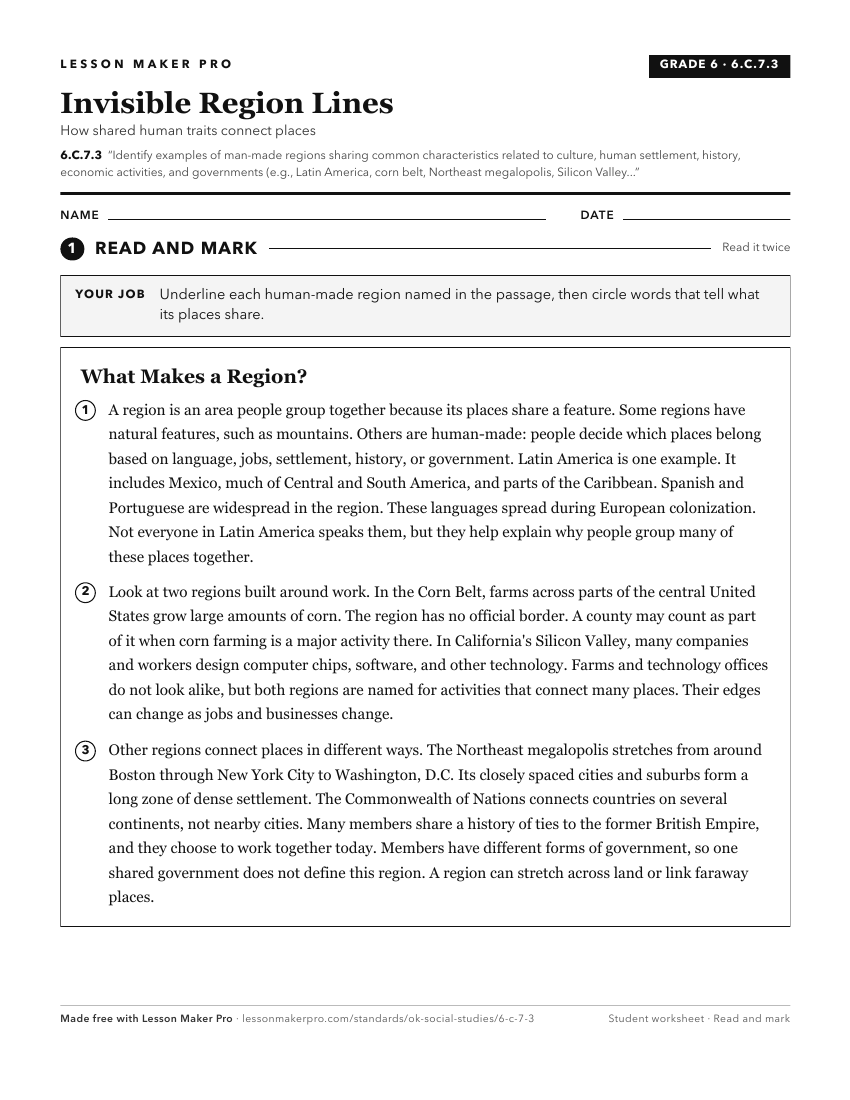
A ready-to-print activity worksheet aligned to 6.C.7.3, with an answer key for the teacher on its own page. No account needed.
PDF, US Letter, prints cleanly in black and white.
Download the worksheetKeep exploring
Related Standards
- 7.C.8.2
Explain and summarize how common physical or human characteristics can link as well as divide regions (e.g., manmade canals linking European trading centers, th...
- 6.C.7.2
Identify examples of physical regions sharing common features of landforms, climate, vegetation, and natural resources (e.g., Great Plains, New England, Amazoni...
- 4.C.2.4.A
Identify the characteristics of culture (e.g., language, customs, religious beliefs, food, clothing, shelter) and compare cultural characteristics of different ...
- 6.C.7
Analyze the common characteristics of regions which create a sense of identity and unity, influencing the interactions among people and nations of the Western H...
Turn this exact standard into a lesson
Grade, subject, topic, and the complete standard are prefilled. Create one free, no account needed.
Also for this standard:Make a WorksheetMake a QuizMake a Sub Lesson