Oklahoma Social Studies 4.C.3
Standard Cluster
Analyze how geography has impacted cultures and interactions during the early history of our nation. Examine the various American Indian cultures inhabiting the nation prior to European explorations. Explain that North America is the home to well-developed societies and cultures (e.g., Inuit, Puebloan, Mississippian, Haudenosaunee) who flourished prior to European arrival. Describe American Indian groups and compare cultural characteristics (e.g., use of natural resources, food, shelter, customs) according to the geographic location of their original homelands (e.g., Eastern Woodlands, Southeast, Great Plains, Southwest, Great Basin, California, Northwest Coast). Explain how museums, national parks, and heritage centers attempt to preserve American Indian cultural heritage (e.g., Mesa Verde, Cahokia Mounds, Chaco Canyon). Summarize the goals and consequences of European expeditions of North America. Explain how Spain, France, and England were motivated to explore the continent by a desire to expand their wealth and culture, convert Native peoples to Christianity, acquire natural resources, and develop trade relations. Trace and describe the impact of significant European expeditions (e.g., England: Henry Hudson; France: Jacques Cartier; Portugal: Vasco da Gama; Spain: Christopher Columbus, Hernando de Soto, Ferdinand Magellan, Juan Ponce de León). Explain interactions between American Indians, Spanish explorations, French fur traders, and early European settlers, comparing different perspectives toward land ownership and use of resources. Evaluate the mutual benefits and consequences of the Columbian Exchange, including agriculture, trade, military alliances, technology, slavery, and disease resulting in the significant decline of Native peoples.
Oklahoma Academic Standards for Social Studies (2026)
Cluster contents
Standards in This Cluster
4.C.3 is a cluster heading. These are the individual standards under it.
- 4.C.3.1
Examine the various American Indian cultures inhabiting the nation prior to European explorations.
- 4.C.3.1.A
Explain that North America is the home to well-developed societies and cultures (e.g., Inuit, Puebloan, Mississippian, Haudenosaunee) who flourished prior to Eu...
- 4.C.3.1.B
Describe American Indian groups and compare cultural characteristics (e.g., use of natural resources, food, shelter, customs) according to the geographic locati...
- 4.C.3.1.C
Explain how museums, national parks, and heritage centers attempt to preserve American Indian cultural heritage (e.g., Mesa Verde, Cahokia Mounds, Chaco Canyon)...
- 4.C.3.2
Summarize the goals and consequences of European expeditions of North America.
- 4.C.3.2.A
Explain how Spain, France, and England were motivated to explore the continent by a desire to expand their wealth and culture, convert Native peoples to Christi...
- 4.C.3.2.B
Trace and describe the impact of significant European expeditions (e.g., England: Henry Hudson; France: Jacques Cartier; Portugal: Vasco da Gama; Spain: Christo...
- 4.C.3.2.C
Explain interactions between American Indians, Spanish explorations, French fur traders, and early European settlers, comparing different perspectives toward la...
- 4.C.3.2.D
Evaluate the mutual benefits and consequences of the Columbian Exchange, including agriculture, trade, military alliances, technology, slavery, and disease resu...
Teacher's field guide
What This Cluster Means
What Students Need to Do
- Students compare how geography shaped Native nations' food, homes, and customs before Europeans arrived. They trace European voyages, explain explorers' goals, and compare views of land and resources. They weigh the benefits and harms of contact and explain how heritage sites preserve history.
What Mastery Looks Like
- A student can connect Pueblo irrigation to the dry Southwest and Haudenosaunee longhouses to Eastern Woodlands forests. They can explain Cartier's search for a route to Asia and describe a disagreement over land use. They can name a benefit of exchange, explain the deadly effects of disease, and tell how Cahokia Mounds preserves evidence of an earlier society.
Common Misconceptions
- Students may treat Native nations as one culture or assume they had no large societies before Europeans arrived. They may think every European explorer had the same goal or that Native peoples and settlers agreed about land ownership. They may focus on new crops and trade while overlooking disease, slavery, and Native deaths.
How to Assess It
- Give students a blank North America map. Ask them to mark the Pueblo homeland, explain one way its climate shaped farming, and name one European exploration goal, one exchange benefit, and one harm to Native peoples.
Lesson moves
Ways to Teach It
Give pairs a blank map and picture cards of Pueblo irrigation canals, Haudenosaunee longhouses, and Mississippian mounds; match each to a homeland.
Ask: Why might a Native community and a European settler disagree about who could use a river or field? Write both viewpoints.
Deal cards showing Cartier's, de Soto's, and Hudson's routes and goals; pairs match each explorer to a map and goal, then check a key.
Open the Mesa Verde National Park and Indian Pueblo Cultural Center websites; students find one way each protects or shares Pueblo history.
Free download
Printable 4.C.3 Worksheet
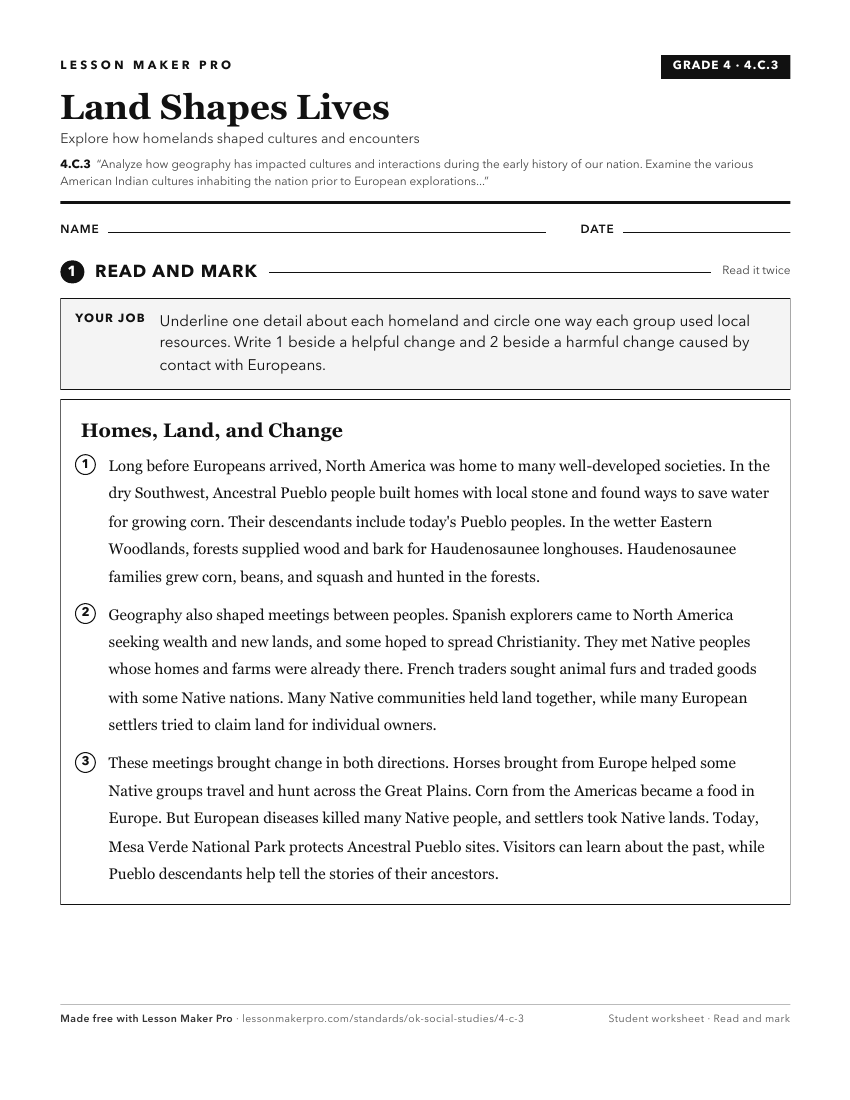
A ready-to-print activity worksheet aligned to 4.C.3, with an answer key for the teacher on its own page. No account needed.
PDF, US Letter, prints cleanly in black and white.
Download the worksheetKeep exploring
Related Standards
- MWH.C.1
Analyze the impact of the patterns of ancient political, economic, and cultural development.
- 6.C.3.2
Analyze how the characteristics of culture impact people and places.
- 3.C.2.3.C
Identify the ways in which physical geography influenced early American Indian cultures of the region (e.g., bison hunting, fur trading, farming).
Turn this cluster into a lesson
Grade, subject, topic, and the complete cluster are prefilled. Create one free, no account needed.
Also for this cluster:Make a WorksheetMake a QuizMake a Sub Lesson