Oklahoma Social Studies 6.C.3.2
Standard Cluster
- 6.C.3
- Identify the characteristics, distribution, and demographic patterns of human populations and systems of the Western Hemisphere.
Analyze how the characteristics of culture impact people and places. Identify and describe cultural traits (e.g., language, ethnic heritage, religion, traditions, the arts) which are unique to a people and region. Explain how culture provides individuals with a sense of identity and how it is transferred from one generation to the next. Compare major cultural groups of the Western Hemisphere (e.g., American Indian, Indigenous peoples of Canada and Amazonia, French-speaking Canadians, Hispanic Latin America).
Oklahoma Academic Standards for Social Studies (2026) · 6.C.3
Cluster contents
Standards in This Cluster
6.C.3.2 is a cluster heading. These are the individual standards under it.
- 6.C.3.2.A
Identify and describe cultural traits (e.g., language, ethnic heritage, religion, traditions, the arts) which are unique to a people and region.
- 6.C.3.2.B
Explain how culture provides individuals with a sense of identity and how it is transferred from one generation to the next.
- 6.C.3.2.C
Compare major cultural groups of the Western Hemisphere (e.g., American Indian, Indigenous peoples of Canada and Amazonia, French-speaking Canadians, Hispanic L...
Teacher's field guide
What This Cluster Means
What Students Need to Do
- Students use maps, photos, and short accounts to identify languages, arts, and traditions in communities across the Americas. They explain how these traits shape places, help people feel connected to a community, and pass from adults to children. They compare communities without assuming everyone in a region shares the same culture.
What Mastery Looks Like
- A student can compare a French shop sign in Quebec with an Inuktitut sign in Nunavut and explain how each makes a local language visible. They can explain how speaking a language with children helps pass it on and can build a sense of belonging.
Common Misconceptions
- Students may assume everyone in Mexico speaks Spanish or that all Indigenous peoples share one language and set of traditions. They may think culture is only holidays and food, or that children learn a language without hearing and using it.
How to Assess It
- Show a French shop sign from Quebec and an Inuktitut sign from Nunavut. Ask students to name the trait both show, compare the languages, and explain how each might reach the next generation.
Lesson moves
Ways to Teach It
Have pairs place five photo cards on a map: Diné weaving, Inuit syllabics, Yanomami baskets, Quebec French signs, and Mexican family altars.
Ask: How might seeing Inuktitut on a Nunavut school sign help a student feel connected to home, and who could teach that language?
Play trait match: students pair the five photo cards with short descriptions, then explain how one trait is taught to children.
Have students sketch two signs near school, then compare their languages with a photo of a French storefront sign in Quebec.
Free download
Printable 6.C.3.2 Worksheet
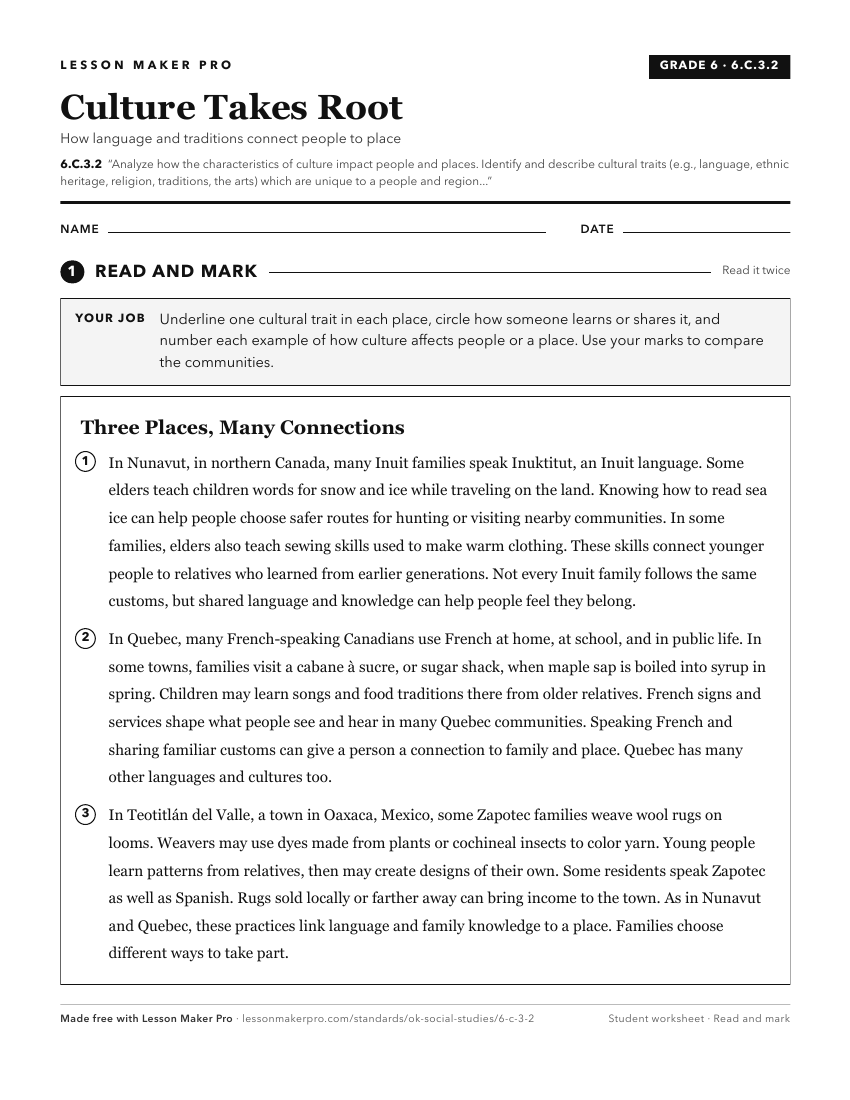
A ready-to-print activity worksheet aligned to 6.C.3.2, with an answer key for the teacher on its own page. No account needed.
PDF, US Letter, prints cleanly in black and white.
Download the worksheetKeep exploring
Related Standards
- S.3.3
Analyze how culture influences individuals, including the mechanisms of ethnocentrism, cultural relativity, and culture shock.
- WG.C.3.1
Compare the world’s major cultural landscapes to analyze cultural differences, cultural identity, social mores, and sets of beliefs which determine a sense of p...
- WG.C.3.3
Analyze the role of the environment in influencing a region’s culture.
- S.2.3
Analyze how culture influences individuals, including the mechanisms of ethnocentrism, cultural relativity, and culture shock.
Turn this cluster into a lesson
Grade, subject, topic, and the complete cluster are prefilled. Create one free, no account needed.
Also for this cluster:Make a WorksheetMake a QuizMake a Sub Lesson