Oklahoma Social Studies 4.C.3.2
Standard Cluster
- 4.C.3
- Analyze how geography has impacted cultures and interactions during the early history of our nation.
Summarize the goals and consequences of European expeditions of North America. Explain how Spain, France, and England were motivated to explore the continent by a desire to expand their wealth and culture, convert Native peoples to Christianity, acquire natural resources, and develop trade relations. Trace and describe the impact of significant European expeditions (e.g., England: Henry Hudson; France: Jacques Cartier; Portugal: Vasco da Gama; Spain: Christopher Columbus, Hernando de Soto, Ferdinand Magellan, Juan Ponce de León). Explain interactions between American Indians, Spanish explorations, French fur traders, and early European settlers, comparing different perspectives toward land ownership and use of resources. Evaluate the mutual benefits and consequences of the Columbian Exchange, including agriculture, trade, military alliances, technology, slavery, and disease resulting in the significant decline of Native peoples.
Oklahoma Academic Standards for Social Studies (2026) · 4.C.3
Cluster contents
Standards in This Cluster
4.C.3.2 is a cluster heading. These are the individual standards under it.
- 4.C.3.2.A
Explain how Spain, France, and England were motivated to explore the continent by a desire to expand their wealth and culture, convert Native peoples to Christi...
- 4.C.3.2.B
Trace and describe the impact of significant European expeditions (e.g., England: Henry Hudson; France: Jacques Cartier; Portugal: Vasco da Gama; Spain: Christo...
- 4.C.3.2.C
Explain interactions between American Indians, Spanish explorations, French fur traders, and early European settlers, comparing different perspectives toward la...
- 4.C.3.2.D
Evaluate the mutual benefits and consequences of the Columbian Exchange, including agriculture, trade, military alliances, technology, slavery, and disease resu...
Teacher's field guide
What This Cluster Means
What Students Need to Do
- Students trace selected voyages and explain why Spain, France, and England sought wealth, trade, resources, and converts to Christianity. They compare how Native nations and Europeans used land and resources. They explain how trade, crops, disease, and enslavement changed lives.
What Mastery Looks Like
- A student can connect Cartier’s St. Lawrence trip to a search for a trade route and de Soto’s Southeast travels to a search for wealth. They can name things that crossed the Atlantic in both directions and explain why disease and land loss devastated Native communities.
Common Misconceptions
- Some students think Europeans arrived in empty lands or that all Native nations used land in the same way. Others think the exchange involved only food, or that its benefits and harms were shared equally.
How to Assess It
- Show a map of Cartier’s St. Lawrence route. Ask students to name one French goal and explain one benefit and one harm of contact for Native communities.
Lesson moves
Ways to Teach It
Give pairs a route map, string, and pins; mark Columbus’s Caribbean landing, Cartier’s St. Lawrence trip, and de Soto’s Southeast travels.
Read short accounts of a Native nation’s river use and a French trader’s goals; ask who should decide fishing and trapping rights.
Play a card sort with maize, horses, smallpox, and metal tools; groups place each by origin and explain one effect.
Show a grocery flyer with tomatoes, potatoes, and wheat; students mark where each crop originated before it crossed the Atlantic.
Free download
Printable 4.C.3.2 Worksheet
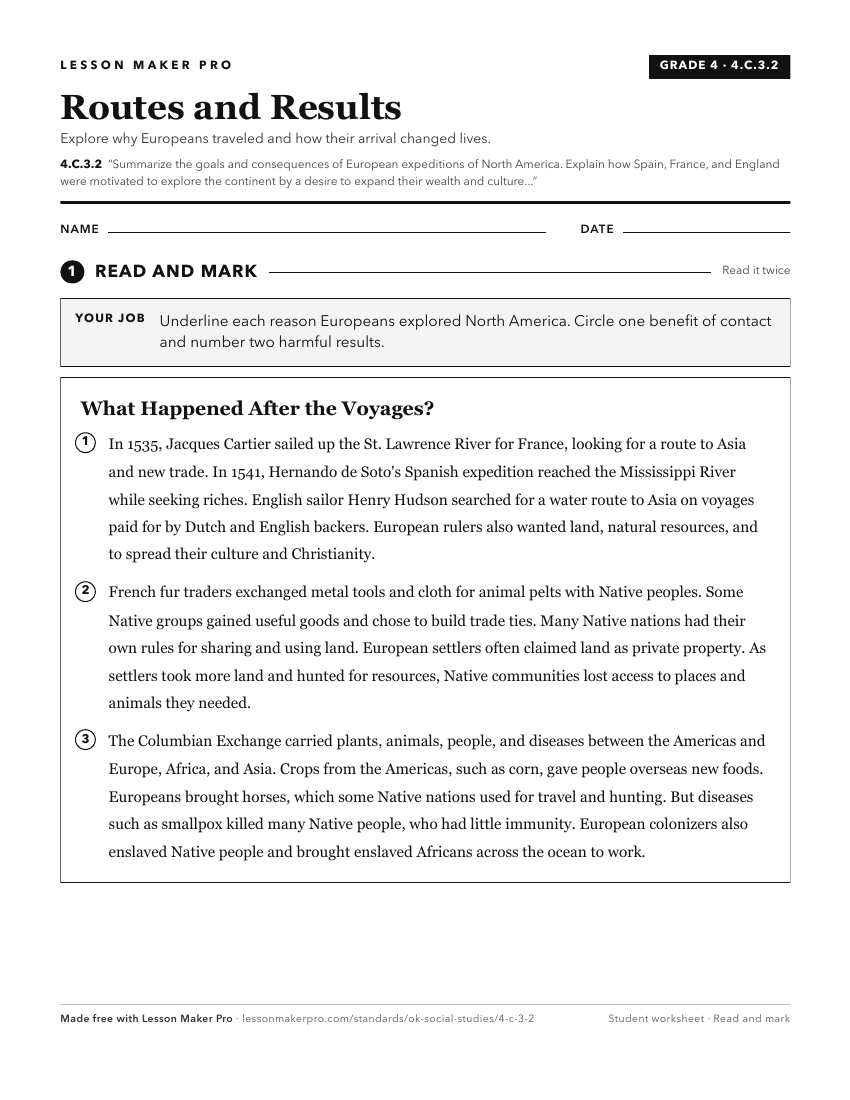
A ready-to-print activity worksheet aligned to 4.C.3.2, with an answer key for the teacher on its own page. No account needed.
PDF, US Letter, prints cleanly in black and white.
Download the worksheetKeep exploring
Related Standards
- MWH.C.2.5.A
Explain the economic and religious motivations that prompted European exploratory expeditions into the Western Hemisphere and describe how these expeditions led...
- 5.C.1.2
Summarize the economic, political, and cultural reasons for European colonization of North America, including competition over the continent’s land and natural ...
Turn this cluster into a lesson
Grade, subject, topic, and the complete cluster are prefilled. Create one free, no account needed.
Also for this cluster:Make a WorksheetMake a QuizMake a Sub Lesson