Oklahoma Social Studies 3.C.3.2
Standard Cluster
- 3.C.3
- Analyze the significant historical events and people contributing to the development of Oklahoma.
Describe the development of the state and its resources. Explain the importance of the cattle industry to the early economy, including the influence of Hispanic ranching traditions (e.g.,vaqueros, lasso, corral) and how cattle trails, such as the Great Western and Chisholm Trails became major transportation routes. Describe continued migration by various newcomers to the region, such as the Boomer Movement, identifying different points of view held by American Indians and settlers regarding the settling of Native lands. Explain how many African Americans migrated to Oklahoma, considering it an opportunity where farming communities, businesses, and schools could grow (e.g., historic Black towns, Tulsa’s Greenwood District). Describe the commemoration of Statehood Day, November 16, as the joining of Indian and Oklahoma Territories and admission of Oklahoma to the United States of America in 1907. Describe challenges faced by citizens during the Dust Bowl, focusing on how Oklahomans adapted to harsh environmental conditions and survived economic hardships. Identify when and under what circumstances the student’s community was founded and describe the different groups of people who have influenced its growth and development.
Oklahoma Academic Standards for Social Studies (2026) · 3.C.3
Cluster contents
Standards in This Cluster
3.C.3.2 is a cluster heading. These are the individual standards under it.
- 3.C.3.2.A
Explain the importance of the cattle industry to the early economy, including the influence of Hispanic ranching traditions (e.g.,vaqueros, lasso, corral) and h...
- 3.C.3.2.B
Describe continued migration by various newcomers to the region, such as the Boomer Movement, identifying different points of view held by American Indians and ...
- 3.C.3.2.C
Explain how many African Americans migrated to Oklahoma, considering it an opportunity where farming communities, businesses, and schools could grow (e.g., hist...
- 3.C.3.2.D
Describe the commemoration of Statehood Day, November 16, as the joining of Indian and Oklahoma Territories and admission of Oklahoma to the United States of Am...
- 3.C.3.2.E
Describe challenges faced by citizens during the Dust Bowl, focusing on how Oklahomans adapted to harsh environmental conditions and survived economic hardships...
- 3.C.3.2.F
Identify when and under what circumstances the student’s community was founded and describe the different groups of people who have influenced its growth and de...
Teacher's field guide
What This Cluster Means
What Students Need to Do
- Students explain how vaquero ranching methods and cattle trails helped Oklahoma's early economy. They compare Native and settler views of land settlement and describe why African Americans built communities here. They explain statehood, Dust Bowl survival, and how their own community began.
What Mastery Looks Like
- A student can locate a cattle trail and explain how ranchers used lassos or corrals. They can explain why Native residents and Boomers viewed settlement differently and distinguish historic Black towns from Tulsa’s Greenwood District. They can describe what happened on November 16, 1907, name a Dust Bowl survival strategy, and tell when and why their community formed.
Common Misconceptions
- Some students think cattle trails were railroad tracks, rather than routes used to drive cattle to market. Others assume Native lands were empty or that Native residents and Boomers welcomed settlement equally. Students may confuse Black towns with Greenwood or think every Dust Bowl family left Oklahoma.
How to Assess It
- Give students six boxes labeled cattle trails, Native lands, Black communities, statehood, Dust Bowl, and our community. Ask for one accurate fact in each, including a Native viewpoint and a Dust Bowl survival strategy.
Lesson moves
Ways to Teach It
Lay paper cattle trails on an Oklahoma map, move toy cattle along them, and label where a vaquero might use a lasso or corral.
Read two short viewpoint cards, one from a Native resident and one from a Boomer, then discuss how they viewed settlement differently.
Match picture cards of Greenwood shops, Black town schools, territory maps, and dust-proofed windows to captions about opportunity, statehood, and survival.
Use a local library history page to find when your community began, why people settled there, and two groups that shaped it.
Free download
Printable 3.C.3.2 Worksheet
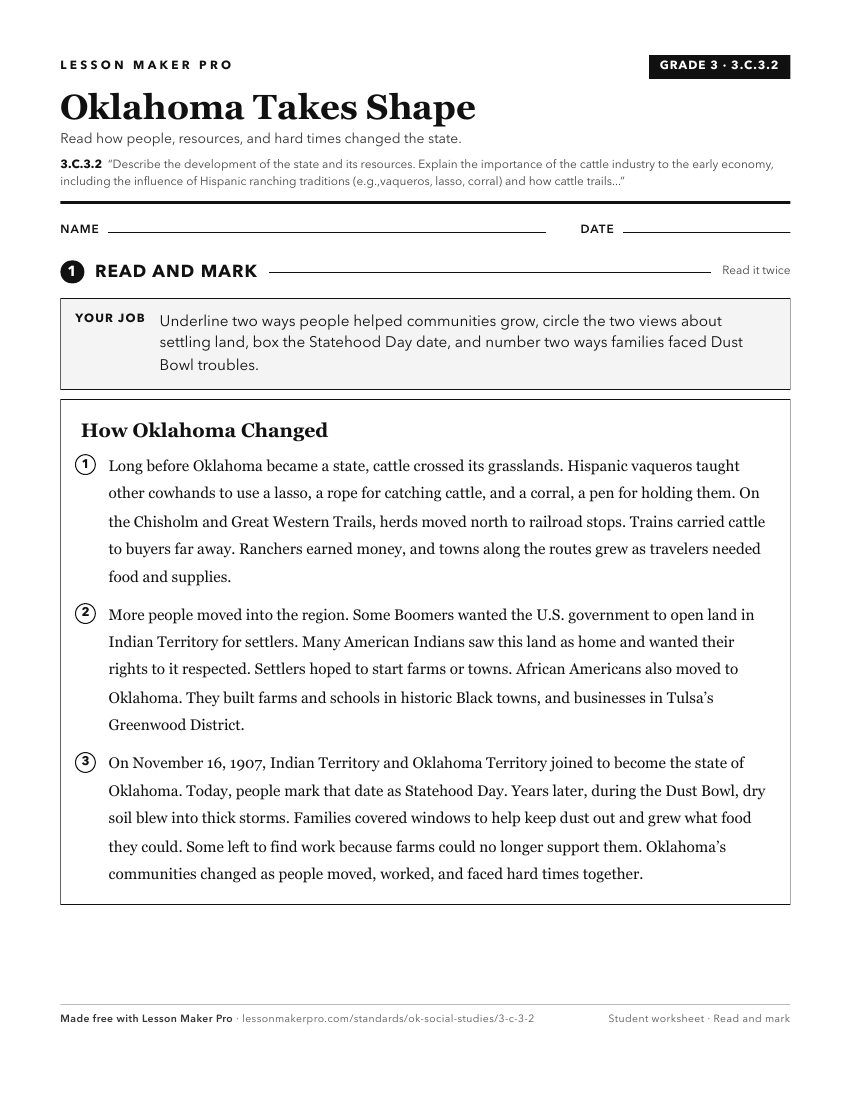
A ready-to-print activity worksheet aligned to 3.C.3.2, with an answer key for the teacher on its own page. No account needed.
PDF, US Letter, prints cleanly in black and white.
Download the worksheetKeep exploring
Related Standards
- 3.C.4.3.B
Examine how the development of recent economic activities has contributed to the state’s economy, identifying examples of goods and services provided by local b...
- OKH.C.3
Evaluate the major political and economic events that transformed the land and its people in the post-Civil War era to statehood.
- OKH.C.4
Analyze significant issues encountered on the path to statehood.
- OKH.C.1
Describe the state’s geography and the historic foundations laid by American Indian, European, and American cultures.
Turn this cluster into a lesson
Grade, subject, topic, and the complete cluster are prefilled. Create one free, no account needed.
Also for this cluster:Make a WorksheetMake a QuizMake a Sub Lesson