Oklahoma Social Studies OKH.C.3
Standard Cluster
Evaluate the major political and economic events that transformed the land and its people in the post-Civil War era to statehood. Examine the impact of the Civil War and Reconstruction Treaties on American Indian peoples, territories, and Tribal sovereignty. Describe the effect of intertribal division related to Tribal support of the Union or Confederacy, as exemplified by Opothleyahola and the Trail of Blood on Ice. Explain conditions of the Reconstruction Treaties of 1866 (e.g., land cessions, the abolition of slavery, and the required Tribal enrollment of the Freedman). Summarize the intent of President Grant’s Peace Policy on the displacement of American Indians from their homelands. Describe the period known as the Second Indian Removal, comparing experiences of Tribal Nations, and explain justifications made for establishing the reservation system. Examine the purpose for western military posts, such as Fort Sill, and the role of military regiments, such as the Buffalo Soldiers, in implementing Indian policy. Describe the confinement of American Indians to reservations, including the significance of the Washita Massacre and explain the impact of the reservation policy. Explain the significance of the Standing Bear v. Crook decision as it relates to the personhood of American Indians and their rights under federal law. Evaluate the lasting effect of early industries on economic growth. Describe the economic and environmental effects of commercial extraction of Indian Territory's coal deposits on the development of regional communities, including the role of entrepreneur James J. McAlester. Trace the routes of cattle trails across Indian Territory and describe the growth of the cattle industry, including the associated role of railroad transportation to meet the needs of an expanding economy. Examine the origins and changing perceptions of the “American cowboy culture” (e.g., dime novels, artwork, motion pictures) versus the reality of the profession. Analyze the influence of the idea of Manifest Destiny on migrations into present-day Oklahoma. Explain opportunities provided by the Homestead Act of 1862 and its impact on mass migration to the region. Analyze the goals, strategies, and escalated tension created by the Boomer Movement under the leadership of David Payne. Examine Tribal responses to increased emigration, featured by calls for unified action through intertribal councils, lobbying efforts, and court challenges. Describe the establishment of all-Black towns and the extent to which they provided economic opportunities, political independence, and escape from discrimination. Explain how American Indians experienced decreasing control over Tribal lands through congressional action. Compare multiple points of view to evaluate the impact of the Dawes Act of 1877 (General Allotment Act) which resulted in the loss of Tribal communal lands through a transfer to individual property. Describe the intent and effects of the Indian Appropriations Act and methods (e.g., land runs, lotteries) used for the forced redistribution of Tribal lands, such as the Unassigned Lands and the Cherokee Outlet.
Oklahoma Academic Standards for Social Studies (2026)
Cluster contents
Standards in This Cluster
OKH.C.3 is a cluster heading. These are the individual standards under it.
- OKH.C.3.1
Examine the impact of the Civil War and Reconstruction Treaties on American Indian peoples, territories, and Tribal sovereignty.
- OKH.C.3.1.A
Describe the effect of intertribal division related to Tribal support of the Union or Confederacy, as exemplified by Opothleyahola and the Trail of Blood on Ice...
- OKH.C.3.1.B
Explain conditions of the Reconstruction Treaties of 1866 (e.g., land cessions, the abolition of slavery, and the required Tribal enrollment of the Freedman).
- OKH.C.3.1.C
Summarize the intent of President Grant’s Peace Policy on the displacement of American Indians from their homelands.
- OKH.C.3.1.D
Describe the period known as the Second Indian Removal, comparing experiences of Tribal Nations, and explain justifications made for establishing the reservatio...
- OKH.C.3.1.E
Examine the purpose for western military posts, such as Fort Sill, and the role of military regiments, such as the Buffalo Soldiers, in implementing Indian poli...
- OKH.C.3.1.F
Describe the confinement of American Indians to reservations, including the significance of the Washita Massacre and explain the impact of the reservation polic...
- OKH.C.3.1.G
Explain the significance of the Standing Bear v. Crook decision as it relates to the personhood of American Indians and their rights under federal law.
- OKH.C.3.2
Evaluate the lasting effect of early industries on economic growth.
- OKH.C.3.2.A
Describe the economic and environmental effects of commercial extraction of Indian Territory's coal deposits on the development of regional communities, includi...
- OKH.C.3.2.B
Trace the routes of cattle trails across Indian Territory and describe the growth of the cattle industry, including the associated role of railroad transportati...
- OKH.C.3.2.C
Examine the origins and changing perceptions of the “American cowboy culture” (e.g., dime novels, artwork, motion pictures) versus the reality of the profession...
- OKH.C.3.3
Analyze the influence of the idea of Manifest Destiny on migrations into present-day Oklahoma.
- OKH.C.3.3.A
Explain opportunities provided by the Homestead Act of 1862 and its impact on mass migration to the region.
- OKH.C.3.3.B
Analyze the goals, strategies, and escalated tension created by the Boomer Movement under the leadership of David Payne.
- OKH.C.3.3.C
Examine Tribal responses to increased emigration, featured by calls for unified action through intertribal councils, lobbying efforts, and court challenges.
- OKH.C.3.3.D
Describe the establishment of all-Black towns and the extent to which they provided economic opportunities, political independence, and escape from discriminati...
- OKH.C.3.4
Explain how American Indians experienced decreasing control over Tribal lands through congressional action.
- OKH.C.3.4.A
Compare multiple points of view to evaluate the impact of the Dawes Act of 1877 (General Allotment Act) which resulted in the loss of Tribal communal lands thro...
- OKH.C.3.4.B
Describe the intent and effects of the Indian Appropriations Act and methods (e.g., land runs, lotteries) used for the forced redistribution of Tribal lands, su...
Teacher's field guide
What This Cluster Means
What Students Need to Do
- Use maps and sources to explain how Civil War alliances, treaties, military campaigns, and allotment changed Tribal land and authority. Trace how cattle, coal, railroads, and migration changed communities. Compare the experiences of Tribal Nations, Freedmen, settlers, and residents of all-Black towns.
What Mastery Looks Like
- A student can use a treaty excerpt and maps to explain how a land cession differed from later allotment. They can connect a cattle trail or coal mine to a growing town and explain who gained opportunities and who lost land or control.
Common Misconceptions
- Students may describe Indian Territory as empty land before land runs. They may assume every Tribal Nation made the same Civil War choices or confuse treaty land cessions with later allotment. Cowboy movies can also lead them to overlook the workers who did the job.
How to Assess It
- Give students a labeled before-and-after allotment map. Ask them to circle one land change and explain how it affected Tribal control.
Lesson moves
Ways to Teach It
Pairs mark cattle trails, rail lines, reservations, and land openings on a blank Oklahoma map, then add dates from event cards.
Write three sentences answering: How could a land run create opportunity for one family and cause loss for a Tribal Nation?
Play a timeline relay with cards for the 1866 treaties, Fort Sill, Standing Bear's case, allotment, and land runs; justify each placement.
Locate McAlester on a historic coal map and a current Oklahoma map; list one mining job and one environmental cost.
Free download
Printable OKH.C.3 Worksheet
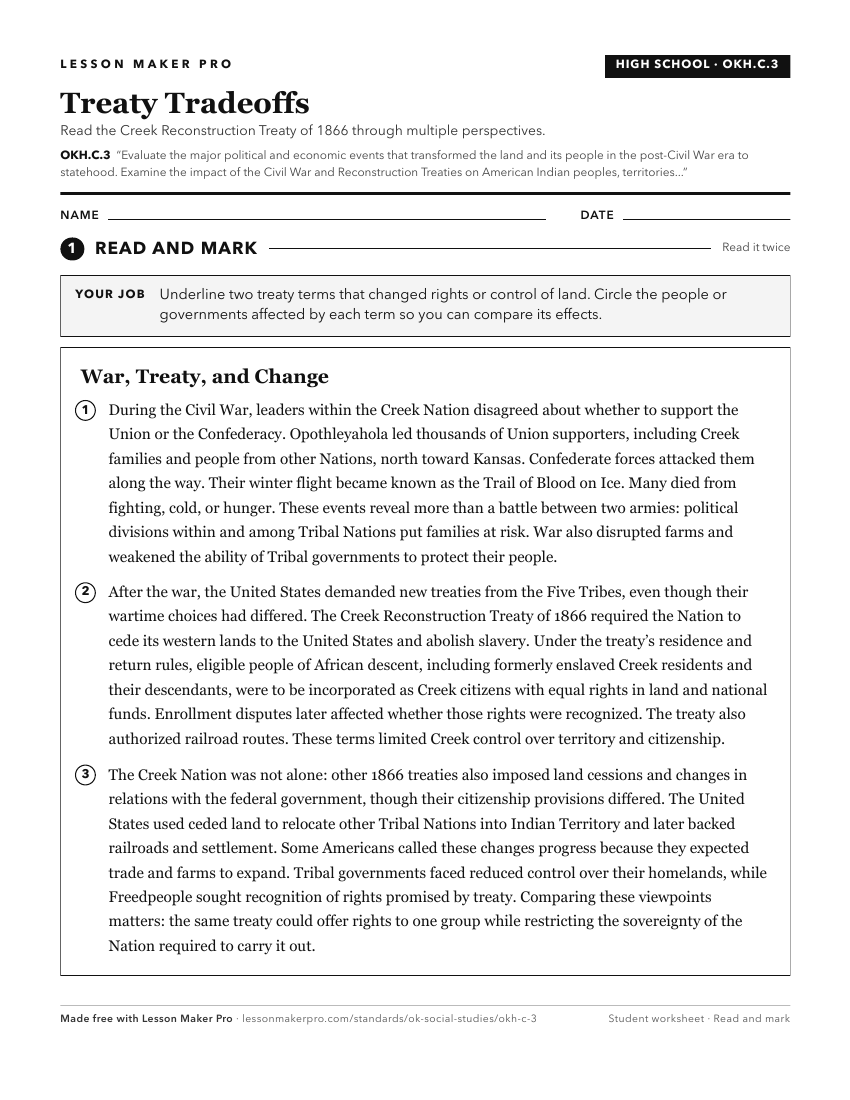
A ready-to-print activity worksheet aligned to OKH.C.3, with an answer key for the teacher on its own page. No account needed.
PDF, US Letter, prints cleanly in black and white.
Download the worksheetKeep exploring
Related Standards
- OKH.C.6
Examine Oklahoma’s political, economic, and social history regarding race during the early decades following statehood.
- USH.C.1
Analyze the transformation of the United States of America through its civil rights struggles, immigrant experiences, and settlement of the American West during...
- OKH.C.4
Analyze significant issues encountered on the path to statehood.
- OKH.C.2
Evaluate the major political and economic events that transformed the land and its people from early contact through Indian Removal and its aftermath.
Turn this cluster into a lesson
Grade, subject, topic, and the complete cluster are prefilled. Create one free, no account needed.
Also for this cluster:Make a WorksheetMake a QuizMake a Sub Lesson