Oklahoma Social Studies OKH.C.4
Standard Cluster
Analyze significant issues encountered on the path to statehood. Describe the effects of the Curtis Act of 1898 and evaluate the outcome of the Indian-led movement to secure a separate statehood for Indian Territory, summarizing major features of the proposed state of Sequoyah’s constitution. Examine the continued migration of African Americans to the region and describe the outcome of a proposed all-Black state, as advocated by Edward McCabe. Explain how the Organic Act of 1890 and Enabling Act paved the way for the admission of Oklahoma and Indian territories into the Union as a single state. Examine the influence of the national Progressive Movement and local social reformers, such as Kate Barnard, on the state constitutional convention (e.g., accountable government, child labor, and public education). Trace the final steps toward statehood from the adoption of the Oklahoma constitution by a vote of the people to presidential proclamation on November 16, 1907.
Oklahoma Academic Standards for Social Studies (2026)
Cluster contents
Standards in This Cluster
OKH.C.4 is a cluster heading. These are the individual standards under it.
- OKH.C.4.1
Describe the effects of the Curtis Act of 1898 and evaluate the outcome of the Indian-led movement to secure a separate statehood for Indian Territory, summariz...
- OKH.C.4.2
Examine the continued migration of African Americans to the region and describe the outcome of a proposed all-Black state, as advocated by Edward McCabe.
- OKH.C.4.3
Explain how the Organic Act of 1890 and Enabling Act paved the way for the admission of Oklahoma and Indian territories into the Union as a single state.
- OKH.C.4.4
Examine the influence of the national Progressive Movement and local social reformers, such as Kate Barnard, on the state constitutional convention (e.g., accou...
- OKH.C.4.5
Trace the final steps toward statehood from the adoption of the Oklahoma constitution by a vote of the people to presidential proclamation on November 16, 1907.
Teacher's field guide
What This Cluster Means
What Students Need to Do
- Students explain how the Organic Act created Oklahoma Territory, the Curtis Act weakened tribal governments, and the Enabling Act allowed one state to form. They compare the proposed state of Sequoyah with Edward McCabe's plan for an all-Black state as African Americans continued moving to the region. They trace Progressive reforms, the vote on the constitution, and the final proclamation of statehood.
What Mastery Looks Like
- A student can name Sequoyah's proposed elected governor, legislature, courts, and bill of rights, and explain that Congress did not approve the state. They can explain that McCabe's all-Black state never formed and connect Kate Barnard to child labor reform. They can distinguish the people's vote on Oklahoma's constitution from the president's proclamation on November 16, 1907.
Common Misconceptions
- Students often treat Indian Territory and Oklahoma Territory as the same place before statehood. They may think Sequoyah or McCabe's all-Black state became a state, or that the Curtis Act protected tribal self-government. Some mistake the vote on the constitution for the final act of statehood.
How to Assess It
- On an exit ticket, ask students to order the Organic Act, Curtis Act, Sequoyah proposal, Enabling Act, constitution vote, and presidential proclamation. Have them add two features of Sequoyah's proposed government, the outcome of McCabe's plan, and one reform Barnard supported.
Lesson moves
Ways to Teach It
Give pairs six dated event cards and have them build a statehood timeline with one effect written under each card.
Ask students to write three sentences comparing what Sequoyah's supporters and McCabe hoped separate statehood would achieve.
Play a clue game: students match 'created Oklahoma Territory,' 'weakened tribal courts,' and 'authorized one state' to the correct acts.
On a current Oklahoma map, mark Langston and Muskogee and label their links to McCabe and the Sequoyah convention.
Free download
Printable OKH.C.4 Worksheet
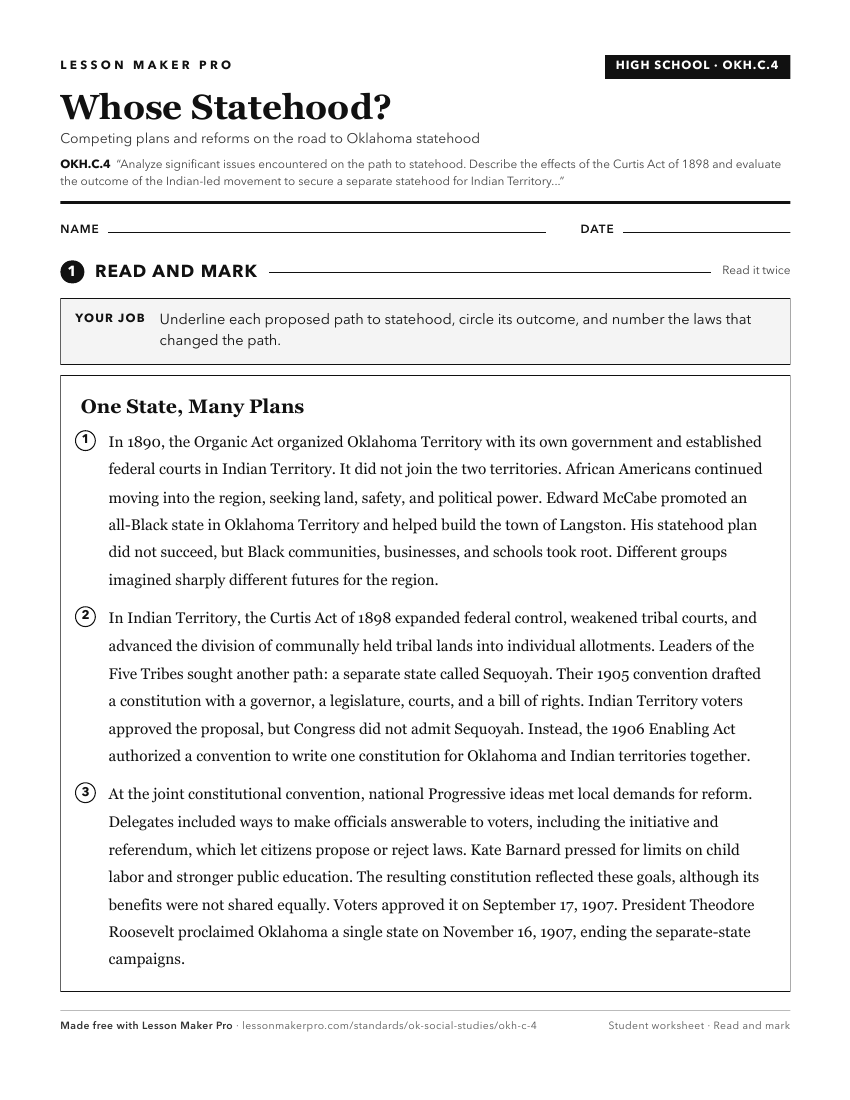
A ready-to-print activity worksheet aligned to OKH.C.4, with an answer key for the teacher on its own page. No account needed.
PDF, US Letter, prints cleanly in black and white.
Download the worksheetKeep exploring
Related Standards
- OKH.C.8.3.B
Describe concerns expressed by Tribal citizens during the transition to statehood, including the loss of land, self-government and legal jurisdiction.
- OKH.C.3
Evaluate the major political and economic events that transformed the land and its people in the post-Civil War era to statehood.
- USH.C.1.3
Analyze the causes and effects of the continuing westward migration and territorial growth after the Civil War.
- 8.C.13.2
Analyze the impact of state and federal legislation following the Civil War.
Turn this cluster into a lesson
Grade, subject, topic, and the complete cluster are prefilled. Create one free, no account needed.
Also for this cluster:Make a WorksheetMake a QuizMake a Sub Lesson