Oklahoma Social Studies OKH.C.2
Standard Cluster
Evaluate the major political and economic events that transformed the land and its people from early contact through Indian Removal and its aftermath. Analyze the role of early trade centers and transportation to the development and growth of the region, by describing the impact of mercantile settlements, such as Chouteau’s Trading Post at Three Forks major peacekeeping goals of military posts (e.g., Fort Gibson, Fort Towson, Fort Washita) ensuring the success of forced removals and furthering the goals of western expansion. Analyze the consequences of American Indian removals to present-day Oklahoma. Explain the motivations which prompted the passage and terms of the Indian Removal Act of 1830 and describe efforts of Tribal resistance, including appeals to the Supreme Court (e.g., Marshall Trilogy), the advocacy of Samuel Worcester, and the positions of Cherokee leadership (e.g., Elias Boudinot, John Ross). Summarize and describe the process and experiences of the forced removal of southeastern Tribes from their homelands, including the establishment of Indian Territory. Examine the consequences of Indian Removal on intertribal relationships among Tribal groups historically residing in Indian Territory and those relocated there.
Oklahoma Academic Standards for Social Studies (2026)
Cluster contents
Standards in This Cluster
OKH.C.2 is a cluster heading. These are the individual standards under it.
- OKH.C.2.1
Analyze the role of early trade centers and transportation to the development and growth of the region, by describing the
- OKH.C.2.1.A
impact of mercantile settlements, such as Chouteau’s Trading Post at Three Forks
- OKH.C.2.1.B
major peacekeeping goals of military posts (e.g., Fort Gibson, Fort Towson, Fort Washita) ensuring the success of forced removals and furthering the goals of we...
- OKH.C.2.2
Analyze the consequences of American Indian removals to present-day Oklahoma.
- OKH.C.2.2.A
Explain the motivations which prompted the passage and terms of the Indian Removal Act of 1830 and describe efforts of Tribal resistance, including appeals to t...
- OKH.C.2.2.B
Summarize and describe the process and experiences of the forced removal of southeastern Tribes from their homelands, including the establishment of Indian Terr...
- OKH.C.2.2.C
Examine the consequences of Indian Removal on intertribal relationships among Tribal groups historically residing in Indian Territory and those relocated there.
Teacher's field guide
What This Cluster Means
What Students Need to Do
- Students trace how trade routes, trading posts, and military forts shaped the region before and during removal. They explain why federal officials pushed removal, how Tribal leaders resisted, and what forced migration was like. They compare its effects on relocated Tribes and Tribes already in Indian Territory.
What Mastery Looks Like
- Students can use a map and sources to connect Three Forks to trade and Fort Gibson to military control during removal. They can explain why federal officials sought removal, how Cherokee leaders challenged it, and how forced migration changed relationships among Tribes.
Common Misconceptions
- Students may think the 1830 law moved every Tribe immediately, or that a Supreme Court ruling stopped removal. They may assume Indian Territory was empty land and overlook the Tribes already living there.
How to Assess It
- Show a map of Three Forks, Fort Gibson, and a Cherokee removal route. Ask students to explain how one site supported U.S. expansion and how removal affected a Tribe already living in Indian Territory.
Lesson moves
Ways to Teach It
Give pairs an 1830s map; have them trace river trade routes, mark Three Forks and Fort Gibson, and label each site's role.
Ask why John Ross opposed the Treaty of New Echota while Elias Boudinot supported it; use one excerpt from each leader.
Play a timeline sort: teams place the 1830 law, the Worcester ruling, the Treaty of New Echota, and Cherokee removal in order.
Compare an 1830s Indian Territory map with a current Oklahoma Tribal Nations map; write one question about changes in land or Tribal relationships.
Free download
Printable OKH.C.2 Worksheet
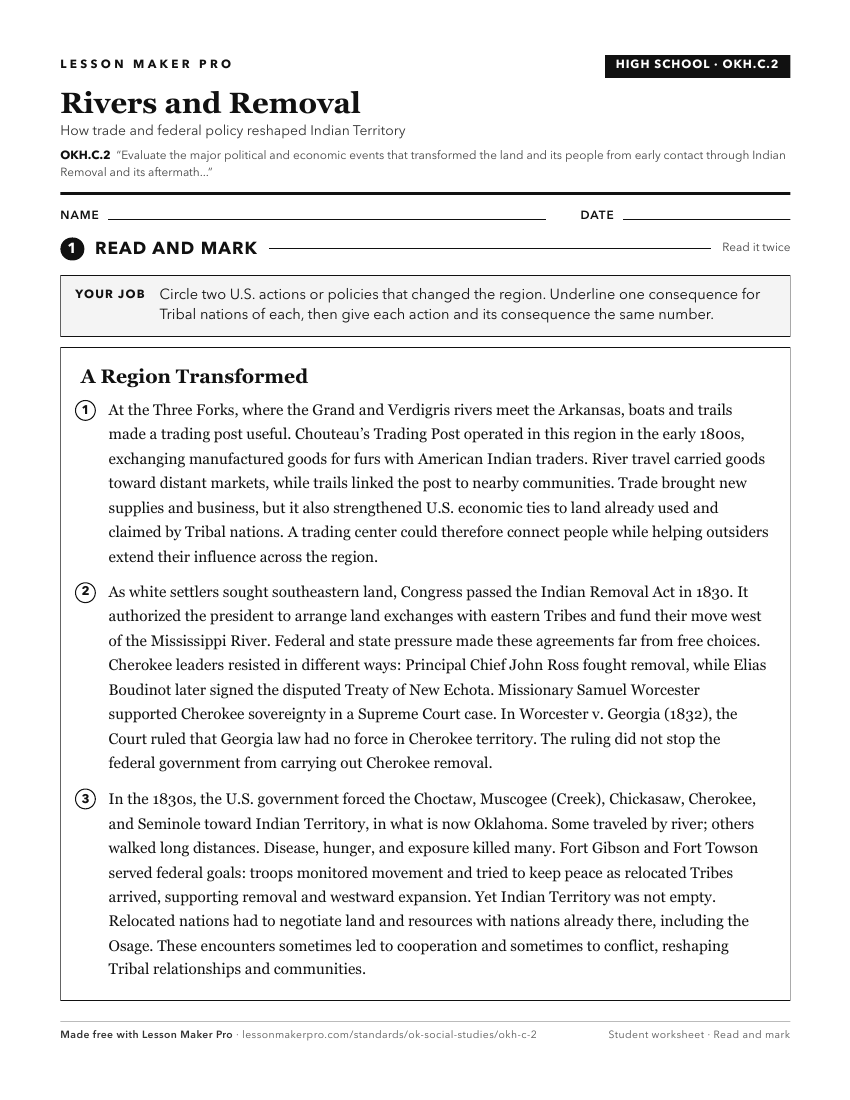
A ready-to-print activity worksheet aligned to OKH.C.2, with an answer key for the teacher on its own page. No account needed.
PDF, US Letter, prints cleanly in black and white.
Download the worksheetKeep exploring
Related Standards
Turn this cluster into a lesson
Grade, subject, topic, and the complete cluster are prefilled. Create one free, no account needed.
Also for this cluster:Make a WorksheetMake a QuizMake a Sub Lesson